

15-Year vs. 30-Year Mortgages: Which One is Actually Cheaper in a High-Inflation Economy?
This is my personal experience.
I once took a loan of 50,000 for 1 year, and I paid it back with interest. Later, I wanted to take a long-term loan for 15 to 30 years, but I was confused about how much total interest I would pay and how much my monthly payments would become over such a long period.
I was unable to understand the calculations properly, so I started searching for a simple solution. Then I found a tool on the GCB (Get Calculator Base) website related to loan planning and calculation.
When I used this tool, it helped me clearly understand:
- Monthly installment over different years
- Total interest paid over the loan period
- Comparison between short-term and long-term loans
- Overall repayment structure
It gave me a clear picture of how a long-term loan affects total cost and helped me make a better decision about loan duration.
This tool is very useful for understanding basic loan calculations and planning in a simple way. However, it is only for informational and educational purposes, not financial advice.
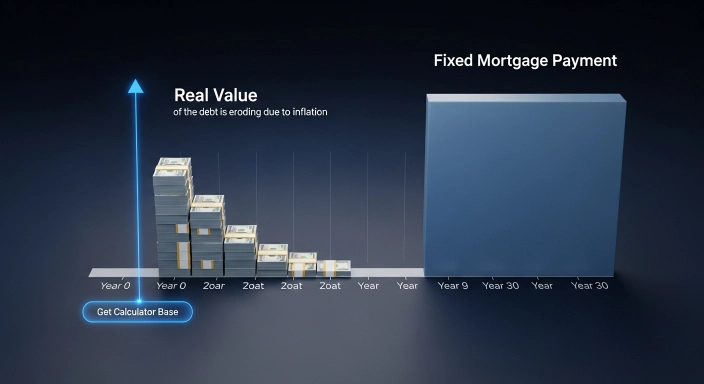
Choosing between a 15-year and a 30-year mortgage is no longer just about the monthly payment. In today’s volatile market, smart investors are looking for the best analytics platforms for loan-portfolio insights to understand how inflation erodes the “real value” of debt.
While a 15-year loan saves you interest, a 30-year loan might actually be a better “inflation hedge.” Let’s break down the predictive data.
The Core Conflict: Speed vs. Strategy
When you use an auto loan payment calculator or a mortgage tool, the first thing you notice is the massive difference in total interest.
- 15-Year Mortgage: Offers a lower interest rate and builds equity twice as fast.
- 30-Year Mortgage: Offers a lower monthly payment, providing more “disposable” cash flow.
However, leading companies in predictive analytics for loan placement suggest that in a high-inflation economy (where inflation is higher than your mortgage rate), the 30-year mortgage becomes a strategic tool. Why? Because you are paying back the bank with “cheaper” dollars in the future.
Predictive Analytics: The Inflation Hedge
Using advanced loan-portfolio insights, we can see that inflation is a borrower’s best friend. If inflation is 7% and your mortgage rate is 4%, the “real” interest rate you are paying is actually negative.

💡 My Expert Pro-Tips from 7 Years of Experience:
- The “Negative Real Rate” Trick: If your mortgage rate is 6.09% but inflation is 7.3%, your “Real Interest Rate” is effectively -1.21%. In simple terms, the bank is paying you to hold the debt because the purchasing power of your future payments is dropping faster than the interest is growing.
- The LTV Safety Zone: Predictive analytics for loan placement suggest that for a 30-year “Inflation Hedge” strategy to work, you should maintain a Loan-to-Value (LTV) ratio of 80% or less. This protects you if home prices stall (as J.P. Morgan predicts they will in 2026) while you benefit from the devalued debt.
Why the 30-Year Loan Wins in High Inflation:
- Devaluation of Debt: Your debt stays fixed, but your income and the price of goods rise. The $2,000 payment you make today will feel like $1,000 in ten years.
- Opportunity Cost: Instead of locking your cash into a 15-year equity build-up, you can invest that extra cash in assets that outpace inflation.
- Liquidity Safety: Lower payments provide a safety net during economic downturns.
When the 15-Year Loan Still Makes Sense
Despite the inflation argument, the 15-year term is the “King of Savings.” If your goal is Debt-Free Living, the analytics don’t lie:
- Lower Rates: Banks usually offer 0.5% to 1% lower rates for 15-year terms.
- Total Cost: You pay significantly less in total interest (often saving $200k+ on a $500k house).
- Psychological Freedom: Being debt-free 15 years earlier is a massive boost to mental and financial wellness.

Portfolio Insights
For those managing multiple properties, using the best analytics platforms for loan-portfolio insights is crucial. These platforms allow you to:
- Track the Loan-to-Value (LTV) across your entire portfolio.
- Monitor how interest rate hikes affect your variable-rate debt.
- Utilize predictive analytics for loan placement to decide when to refinance.
Developer’s Expert Tip: When I built the Loan Analytics Pro (V12) engine, I made sure to include “Daily Interest Tracking.” This is because, in a 30-year mortgage, the interest accrual in the first 5 years is staggering. Always check your amortization schedule to see exactly when you hit the “break-even” point.
How to Use Our Tool for This Decision
[Image: Person comparing two loan scenarios on a tablet]
To decide which is right for you, use our Loan Analytics Pro tool on GetCalcBase:
- Run Scenario A: Input your 15-year term and note the “Total Interest.”
- Run Scenario B: Input the 30-year term.
- Compare: Look at the “Total Repayment” box. If you are in a high-inflation country like Pakistan (PKR) or parts of the EU, calculate if investing the difference in payments earns more than the extra interest paid.

Checklist: Which Side Are You On?
| Choose 15-Year If… | Choose 30-Year If… |
| You want the lowest possible interest rate. | You want to hedge against high inflation. |
| You want to be debt-free quickly. | You need maximum monthly cash flow. |
| You have a very high, stable income. | You plan to invest the “saved” money elsewhere. |
| You are closer to retirement age. | You are a young investor building a portfolio. |
Frequently Asked Questions (FAQ)
1. Can I use an auto loan payment calculator for mortgages?
While the basic math is similar, mortgages have different compounding rules and insurance costs (PMI). It’s best to use our specialized Loan Analytics Pro which handles long-term amortization.
2. How does predictive analytics help with loan placement?
Leading companies use big data to predict when interest rates will drop. This tells you the perfect time to “place” or refinance a loan to maximize your portfolio’s value.
3. Does inflation reduce my mortgage balance?
Not the numerical balance, but the value of that balance. If a loaf of bread goes from $1 to $5, but your mortgage stays at $2,000, your mortgage has effectively become cheaper.
The Bottom Line
In a low-inflation world, the 15-year mortgage is the clear winner for cost-savings. But in an era of high inflation, the 30-year mortgage—combined with the best analytics platforms for loan-portfolio insights—becomes a sophisticated wealth-building tool.
Ready to see the numbers for yourself? Navigate to our [Loan Analytics Pro] page, enter your details, and export your PDF schedule to see exactly how your debt will behave over the next three decades.