
Zakat Calculator 2026: Precise Wealth Calculation for Worldwide Muslims
Zakat is not just a tax; it is a profound spiritual obligation and one of the Five Pillars of Islam. It serves as a mechanism for the purification of wealth and a bridge for wealth redistribution within the Ummah. At GetCalcBase, we have engineered the Zakat Calculator 2026 to be the most reliable, private, and user-friendly tool available online.
This tool was developed through a unique collaboration. Our lead developer, Waseem Aijaz, who is also a Hafiz-e-Quran, worked alongside Islamic finance experts to ensure that every line of code aligns perfectly with Islamic jurisprudence on charity.
USA User Review:
I am a Muslim and from Pakistan, and I am currently working in the USA. While living here, I faced difficulty in calculating Zakat because I was not always able to visit a scholar or mosque easily. Sometimes I was unsure about how to correctly calculate Zakat in different situations, like salary, gold, and silver, especially while living abroad.
In Pakistan or India, it is easier because you can directly ask a local scholar (Molvi), but in the USA, it was more difficult for me. I was confused for a long time and could not find a proper solution.
Then I found the Zakat Calculator on the GCB (Get Calculator Base) website. I used it and entered my details like income, savings, gold, and silver values. The tool gave me a clear estimate of how much Zakat I should pay. It also explained different categories, such as gold, silver, salary-based Zakat, and how calculations are done.
This helped me understand my Zakat responsibility in a much better way. I also shared it with a friend in Canada, and he also found it useful.
However, I clearly understand that this tool is only for informational and educational purposes. It is not a replacement for religious scholars or financial experts. For final decisions, it is always better to consult a knowledgeable scholar.
Overall, the tool helped me simply understand Zakat calculation, especially while living abroad, but it should be used only as a guide, not as a final religious authority. “Calculations based on June 2026 gold/silver market prices. Nisab threshold: [Insert Amount]. Please check current local market rates for daily fluctuations.”
My Personal Experience
Listen carefully, because this is important for every Muslim. Paying Zakat is obligatory for Muslims if they have enough wealth and meet the required conditions.
At first, I did not have enough income to pay Zakat. But now, that situation has changed. By the grace of Allah, my income has improved, and I have started earning well. Now, I want to pay Zakat.
As you know, I am a developer. I earn money from my work, and I also have some savings and assets, including gold and other investments. I have already shared my personal experience about trading and my other work in my previous tool. You can also check the link I have added above.
The reason I wanted to pay Zakat was that I was not sure exactly how much Zakat was obligatory on my wealth. I wanted to know how much Zakat I needed to pay based on the money and assets I had.
I knew some things about Zakat myself, as I am also a Hafiz, but I wanted to make sure I calculated everything correctly.
That is why we started building this tool. We took help from some Hafiz and experts to make it useful and understandable.
In this way, I was able to solve my own problem. However, I also realized that other people might face the same problem. They might have money, gold, savings, or investments but may not know exactly how much Zakat they need to pay.
That is why I decided to share this tool with others, so they can also check and calculate their Zakat according to their own situation.
Here is a tip from me:
Here is a tip from me: If you do not know much about Zakat, first read the details below and the related blog. You will find all the information there.
If you still have any questions or problems, we are here to help you 24/7. Just contact us through the contact section and ask us anything you want to know.
How to Calculate Zakat on Gold, Silver, and Cash (Step-by-Step Guide)
Calculating your net zakatable assets can feel overwhelming, but our tool breaks it down into a logical flow. Here is a human-friendly guide to getting your numbers right:
Select Your Local Currency: Our tool supports PKR (Pakistan), INR (India), USD (USA), GBP (UK), SAR (Saudi Arabia), and many more. Choosing your currency first ensures all subsequent inputs are relevant to your economy.
Define Your Nisab Threshold: The Zakat Nisab is the “trigger point” for Zakat. You must enter the current market value of either 87.48 grams of gold or 612.36 grams of silver.
Inventory Your Assets: Input the value of your liquid cash (bank or hand), the current market value of your gold/silver jewelry via our gold zakat calculator feature, and any business investments.
Account for Liabilities: Enter your deductible liabilities—money you owe to others, pending utility bills, or business expenses due immediately.
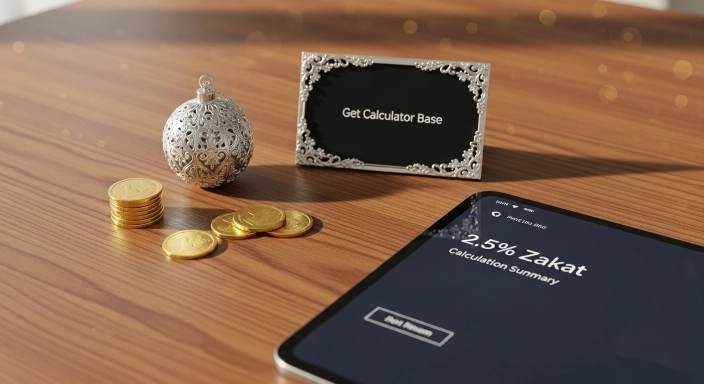
Instant Calculation: The tool uses a precise mathematical engine to subtract your debts from your assets and, if you are above the Nisab, calculates your 2.5% contribution.

The “Nisab” Logic: Based on my technical background, I designed this tool to follow the Silver Nisab by default if you want to maximize your charity (as it’s a lower threshold), but always consult your local scholar if you are unsure which standard to apply.
What is the Zakat Nisab 2026 for Gold and Silver?
The threshold of eligibility is defined by the Nisab. If your surplus wealth stays above this limit for one full lunar year (Hawl), Zakat becomes a mandatory Islamic financial obligation.
The Universal Nisab Standards
| Asset Type | Standard Weight (Tola) | Standard Weight (Grams) | Requirement |
| Gold | 7.5 Tola | 87.48 Grams | Must be held for 1 Lunar Year |
| Silver | 52.5 Tola | 612.36 Grams | Must be held for 1 Lunar Year |
2026 Regional Zakat Estimates
To help you plan, here is how Zakat typically looks across different regions in 2026. (Note: Always use the calculator for real-time rates).
| Country | Currency | Zakat Rate | Common Threshold Basis |
| Pakistan | PKR | 2.5% | Silver Nisab (usually for lower-income) |
| India | INR | 2.5% | Gold/Silver Market Rates |
| USA | USD | 2.5% | Bullion Spot Price |
| UK | GBP | 2.5% | London Metal Exchange Rates |
| Saudi Arabia | SAR | 2.5% | Local Gold Market Value |
The Technical Formula: How This Tool Works
Our Zakat Calculator 2026 doesn’t just “guess.” It uses a strict financial algorithm audited for Shariah compliance. The mathematical logic is as follows:
If your Net Zakatable Wealth is greater than or equal to the Nisab Value, the tool executes:
Why “Immediate” Liabilities Matter
Under Islamic jurisprudence on charity, you cannot deduct long-term debts like a 20-year mortgage from your Zakat. You only deduct what is due now or within the current month. Our tool’s logic is coded to reflect this “instant-due” rule, ensuring you don’t underpay your obligation.
For broader fiqh guidance on Zakat calculation methodology, resources like the Assembly of Muslim Jurists of America (AMJA) provide detailed scholarly rulings — this calculator handles the arithmetic, but always consult a qualified scholar for rulings specific to your situation.
Understanding Zakatable Assets: What to Include?
Calculating Zakat on Shares, Bonds, and Business Investments
Investments are often overlooked. If you own shares in a company, you must pay Zakat on the “Zakatable Assets” of that company (usually cash and stock-in-trade). If you cannot find that data, scholars recommend paying 2.5% on the entire market value of the shares.
Rules for Zakat on Property and Rental Income
Personal Home: Exempt.
Investment Property: If you bought land to sell it later, Zakat is due on the entire market value.
Rental Property: No Zakat on the value of the building, but Zakat is due on the rental income you have saved.
Expert Guidance & Collaboration: The Waseem Aijaz Approach
This tool isn’t just code; it’s a collaboration. As a Hafiz-e-Quran and Lead Developer, I (Waseem Aijaz) have personally ensured that the technical architecture honors the spiritual weight of this task.
“When I built this, I kept the concept of Al Fuqara and Al Masakin (the poor and needy) in my heart. A single calculation error could mean a poor family loses out on their right. That is why we used high-precision floating-point math to ensure every cent is accounted for.” — Waseem Aijaz
This calculator’s Nisab thresholds and formulas are re-verified each Islamic year against current gold and silver spot prices — not a static number left unchanged since launch.

Personal Experience Tip:
In my years of developing health and financial engines, I’ve learned that User Experience (UX) is key. If a calculator is too hard to use, people give up. We made this interface “Human-First”—large inputs, clear labels, and no confusing jargon.
Rules for Zakat on Salary and Personal Savings
Many users wonder if they pay Zakat on their monthly paycheck. Under Islamic jurisprudence on charity, Zakat is not due on your salary the moment you receive it. Instead, it is due on whatever remains of that salary after your expenses, provided it stays above the threshold of eligibility for one lunar year (Hawl). Our tool allows you to input these “Cash in Hand” savings specifically to ensure you only pay what is truly due.
Islamic Guidelines on Jewelry: Personal Use vs. Investment
There is a common debate regarding Zakat on jewelry worn daily. While some schools of thought exempt “personal ornaments,” many scholars (especially in the Hanafi school) suggest that all gold and silver above the Zakat Nisab is subject to the 2.5% rate.
Pro Tip by Waseem Aijaz: To be safe and maximize your reward, our gold zakat calculator treats all gold holdings as zakatable. This ensures your purification of wealth is complete and leaves no room for doubt.

Common Mistakes People Make When Calculating Zakat
- Forgetting jewelry worn regularly — Many scholars hold that gold and silver jewelry is Zakatable regardless of personal use, unlike other personal items. Don’t assume “I wear it daily” exempts it.
- Ignoring debts owed TO you — Money others owe you (that you expect to recover) generally counts as a zakatable asset, not just money you have on hand.
- Not deducting immediate liabilities — Zakat is due on net wealth, not gross. Short-term debts and due bills should be subtracted before calculating.
- Using the wrong Nisab metal — Using the gold Nisab when your wealth is mostly cash/silver (or vice versa) can significantly change whether you’re even liable. Most scholars recommend using whichever Nisab (gold or silver) is lower, to be safe.
- Missing the Hawl (lunar year) reset — If your wealth dips below Nisab at any point during the year, some scholars say the Hawl clock resets. Track this carefully rather than assuming a fixed annual date works for everyone.
New Features & Expert Innovations in the 2026 Version
- Zero-Server Privacy: We use client-side JavaScript. Your financial secrets never leave your computer. We don't store your data; we only help you calculate it.
- Real-time Tola to Gram Conversion: Many users in Pakistan and India think in Tolas. Our tool allows you to input weights in either format seamlessly.
- Dynamic Currency Fetching: The tool is designed to work with 140+ currencies, making it a truly global online zakat calculator.
- Nisab Alert System: If your wealth is below the threshold, the tool will gently notify you that Zakat is not yet mandatory for you, providing peace of mind.
The 2026 Zakat Compliance Checklist
- Ownership: Do you have full possession of the asset?
- Growth: Is the asset capable of increasing (Cash, Gold, Stock)?
- Nisab: Does your total wealth exceed the value of 612.36g of silver?
- Hawl: Have you owned this wealth for 12 lunar months?
- Niyyah: Have you made the intention that this is for the sake of Allah?
Frequently Asked Questions (FAQs) - Zakat 2026 Insights
Do I need to pay Zakat on my 401(k) or retirement account?
This is a matter of some scholarly difference, similar to EPF accounts — it generally depends on whether you have current access to the funds. Many scholars hold that Zakat becomes due once you can access and control the funds (even with an early-withdrawal penalty), while others say it’s only due once withdrawn. We’d recommend checking with a qualified Islamic scholar for a ruling specific to your account type and country.
How do I calculate Zakat on gold?
Simply find the current weight of your gold. Multiply that by the 2026 market rate per gram, and take 2.5% of that total. Our tool does this for you automatically.
Is Zakat due on 7.5 tola gold?
Yes. 7.5 tola (approximately 87.48 grams) is the minimum Nisab for gold. If you have held this amount for a year, Zakat is a mandatory Islamic financial obligation.
How much Zakat is due on 1000 grams of gold?
For 1000g, find the total value based on today’s rate and divide by 40. This is the simplest way to calculate the 2.5% share.
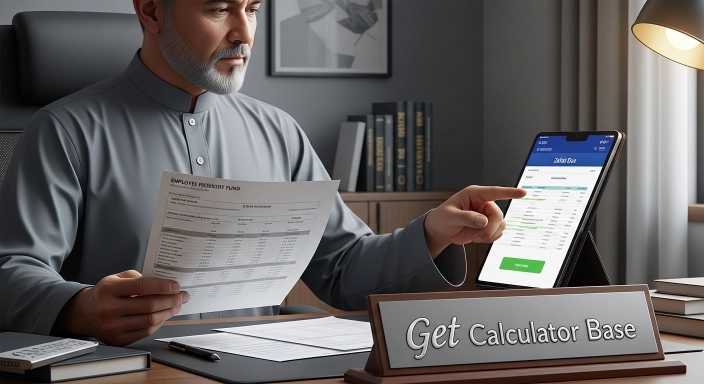
Is Zakat applicable on my Employee Provident Fund (EPF)?
Yes, but usually only on the portion that is “accessible.” If you can withdraw it, it is zakatable. Many scholars suggest calculating it once you actually receive the funds.
What is the difference between Zakat and Sadaqah?
Zakat is a fixed, mandatory 2.5% requirement for those who meet the Nisab. Sadaqah is voluntary charity that can be given in any amount, at any time, to anyone.
How much Zakat is due on $10,000 in savings?
If your total zakatable wealth (cash, gold, silver, and business assets combined) exceeds the Nisab threshold and you’ve held it for one full lunar year (Hawl), you owe 2.5% — so on $10,000, that’s $250. Use the calculator above to factor in your specific assets and liabilities for an exact figure.
Is Zakat always 2.5% of your savings?
Yes, for cash, gold, silver, and most liquid business assets, the standard Zakat rate is 2.5% (1/40th) once your wealth exceeds the Nisab threshold and has been held for one lunar year. Different rates apply to agricultural produce and livestock, which this calculator doesn’t cover.
What are the conditions for Zakat to become obligatory?
Most scholars agree on five core conditions: (1) full ownership of the wealth, (2) the wealth has growth potential (savings, gold, trade goods — not personal-use items), (3) it meets or exceeds the Nisab threshold, (4) it has been held for one full lunar year (Hawl), and (5) it exceeds your basic needs and outstanding debts. As always, consult a qualified scholar for guidance specific to your situation.
Conclusion: Purify Your Wealth with Confidence
The Zakat Calculator 2026 by GetCalcBase is more than a utility—it is a partner in your spiritual journey. By combining modern technology with Hafiz-verified logic, we provide a tool that respects your privacy and your faith. Start your calculation today and ensure your wealth redistribution helps those who need it most.
Disclaimer: The GetCalcBase Zakat Calculator is an informational and educational tool. We provide high-precision calculations to assist you, but we do not collect, hold, or distribute Zakat funds. For complex legal or religious rulings regarding your specific financial situation, we always recommend
consulting a qualified Islamic scholar or Mufti.
Financial logic reviewed by Zainab Sarfraz Financial Logic Expert.
Managing Wealth Beyond Zakat
If part of your wealth is in cryptocurrency, our Crypto Currency Converter helps you get an accurate PKR/USD value before calculating what’s owed. Planning major purchases with your remaining wealth? Our Rent vs Buy Calculator and Mortgage Recast Calculator can help you plan responsibly alongside your religious obligations.
What the Get Calculator Base Community Says
Average Rating: 4.9/5 based on our beta users