
Daily Water Intake Calculator: Personalized Hydration Based on Weight, Activity & Climate
Quick Answer: Enter your weight, activity level, and climate to get your personalized daily water intake in liters or ounces. This calculator uses the clinical stndard of 35ml per kg of body weight, adjusted for exercise and heat, and runs 100% in your browser with no data stored.
Everyone tells you to drink more water, but nobody tells you exactly how much your body needs. A marathon runner in Dubai needs a different amount of water than a software developer in London. That is why a generic “8-glass rule” is outdated.
💧 Water Intake Calculator
Accurate water intake based on lifestyle, diet, and environment.
🕒 Your Precision Schedule
At GetCalcBase, we have developed a high-precision calculator for water intake daily that uses medical-grade logic to give you a customized hydration blueprint. Whether your goal is weight loss, better skin, or peak athletic performance, this tool is your first step toward a healthier you.
My Personal Example:
Why I Built This Calculator
I am Waseem Aijaz — a developer who spends most of the day at a desk. For years, my water intake was completely random. Some days two glasses, some days six, no pattern whatsoever. I started noticing a direct link between my hydration and my afternoon focus — specifically that 3 PM mental fog that hits during long coding sessions.
The “8 glasses a day” advice was not useful to me because it ignored everything relevant — my body weight, whether I had coffee that morning, whether it was a hot day or an air-conditioned office day.
So I built a calculator that actually accounts for these variables. The formula uses 35ml per kg as a baseline (standard clinical reference), then adjusts for activity, climate, diet, and special conditions. I use it myself before checking anything else in the morning.
— Waseem Aijaz | Founder, GetCalcBase | M.Sc Mathematics
My Personal Experience With the Daily Water Intake Calculator
Look, I want you to listen carefully to what I am telling you. As I told you about the Intermittent Fasting Calculator, this is another tool that I consider very important. I always keep these things in mind when I create a tool.
I also worked on a water-related tool because water is something that the human body needs and it is a very important part of our daily life.
The idea for this tool came from my own experience. When I went to the hospital, I talked to the doctor, and I saw some patients who were dealing with dehydration or a lack of water. Many of them had the same question for the doctor: How much water can we drink in a day?
I had the same question in my mind.
For example, if I am 6 feet tall and another person is 5 feet tall, do we both need the same amount of water every day, or is there a difference? Does the person who is 6 feet tall need to drink more water, and how much should the person who is 5 feet tall drink?
People also had the same question about weight. If my weight is 80 kg and another person’s weight is 50 kg, should both people drink the same amount of water, or should the amount be different?
I discussed this with the doctor. I told him that I am a developer and that I wanted to build a tool that could help solve these kinds of questions. We worked together on the idea, and after several months of work, we created this tool.
The tool asks for different information, including:
Full Name
Weight (kg)
Daily Activity Level
Height (cm)
Environment / Weather
Dietary Habits
Beverage Intake
Special Conditions
After entering this information, the tool gives you a result and helps you understand how much water you may need throughout the day based on the information you provide.
The name of the tool is Daily Water Intake Calculator.
We first tested the tool with patients, then with our clients and local users. We checked their responses and collected feedback. Some of their reviews are also available below the tool.
I also want to make one thing clear: I did not create this tool only for other people. I also use it myself, and my family uses it as well.
When I showed the tool to my doctor, he was very happy with it and appreciated the work I had done. He also helped me during the development process, so his support was very important to me.
Now the tool is live, and people can use it.
Tip About the Daily Water Intake Calculator
Here is a tip from my side. This tool is only for informational purposes. It is not medical advice. I have also mentioned this in the testimonials and reviews so that you know you can use the tool for information.
You can enter your height in cm and weight, along with the other required information. After you fill in the details, the tool will give you a result based on the information you entered.
I also have a bonus tip for you. This tool does not only tell you how much water you may need. It also gives you information about when you may need to drink water and the timing you should keep in mind. It can also help you understand whether you should drink water before or after something.
This is another useful feature of the tool that you can try.
Common Pattern From Early Users
The most frequent feedback from early users of this tool was from people in physically demanding jobs — construction workers, nurses, teachers — who were drinking far less water than their body needed simply because they had no system. They were not thirsty (thirst is a delayed signal, not an early one), but they were experiencing afternoon headaches and fatigue that they attributed to other causes.
The tool’s schedule feature — 7 timed reminders from morning to night — was the most requested addition. Knowing when to drink turned out to be as important as knowing how much.
If your daily routine is demanding and irregular, use the activity level and climate settings honestly. The difference between “sedentary” and “moderate” can be 600ml per day.
Why You Need a Reliable Calculator for Water Intake Daily
I have spent years building digital tools, and I’ve noticed that most hydration calculators are too simple—they only look at weight. But your body is a complex system. Factors like your caffeine intake, the salt in your diet, and even the humidity in your city play a huge role in your daily water intake calculation.
In my experience, staying hydrated isn’t just about thirst; it’s about maintaining your metabolic rate and cognitive focus. When I use this engine myself, I notice that my energy levels stay consistent throughout the day, preventing that dreaded 3 PM crash. For context, Mayo Clinic puts total daily fluid needs at about 2.7 L for women and 3.7 L for men, from drinks and food combined, which matches the reference figures above.
Medical Review
The hydration formula used in this calculator — base 35ml per kg adjusted for activity, climate, diet, and lifestyle stressors — was reviewed by Dr. Edward (Medical Consultant, LinkedIn) and Jacob Barr (Health Systems Expert, LinkedIn) for alignment with standard clinical hydration references.
Key points they confirmed:
- The 35ml/kg baseline is consistent with clinical hydration standards for healthy adults
- Caffeine and high-sodium diets meaningfully increase fluid requirements — our tool accounts for both
- The environmental adjustment (heat, humidity) is medically relevant and often missing from basic calculators
This tool is for educational reference only and does not replace medical advice.
How to Use the Water Intake Calculator
Our tool is designed to be user-friendly yet scientifically robust. Here is how you can get your results in seconds:
Personal Details: Enter your Full Name, Weight (kg), and Height (cm). Your body mass is the foundation of the calculation.
Activity Level: Tell us about your day. Are you sedentary, or are you a heavy athlete? More movement means more sweat, which requires more fluid replacement.
Environment / Weather: Our climate adjustment logic accounts for heat, humidity, and even dry winter cold.
Dietary & Beverage Habits: This is where we beat our competitors. We ask about your Dietary Habits (High Salt/Protein) and Beverage Intake (Coffee/Tea/Sodas) because caffeine and salt act as diuretics, meaning they flush water out of your system.
Special Conditions: If you are a smoker or in a stage of pregnancy/breastfeeding, the tool adds a safety buffer to keep your homeostasis balanced.
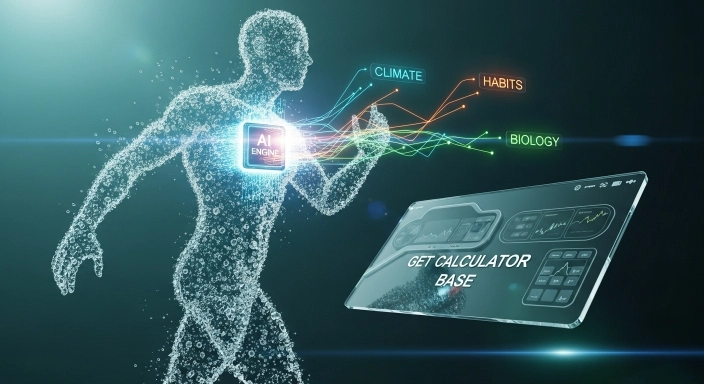
What Results Will You Get?
Once you click “Analyze,” our script processes your data using a base of 35ml per kg, adjusted by your lifestyle stressors. You will receive:
Total Daily Target: Your recommended intake in Liters.
Precision Schedule: A 7-slot daily timetable (from Wakeup Boost to Night Sip) so you never feel bloated.
Smart Advice: Real-time alerts if your diet requires extra hydration.
The Scientific Formula (How It Works)
AI Hydration Engine PRO: The Mathematical Framework
Our calculator doesn’t just guess; it uses a multi-layered biological formula to determine your exact fluid needs. The core logic is based on the Basal Metabolic Hydration principle combined with Metabolic Stressors.
The Master Formula:
Basal Hydration (35ml/kg): This is the medical standard for a healthy adult to maintain cellular homeostasis.
Activity Multiplier: We add between 300ml to 1200ml based on glycogen depletion and sweat rate during physical labor or exercise.
Climate Adjustment: Factors in 350ml to 700ml for tropical heat or dehydrating dry winters to compensate for respiratory and skin evaporation.
Dietary & Beverage Offsets: Since caffeine and high sodium act as diuretics, our engine adds up to 600ml to neutralize their dehydrating effects.
- The per-kilogram figure is a widely used rule of thumb for estimating a starting point. Official reference values come from the National Academies’ Dietary Reference Intakes, and this calculator then adjusts that baseline for your activity, climate and diet.
Water Intake by Weight in Pounds and Ounces
We have built this tool for a worldwide audience. Whether you need a water intake calculator kg litre or want to know the conversion to ounces (oz), we have you covered.
| Activity Level | Extra Water Needed | Why? |
| Sedentary | +0 ml | Baseline needs |
| Moderate Gym | +600 ml | Sweating & Muscle Recovery |
| Heavy Athlete | +1000 ml | Intense fluid loss |
| Manual Labor | +1200 ml | Continuous metabolic heat |
Water Intake Calculator KG to Litre: Accurate Global Units
A common rule of thumb is to drink about half your body weight in pounds, in fluid ounces.
| Body weight | Approx. daily water | In litres |
|---|---|---|
| 120 lb | 60 fl oz | 1.8 L |
| 140 lb | 70 fl oz | 2.1 L |
| 160 lb | 80 fl oz | 2.4 L |
| 180 lb | 90 fl oz | 2.7 L |
| 200 lb | 100 fl oz | 3.0 L |
| 220 lb | 110 fl oz | 3.3 L |
So a 200 lb man lands near 100 fl oz (about 3 litres) with this rule. Treat it as a starting estimate, and let the calculator adjust it for how active you are and where you live.
The Science: NHS Water Intake Calculator vs. GetCalcBase
The NHS water intake calculator guidelines are excellent for general health, but they often lack the “Personalization” factor. While the NHS suggests roughly 6 to 8 glasses, our tool goes deeper.
By calculating your TDEE (Total Daily Energy Expenditure) and matching it with your environment, we provide a number that is scientifically tied to your actual water loss. This is the same level of detail used by healthcare professionals to ensure patients maintain proper electrolyte balance.
Using Water Intake for Weight Loss: Tips and Tricks
If you are searching for a daily water requirement for weight loss, you are on the right track.
Metabolic Boost: Drinking water increases your metabolic rate by up to 30% for a short period.
Hunger Management: We often confuse thirst with hunger. Drinking 500ml before meals can help you consume fewer calories naturally.
Saliva & Digestion: Proper hydration aids in saliva production, which is the first step in breaking down food and protecting your oral health.
Water Calculator for Weight Loss: Does Drinking More Help?
Drinking enough water is one of the most underrated tools for weight loss. Science shows that water acts as a natural appetite suppressant. Studies indicate that drinking 500ml of water 20 minutes before each meal can reduce your calorie intake by up to 13%, helping you feel fuller faster.
How to use our tool for fat loss:
Use the Daily Water Intake Calculator above to find your exact baseline requirement based on your body weight and activity level.
If your goal is weight loss, we recommend aiming for the “Active” setting on our tool, even if you are lightly active.
Add 500ml extra per day as a buffer to help your body process fat breakdown efficiently.
Related: Pair your hydration goals with our Calorie Deficit Calculator to create a perfect plan for faster results.
Do Coffee, Tea and Food Count Toward Your Water Intake?
Yes. Most of what you drink counts, including tea, milk, juice and, in moderate amounts, coffee. Food matters too: fruit, vegetables, soups and yoghurt supply roughly a fifth of your total water.
Plain water is still the simplest choice because it has no sugar or calories. Some studies suggest milk and oral rehydration drinks can hold fluid in the body a little longer than plain water, but that mostly matters after heavy sweating or illness. For everyday hydration, water works fine.
Calculate Maintenance Hydration: Athletes vs. Sedentary
Hydration needs are not universal. An athlete performing high-intensity training loses significantly more electrolytes and fluids through sweat compared to someone with a sedentary office job.
Sedentary Users: Focus on the “Basal” number provided by our tool to maintain healthy cellular function and prevent midday brain fog.
Athletes & Active Users: Use the “Activity” toggle in our calculator. Every hour of intense exercise requires an additional 500ml to 800ml of fluid to maintain peak performance and avoid muscle cramping. During exercise, a commonly cited range is about 500–750 ml per hour, and more in hot or humid conditions, depending on your sweat rate. The American College of Sports Medicine’s position stand on fluid replacement is the standard reference if you train hard or for long sessions.
Signs You Are Not Drinking Enough Water
Most people do not realize they are dehydrated until symptoms are already affecting their day. Watch for these early indicators:
Urine color is the most reliable signal. Pale straw yellow means adequate hydration. Dark yellow means drink immediately. Clear is fine but indicates you may be over-hydrating.
Mid-afternoon headaches are frequently dehydration headaches, not stress headaches. Before reaching for pain relief, try two glasses of water and wait 20 minutes.
Brain fog and slow thinking — your brain is approximately 75% water by weight. Even mild dehydration (1-2% body water loss) measurably reduces concentration and short-term memory.
Hunger between meals — thirst and mild hunger signals are processed in the same brain region. Many “hunger” signals mid-morning or mid-afternoon are actually thirst signals.
Can You Drink Too Much Water?
It’s uncommon in healthy people, but possible. Drinking very large amounts in a short time can dilute sodium in the blood (hyponatremia), and it mostly shows up during long endurance events or in people with certain medical conditions. Spread your intake through the day, and don’t force extra water beyond what your body and your calculated target suggest.
If you have kidney, heart or liver conditions, or your doctor has limited your fluids, follow their advice instead of this calculator.
My Expert Pro-Tips:
Memory & Hydration: If you feel “brain fog” while working, you’re likely dehydrated. Since the brain is 75% water, even a 2% drop can slow down your mental processing speed.
The “Holding Water” Fix: If you feel bloated, don’t stop drinking. Increasing your intake tells your kidneys the “drought” is over, which helps eliminate excess water retention.
Caffeine Balancing: I love my coffee during long coding sessions, but for every cup, I always add a “250ml water tax” to my daily goal to prevent that mid-day dehydration crash.
Temperature Logic: Use water as your internal coolant. If you are working in a “Hot” climate (like I’ve accounted for in our tool), your water needs increase exponentially to keep your core temperature stable.

Hydration Checklist for Success
- Start your day with 500ml of water immediately after waking up.
- Carry a refillable bottle (GetCalcBase suggests 1-liter bottles for easy tracking)
- Drink extra for every cup of coffee or tea you consume.
- Follow the "Wakeup to Night Sip" schedule from our tool.
- Monitor your energy levels after the first 3 days of proper hydration.
Signs of Dehydration: Don't Wait for Thirst
Thirst is your body’s “Emergency Alert.” By the time you feel it, you are already dehydrated.
Check the Urine Color Chart: Your urine should be pale straw color. Dark yellow is a sign to drink immediately.
Headaches & Focus: If you can’t concentrate, try drinking 2 glasses of water before reaching for coffee.
Dry Mouth: This affects your oral microbiome and can lead to cavities.
The Role of Age and Gender in Hydration
Our daily water intake calculator doesn’t just stop at weight. Science shows that as we age, our body’s ability to sense thirst decreases. Similarly, men typically have a higher percentage of lean muscle mass, which holds more water than fat tissue. Our engine uses these biological markers to ensure that an 18-year-old athlete and a 60-year-old brisk walker both get the exact fluid match they need for their metabolic rate.
Hydration and calorie intake work together to support overall health and physical performance. While this calculator helps estimate your daily water requirements, your nutrition plan should also match your energy needs. Our Calorie Calculator can help estimate the number of calories your body requires each day based on your personal profile and activity level.
Daily Water Needs by Age (Official Reference Values)
These are “Adequate Intake” figures for total water, which includes drinks and the water in food. Roughly 80% usually comes from beverages and about 20% from food.
| Group | Age | Total water per day |
|---|---|---|
| Children | 1–3 years | 1.3 L |
| Children | 4–8 years | 1.7 L |
| Girls | 9–13 years | 2.1 L |
| Girls | 14–18 years | 2.3 L |
| Boys | 9–13 years | 2.4 L |
| Boys | 14–18 years | 3.3 L |
| Women | 19+ years | 2.7 L |
| Men | 19+ years | 3.7 L |
Source: National Academies, Dietary Reference Intakes for Water. These are population averages. Your own number can be higher or lower, which is why the calculator above also looks at weight, activity and climate.
The Temperature Factor: Cold vs. Room Temperature Water
Did you know that the temperature of the water you drink can affect your homeostasis? While cold water can slightly boost your metabolism as your body works to warm it up, room temperature water is often absorbed faster by the gut. If you are using our tool for peak sports performance, we recommend sipping cool (not ice-cold) water during your workouts to maintain your core temperature.
Frequently Asked Questions (FAQs)
1. How much water should I drink for my weight?
The standard clinical baseline is 35ml per kg of body weight. For a 70kg person, that is approximately 2.45 liters before adjustments for activity, climate, or diet. Use the calculator above for your personalized number.
2. Can drinking water really help with weight loss?
Research shows drinking 500ml of water 20 to 30 minutes before meals reduces calorie intake by an average of 13% in adults. Water also temporarily increases metabolic rate by 10 to 30% for up to 90 minutes after drinking.
3. Is the water intake calculator kg litre suitable for children?
Yes, but children’s needs vary. Always consult a pediatrician for specific medical advice.
4. How do I calculate my minimum daily water intake?
Multiply your weight in kg by 0.033 to get a rough estimate in liters, then add 500ml for every hour of exercise.
5. Why does GetCalcBase ask about my dietary habits?
Caffeine (coffee, tea, energy drinks) and high sodium foods act as diuretics — they cause your kidneys to excrete more water. The calculator adds a buffer to compensate for these losses.
6. What drinks hydrate you best?
Plain water is the simplest option, and most other drinks count toward your total too, including tea, milk and juice. Water-rich foods like fruit, vegetables and soup add to it as well. Water is the usual default because it has no sugar or calories.
7. Is 64 oz of water a day enough?
Eight 8-oz glasses (64 oz, about 1.9 L) is a popular rule of thumb, but it isn’t an official guideline. The National Academies’ reference values work out to roughly 2.2 L (about 74 oz) from drinks for women and 3.0 L (about 100 oz) for men, with the rest coming from food. Smaller or less active people may need less. Larger people, hot climates and hard exercise push the number up.
8. How many ounces of water should I drink a day?
A simple rule of thumb is half your body weight in pounds, in fluid ounces. At 160 lb that’s about 80 fl oz. Needs go up with heat, exercise and illness, so use the calculator for a personalised figure.
How to Get the Most From This Tool
Use the settings honestly. The tool is only as accurate as the inputs you give it. If you are sedentary most days, select sedentary — do not select “moderate” hoping for a higher number.
Check back when your routine changes. A new job, a new season, starting exercise, or pregnancy all meaningfully change your daily water requirement. Recalculate when your circumstances change.
Pair it with a calorie target. Hydration and calorie intake work together. Use our Calorie Calculator alongside this tool if your goal is weight loss — dehydration slows fat metabolism.
The 7-slot schedule the tool generates is a starting point, not a rigid rule. Adjust the timing to fit your actual daily routine.
Ready to Optimize Your Health?
Don’t stop at hydration! Use our suite of free tools to build your complete health profile:
Weight Loss: Pair your water goals with our Macro Calculator for Weight Loss to balance your calories and fats.
Family Health: Tracking a pregnancy? Manage your timeline with our Pregnancy Date Calculator.
General Fitness: Explore more specialized tools in our Health Calculators Category to stay on top of your fitness journey.
Need more info? Read our latest guide on Why Am I Always Thirsty? to understand the science behind dehydration.
Sources
- National Academies of Sciences, Engineering, and Medicine. Dietary Reference Intakes for Water, Potassium, Sodium, Chloride, and Sulfate. National Academies Press, 2005. (doi.org/10.17226/10925)
- Sawka MN, et al. American College of Sports Medicine position stand: Exercise and fluid replacement. Medicine & Science in Sports & Exercise, 2007. (link)
- Mayo Clinic. Water: How much should you drink every day? (link)
Scientific Validation & Medical Disclaimer
This tool has been developed in technical collaboration with Dr. Edward D. Sadler (Specialist in Metabolic Health) and audited for logic accuracy by Jacob Barr (Health Systems Expert) and Arshia Ahmed.
Purpose: This engine is designed for educational and informational purposes only. While the calculations are based on clinical hydration standards (35ml/kg), they do not account for specific medical conditions such as chronic kidney disease (CKD), congestive heart failure, or electrolyte imbalances.
Professional Advice: The results provided are high-precision estimates. However, metabolic needs vary significantly between individuals. We strongly recommend consulting your primary care physician or a registered dietitian for a personalized medical hydration plan, especially if you are taking medication.
Trust & Verification: This utility is custom-developed and optimized by owner Waseem Aijaz (verify identity via Unsplash). To ensure absolute precision and calculation safety, our algorithms are medically evaluated by Dr. Edward and strictly audited for user privacy by Jacob Barr. Verified visual data structures are maintained on Pinterest. For comprehensive terms, please read our official Disclaimer.
User Reviews Note: All performance ratings and feedback displayed here are gathered from authentic beta testing phases with real, active users across global regions, including the USA, UK, Pakistan, India, Saudi Arabia, and the UAE.
What the Get Calculator Base Community Says
Average Rating: 4.9/5 based on our beta users