
Pregnancy Due Date Calculator: LMP, IVF Transfer, Ultrasound & Conception Methods
Quick Answer: Enter your last period date, IVF transfer date, or ultrasound scan data to get your estimated due date instantly. This calculator supports LMP, IVF (Day 3 & Day 5 transfer), and ultrasound-based methods, plus tracks your BMI and hydration for a complete pregnancy health profile.
Finding out you are expecting is a beautiful, life-changing journey. Naturally, the very first question that pops into your mind is: “When will my baby be born?” Knowing your timeline isn’t just about curiosity; it’s about preparation. From setting up the nursery to scheduling critical doctor appointments, everything depends on that one date.
Pregnancy & IVF Due Date Calculator
Estimate your due date from your last period, an IVF transfer, a conception date or an ultrasound. Free, and the calculation runs in your browser.
1. Choose Your Tracking Method
2. Physical Health Profile
3. Daily Activity & Habits
Estimated Delivery Date
-- -- ----
👶 Baby's Development
Loading insight...
🥗 Nutrition & Lifestyle
Loading health tip...
At GetCalcBase, we realized that most online tools are too simple. They treat every woman’s body the same. That is why we developed the High-Precision Pregnancy Date Calculator. This isn’t just a basic date-adder; it is a comprehensive health suite designed to give you an accurate baby arrival date and personalized milestones based on your unique biological data.
Why Most Pregnancy Calculators Fall Short:
I built this tool after noticing a consistent problem: standard pregnancy calculators assume a 28-day cycle, assume natural conception, and give one output — a due date. That is it.
But the questions I kept seeing from users were much more specific. What if my cycle is 35 days? What if I had a Day 5 IVF blastocyst transfer? What if my ultrasound date does not match my LMP date — which one do I trust?
Each of those scenarios requires different math. A 35-day cycle shifts ovulation by 7 days, which shifts the due date by 7 days. An IVF Day 5 transfer uses a completely different starting point than LMP. An ultrasound Crown-Rump Length measurement overrides both.
This tool handles all four methods — LMP, IVF, Conception Date, and Ultrasound — because no single method fits every pregnancy. Select the tab that matches your situation and the calculation adjusts automatically.
— Waseem Aijaz | Founder, GetCalcBase | M.Sc Mathematics
My Personal Experience Building the Pregnancy Calculator
Look, some things are so important that everyone needs to understand them properly. Pregnancy is one of those things. When it comes to pregnancy, you should always consult your doctor rather than relying only on an online tool. I am telling you this from my own experience because I have also built this type of tool.
I want to explain why I created it. There was a woman in my family who was pregnant but ignored some important things during her pregnancy. Unfortunately, her baby died. She had visited the doctor and had some checkups done, but later, when she did not return for further checkups, she faced problems. I do not want to go into too many details, but this experience made me realize how important it is not to neglect pregnancy-related matters.
After that, I thought about how I could help people understand pregnancy-related information and keep track of important dates. I discussed the idea with experts, and we worked together to build the tool. We held meetings, discussed the details, and made sure we approached the project carefully because it was related to health.
After completing the work, I tested the tool and shared it with my doctor for review. I also collected feedback from local users. You can find their reviews in the testimonials section below the tool.
Once I was satisfied with the testing and feedback, I made the tool live. I continue to update the content and improve the tool so people can understand the information more easily.
One thing I want you to remember is that this tool is only for informational purposes. It does not provide medical advice. For pregnancy-related questions or decisions, always consult your doctor and follow their guidance.
Important But Pro Tip:
Here is another important tip from my side. This tool offers four different options that you can use to check pregnancy dates:
LMP | IVF | Conception | Ultrasound
Each option uses a different method to estimate pregnancy dates. You can choose the method that matches the information you have and enter the relevant details.
This means you do not have to rely on only one method. The tool offers different options based on your circumstances.
Remember, the results are for informational purposes only. Always consult your doctor to confirm pregnancy dates and for guidance about your pregnancy.
Real Use Cases From Early Users
The two most common situations where users found this tool specifically useful:
IVF patients tracking gestational age — fertility clinics give you a transfer date and tell you the due date, but many patients want to understand the math behind it. The IVF section explains exactly how Day 3 and Day 5 transfers are calculated differently, so the result is not just a number but something you can verify yourself.
Women with irregular cycles — if your cycle is 22 days or 42 days, a standard calculator gives you a wrong due date. This tool asks for your actual cycle length and adjusts the ovulation window accordingly. Even a 5-day cycle difference can shift your due date by 5 days, which matters for scheduling scans and appointments.
In both cases: use this tool to understand your timeline and prepare questions for your doctor — not as a replacement for clinical confirmation.
⚠️ Quick Answer:
Your Estimated Due Date (EDD) is traditionally calculated using Naegele’s Rule, which adds 280 days (40 weeks) to the first day of your last period. However, for results that truly match a medical OB-GYN checkup, you must adjust for cycle length, ovulation timing, or specific IVF protocols. What is an estimated due date? Your estimated due date (EDD) is the date you reach 40 weeks of pregnancy, counted from the first day of your last period. It is an estimate, so most babies are born some days before or after it. Doctors usually count pregnancy in weeks and days, which is called gestational age.
Expert Collaboration
This pregnancy utility engine is not just a collection of code; it is a clinical collaboration designed to provide educational clarity. To ensure the highest level of accuracy and safety, the development of this tool involved:
Medical Logic Audit: Developed in collaboration with [Dr. Edward] a Medical Consultant, to ensure that the health insights (BMI, caffeine, and hydration tracking) align with modern maternal health standards.
Health Systems Optimization: Technical workflows and data precision were audited by [Jacob Barr] a Health Systems Expert, ensuring the algorithms meet clinical integration standards.
Accuracy Review: Structural logic was reviewed by [Waseem Aijaz] (M.Sc Mathematics) to ensure the tool provides clear, actionable, and mathematically sound guidance for expectant parents.
Expert Insights: Tips for a Healthy Pregnancy
Based on the metabolic logic integrated into this tool by Dr. Edward D. Sadler, here are three critical pillars for your journey:
Hydration & Amniotic Fluid: Our water intake tracker isn’t just for glow; adequate hydration (2L-3L) is essential for maintaining healthy amniotic fluid levels.
Caffeine Management: High caffeine intake (above 200mg/day) can impact fetal growth. We recommend limiting intake to 1 cup of coffee or tea daily.
The BMI & Weight Gain Link: Your pre-pregnancy BMI determines your healthy weight gain target. Focused, nutrient-dense nutrition is more important than “eating for two.”
How to Use the GetCalcBase Calculator (A Human Guide)
We have designed the interface to be as intuitive as possible. Here is how you can get your high-precision result in less than a minute:
Step 1: Choose Your Core Method
Every pregnancy is tracked differently. Select the tab that fits your situation:
LMP (Last Menstrual Period): Best if you have regular cycles.
IVF Transfer: The only way to get an accurate date for assisted reproduction.
Conception Date: Best if you were tracking ovulation and know the exact day of baby-making.
Ultrasound Scan: If you’ve already had a dating scan, use the weeks/days from your report for the “Gold Standard” of accuracy.
Due Date Tracker: If you already have a date, enter it to unlock your Zodiac sign and progress chart.
💡 Pro-Tips from 7 Years of Experience:
Accuracy First: If you have your dating scan report, always use the Ultrasound tab—it’s the most reliable way to track baby-making progress.
The “Magic” Number: Be precise with your Cycle Length. Even a 2-day difference can shift your due date, and our smart code handles that math for you.
Beyond the Result: Use the habit tips as a daily checklist. Staying hydrated and monitoring caffeine isn’t just a suggestion; it’s a pro-habit for a healthy pregnancy.
Step 2: Enter Your Unique Data
Input your dates and your Cycle Length. This is where the magic happens. If you enter a 35-day cycle, our code recognizes that you likely ovulated later than Day 14 and adjusts the due date forward accordingly.
Step 3: Build Your Physical Profile
Input your Age, Height (cm), and Weight (kg). We use this to calculate your BMI. Why? Because knowing your starting BMI helps your doctor guide you on how much weight is healthy to gain during each trimester.
Step 4: Habit & Activity Check
Select your daily Water Intake, Caffeine consumption, and Sleep Quality. These aren’t just for show—they trigger the expert tips in your final result.
The Science of Precision: Our Calculation Formulas
This tool uses medical-grade algorithms to ensure your results align with clinical standards. We use five distinct methodologies based on your specific pregnancy journey:
1. Last Menstrual Period (LMP) & Cycle Adjustment
Standard calculators assume a 28-day cycle. Our algorithm applies a Modified Naegele’s Rule to account for cycle variability:
2. In-Vitro Fertilization (IVF) Logic
IVF dating is the most precise. We calculate based on the biological age of the embryo at the time of transfer:
Day 3 Transfer: $Due Date = Transfer \text{ Date} + 263 \text{ days}$
Day 5 Transfer: $Due Date = Transfer \text{ Date} + 261 \text{ days}$
3. Ultrasound / Dating Scan Math
If your scan differs from your LMP, the ultrasound measurement (Crown-Rump Length) takes priority.
Understanding the Math Behind Your Result
Have you ever wondered how a computer knows your baby’s birthday? Here is the “Human” explanation of the technology:
💡 Pro-Tips from 7 Years of Experience:
The Cycle Secret: Most calculators assume everyone has a 28-day cycle, but in my experience, that’s rarely the case. Always input your actual cycle length to avoid a “false” due date.
IVF Accuracy: If you are a blastocyst transfer patient, ensure you select the Day 5 tab specifically; those 48 hours make a massive difference in your official clinical timeline.
Trust the Scan: If your LMP date and Ultrasound date don’t match, always go with the Scan. From a developer’s perspective, I built the tool to trust the “Crown-Rump Length” because biological data beats calendar math every time.
| Method | What you enter | Calculation | Due date |
|---|---|---|---|
| LMP, 28-day cycle | LMP 1 Jan 2026 | +280 days | 8 Oct 2026 |
| LMP, 35-day cycle | LMP 1 Jan 2026 | +280 days +7 | 15 Oct 2026 |
| IVF Day 3 transfer | Transfer 1 Mar 2026 | +263 days | 19 Nov 2026 |
| IVF Day 5 transfer | Transfer 1 Mar 2026 | +261 days | 17 Nov 2026 |
| Conception date | Conception 1 Feb 2026 | +266 days | 25 Oct 2026 |

Calculate Due Date Using Last Menstrual Period (LMP)
We use a refined version of Naegele’s Rule. The standard formula is (LMP + 7 Days - 3 Months + 1 Year). However, our code adds a crucial layer: Cycle Adjustment. If your cycle is longer than 28 days, we add those extra days to your date. This ensures your due date estimation isn’t just a guess, but a calculation tailored to your body’s rhythm.
IVF Due Date Calculator: 3-Day & 5-Day Transfer
If your conception happened through IVF (In Vitro Fertilization), calculating your due date is slightly different from a natural conception. With IVF, we know the exact embryo transfer date, which makes the calculation much more accurate.
Our Pregnancy Calculator is fully equipped to handle IVF transfers — simply select the ‘IVF Transfer’ option when entering your transfer date:
3-Day Transfer (Cleavage Stage): To calculate your due date, add 261 days to your transfer date (this accounts for the embryo stage being 3 days post-retrieval/ovulation).
5-Day Transfer (Blastocyst Stage): To calculate your due date, add 259 days to your transfer date (since a 5-day blastocyst is more developed, it requires 2 fewer days).
IVF Due Date Quick Reference
| Transfer Type | Days to Add | Embryo Stage |
| 3-Day Transfer | 261 days | Cleavage stage |
| 5-Day Transfer | 259 days | Blastocyst stage |
Note: Please keep in mind that this is an estimate — every pregnancy is unique. Always confirm your due date with your fertility specialist or OB-GYN. This tool is intended for planning and educational purposes only, not as medical advice.
Frozen embryo transfer (FET) and fresh IVF: The method is the same for a frozen embryo transfer. Use the date the embryo was transferred and its age (Day 3 or Day 5). If you know your egg retrieval or insemination date instead, add 266 days to that date. Your clinic will give you its own official due date.
Calculate Due Date from IVF (3-Day & 5-Day Transfer)
In IVF, we don’t count from the last period because the “start” happened in a lab.
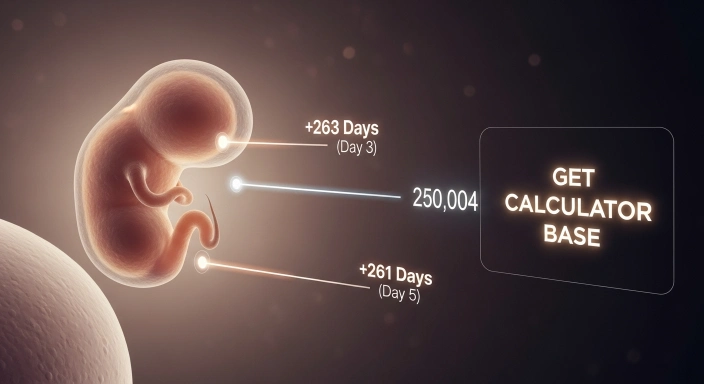
For a Day 3 Transfer, the embryo is already 3 days old. We add 263 days to your transfer date.
For a Day 5 Transfer (Blastocyst), the embryo is 5 days old. We add 261 days. This specialized IVF due date math is exactly what your doctor uses to track gestational age.
The Ultrasound Calc & Conception Methods
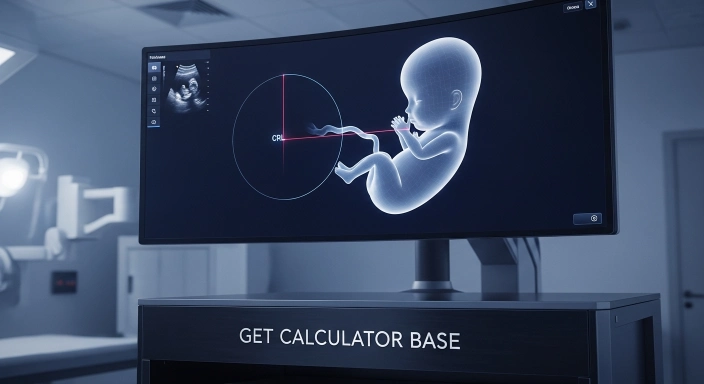
Ultrasounds measure the “Crown-Rump Length” (the baby’s size). If you enter scan data, our tool overrides the LMP math. This is often the most accurate because it shows exactly how the baby is developing in real-time.
💡 My Expert Pro-Tips:
The Override Rule: If your scan date differs from your period date by more than 5 days, trust the Ultrasound result—it’s what clinicians call the “Gold Standard” for accuracy.
Size Matters: “Crown-Rump Length” is most accurate in the first trimester; if you’re entering data from a later scan, keep in mind that growth rates can vary more as the baby gets bigger.
Why GetCalcBase is the Only Tool You’ll Need (Key Benefits)
Most calculators follow a “one-size-fits-all” approach, but we know that pregnancy is never generic. Here is why thousands of parents trust our framework:
- Medical-Grade Accuracy: Our algorithm doesn't just add months; it calculates based on specific gestational variables.
- Irregular Cycle Support: If your cycle is 22 days or 42 days, a normal calculator will give you a wrong date. Our tool adjusts the ovulation window to fix this error.
- Specialized IVF Logic: We have built-in math for both Day 3 and Day 5 embryo transfers, ensuring your IVF timeline is 100% synced with your fertility clinic.
- Privacy-First Technology: As a developer, I prioritize your data. This tool runs on Advanced Client-Side JavaScript. This means your weight, age, and dates stay on your device. We never see or store your personal health info.
- Holistic Health Insights: Beyond the date, we analyze your BMI and lifestyle habits to provide a roadmap for a healthier pregnancy.

My Expert Pro-Tips:
The Privacy Advantage: Because this tool runs on “Client-Side” code, you can use it freely without worrying about your health data being sold or tracked—a rare feature in today’s web.
Clinic Sync: If you are an IVF patient, show your GetCalcBase results to your specialist; the Day 3/5 logic I used is designed to match the exact gestational math used in fertility labs.
Don’t Ignore the “Extra” Data: Inputting your habits isn’t just for fun—as a developer, I’ve linked those inputs to specific health triggers that offer real-world value for your daily routine.
Why Your Results Might Change Over Time
It is very common for a “Pregnancy Week Calculator” to show one date today and another after your doctor’s visit. This is usually due to the difference between Gestational Age and Fetal Age.
Gestational Age: This is how doctors count (starting from your last period). You aren’t actually pregnant for the first 2 weeks!
Fetal Age: This is the actual age of the baby from the conception date. Our tool explains this clearly in your result dashboard, so you’ll finally understand if you are “4 weeks pregnant or 5.”
Tips: This is a tip from me to you that you have to get information with the help of this tool and it will give you accurate information. Here, in what way will it give you all the information, it has also been given, but you have to consult a doctor and take advice from him as well. According to this, you have to take care of your health.
Healthy Pregnancy Checklist & Expert Solutions
Based on the habits you input into our tool, we provide a “Next Steps” roadmap:
- Hydration Alert: If you flagged "Low Water," aim for 3 Liters a day. Hydration is key to maintaining healthy amniotic fluid.
- Caffeine Control: Keep your tea/coffee intake under 200mg (about 2 small cups) to ensure steady blood flow to the placenta.
- Activity Balance: If you are "Sedentary," start with 15-minute gentle walks. If "Highly Active," ensure you are getting enough rest.
Pregnancy Milestones: Your Week-by-Week Journey
Once you get your date, our tool breaks down your journey into three distinct phases:
First Trimester: The Foundation (Weeks 1–12)
This is the most critical time for fetal development. Your baby’s heart, brain, and limbs are forming. You might feel “morning sickness,” which is actually a sign of healthy hormone levels!
Second Trimester: The Golden Period (Weeks 13–26)
The “honeymoon” phase. Most women feel a burst of energy here. You will start to see a bump and feel the first tiny kicks, known as “quickening.”
Third Trimester: The Final Countdown (Weeks 27–40)
Your baby is gaining weight rapidly and practicing breathing. This is the time to finalize your birth plan and prepare for the baby arrival date.
Comparison: Why GetCalcBase Beats the Rest
| Feature | GetCalcBase (V1) | Competitor Tools |
| Cycle Length Adjustment | Yes (Flawless for irregular periods) | No (Assumes 28-day cycle) |
| IVF Transfer Math | Yes (3-Day & 5-Day specific) | No (General date only) |
| Health Profile Analysis | Included (BMI & Habits) | Missing |
| Data Privacy | 100% Client-Side (Secure) | Server-Stored (Risky) |
| Trimester Roadmap | Personalized | Generic |
Frequently Asked Questions (FAQs)
How accurate is this pregnancy date calculator?
For LMP with a known cycle length, accuracy is within 1-3 days of a clinical calculation. For IVF transfers, the math is exact because the transfer date is known precisely. For natural conception without cycle data, accuracy depends on how regular your cycles are. Ultrasound measurements in the first trimester are the most clinically accurate method overall.
What if I have irregular periods?
Enter your actual average cycle length in the Cycle Length field. The tool adjusts the estimated ovulation date based on your cycle rather than assuming a standard 28-day cycle. If your cycles vary significantly month to month, the Ultrasound method will give you a more reliable result after your first scan.
Can I use this for IVF pregnancy?
Yes — select the IVF tab and enter your embryo transfer date. Choose Day 3 or Day 5 based on what your clinic told you about the embryo stage at transfer. Day 3 (cleavage stage) adds 261 days. Day 5 (blastocyst) adds 259 days. These match the calculations used by fertility clinics.
Can my due date change after an ultrasound?
Yes. An Ultrasound Calc is more accurate than LMP because it measures the baby’s physical size. Doctors often update the date based on the first-trimester scan.
How is an IVF due date calculated?
For a 5-day transfer, add 259 days to your transfer date. For a 3-day transfer, add 261 days to your transfer date.
Is an IVF due date more accurate than a natural pregnancy due date?
Yes, because the exact conception/transfer date is known, making the calculation highly precise without relying solely on early ultrasound dating.
What is Naegele’s Rule?
Naegele’s Rule is the classic way to estimate a due date: take the first day of your last period, add 7 days, subtract 3 months and add 1 year. It gives the same date as adding 280 days, and it assumes a regular 28-day cycle.
How many weeks pregnant am I if I know my due date?
Take 280 days and subtract the number of days left until your due date. Divide the result by 7 for weeks and days. For example, with 100 days to go you are 180 days along, which is 25 weeks and 5 days.
Important Medical Disclaimer
Educational Purpose Only: This tool is designed for informational and educational purposes to help you understand your pregnancy timeline. While our formulas are based on established medical rules (Naegele’s and Hodgdon-Beckett), the results are estimates and do not constitute a clinical diagnosis.
Consult Your Physician: Pregnancy is a unique biological process. Factors such as irregular ovulation, fetal growth rates, and medical history can influence your actual delivery date. Always consult your healthcare provider for a professional ultrasound and clinical check-up. The collaboration with our experts ensures high-fidelity data, but it does not replace the personalized care of your OB-GYN.
Trust & Verification: This utility is custom-developed and optimized by owner Waseem Aijaz (verify identity via Unsplash). To ensure absolute precision and calculation safety, our algorithms are medically evaluated by Dr. Edward and strictly audited for user privacy by Jacob Barr. Verified visual data structures are maintained on Pinterest. For comprehensive terms, please read our official Disclaimer.
User Reviews Note: All performance ratings and feedback displayed here are gathered from authentic beta testing phases with real, active users across global regions, including the USA, UK, Pakistan, India, Saudi Arabia, and the UAE.
Final Thoughts: Your Journey Starts Here
At GetCalcBase, we believe that every parent deserves high-precision data without compromising their privacy. Whether you are tracking an IVF transfer, curious about your conception date, or just starting your first trimester, we are here to provide the clarity you need.
Enter your details in the tool above and start your high-precision countdown today!
Explore More Health & Wellness Calculators
Health needs vary from person to person, and one calculator may not answer every question. If you’re looking for additional wellness, fitness, nutrition, or body measurement tools, browse our complete Health Calculators collection to explore more resources designed for everyday health planning.
Where This Pregnancy Due Date Calculator’s Rules Come From
This pregnancy due date calculator uses standard dating rules, not guesswork. Here is each rule and where it comes from:
- Last period (LMP): An average pregnancy lasts 280 days from the first day of your last menstrual period, or 266 days from conception. Naegele’s Rule is the classic way to apply it. (StatPearls)
- IVF transfer: The estimated due date is the transfer date plus 266 days, minus the age of the embryo at transfer. That gives 263 days for a Day 3 embryo and 261 days for a Day 5 blastocyst. (ACOG Committee Opinion 700)
- Ultrasound: A first-trimester scan is the most accurate way to check gestational age. Doctors usually change a last-period due date if the scan differs by more than 5 days up to 8 weeks 6 days, or by more than 7 days from 9 weeks to 13 weeks 6 days. (ACOG Committee Opinion 700)
- Caffeine: ACOG says moderate caffeine, less than 200 mg a day, does not appear to be a major cause of miscarriage or preterm birth. (ACOG Committee Opinion 462)
What a calculator can’t do. It can’t see your cycle history, your scan or your medical history. If your dates are uncertain, your cycles are irregular, or your scan and last-period dates don’t match, ask your doctor which date to use. If you have heavy bleeding or severe pain, contact your doctor or emergency services right away.
Check it yourself. You can verify this IVF due date and LMP calculator with the worked examples in the table above.
What the Get Calculator Base Community Says
Average Rating: 4.9/5 based on our beta users