
Body Fat Calculator: Navy Method Percentage, Lean Mass & ABCP Standards
Looking at the scale only tells you half the story. Your total weight includes muscles, bones, water, and fat. If you want to know how fit you truly are, you need to track your Body composition.
Whether you are a fitness beginner or a soldier preparing for the Army Body Composition Program (ABCP), our Pro Body Fat Analyzer gives you the precise numbers you need. Using the U.S. Navy Method formula, this tool helps you track what matters: losing fat while keeping your muscle. (“Army Body Composition Program (ABCP).
Pro Body Fat Analyzer
Estimated Body Fat
0%
Health Insights & Goals
Quick Answer: Enter your neck, waist, and hip measurements to estimate your body fat percentage with the U.S. Navy Method. Unlike BMI, it estimates fat from your body measurements instead of weight alone. Results include Lean Body Mass and a comparison with Army ABCP limits. Read this first: This calculator gives an estimate, not a diagnosis. It can’t tell you whether you pass an official Army or Navy assessment, because those use their own measuring rules.
My Personal Experience
Look, as I told you before, some things can be helpful when we understand them properly, while others can cause problems if we ignore them. Body fat is one of those things. As body fat increases, it can become a concern for our health, so I wanted to understand more about it.
I want to share my personal experience with you because it is the reason I decided to build this tool.
As I mentioned earlier, I started eating fast food regularly. I enjoyed it, but I noticed that my weight and body fat were increasing. I became concerned that I might become overweight, so I started thinking about running and other ways to manage my weight. However, I did not know how much body fat I had or how to estimate it.
For example, my height is 5 feet 9 inches, and my weight was around 85 kg. I wanted to understand my body fat percentage based on my measurements, but I could not find a suitable tool that gave me the information I needed in the way I wanted.
I started researching the topic and decided to build a tool that could help me understand my body composition. I discussed the idea with my doctor and friends, and I also tested the tool with clients from different countries.
After testing and collecting feedback, I added their reviews to the testimonials section. I also continued improving the tool and made it available for people to use.
The tool is now live, and you can try it yourself to explore your estimated body fat percentage. You can also read the reviews and feedback from people who have used it.
Remember, this tool provides estimates for informational and educational purposes only. It does not provide medical advice or diagnose any health conditions.
Here is another important tip from my side.
Here is another important tip from my side. This tool asks for more than just your age, height, and weight. It also asks for your neck and waist measurements, which help calculate your estimated body fat percentage.
I also want to remind you that the tool includes a How to Use section. Since this is a health-related tool, you should read the instructions carefully before using it. Take your time to understand the information provided on the page, then enter your details and check the result.
Remember, this tool is only for informational purposes. It does not provide medical advice.
Why I Built This Body Fat Calculator
I am Waseem Aijaz — developer and founder of GetCalcBase. I built this tool because I wanted a simple Navy-method calculator that also shows lean mass and compares your result with military limits in one place. BMI alone can’t tell you your body fat, and clinical scans need equipment most people don’t have at home.
The U.S. Navy Method is different. It uses circumference measurements — neck, waist, and hips — that anyone can take with a tape measure at home. The Hodgdon-Beckett equations behind it were developed for the U.S. Navy. It is practical and easy to repeat, but it is an estimate.
I added the Army Body Composition Program (ABCP) table because many people who search for body fat calculators also ask about military standards. Remember that the Army’s official test is done by trained staff with its own rules.
— Waseem Aijaz | Founder, GetCalcBase | M.Sc Mathematics
Why the Navy Method Beats BMI
BMI (Body Mass Index) calculates a ratio of weight to height. It cannot distinguish between muscle mass and fat mass. A 180-pound person with 15% body fat and a 180-pound person with 35% body fat have identical BMIs but completely different health profiles.
The U.S. Navy circumference method measures waist size — where visceral fat accumulates — which makes it a more meaningful metabolic health indicator than total weight alone. Jacob Barr (Health Systems Expert, LinkedIn) reviewed the clinical logic of this tool to confirm the Hodgdon-Beckett equations are implemented correctly.
For clinical-grade accuracy, a DEXA scan remains the gold standard. This tool provides a reliable home alternative that requires only a tape measure.
How People Actually Use This Tool
Fitness beginners tracking starting point. Most people starting a weight loss journey have no idea what their body fat percentage is. The scale tells them their total weight but not their composition. This tool gives them a starting baseline — fat mass versus lean mass — so they can track whether they are losing fat specifically, not just overall weight.
Military applicants checking ABCP eligibility. The Army, Navy, and Air Force all use circumference-based body fat measurement, not BMI. Applicants use this tool to check where they stand against the official age-group standards before their physical assessment.
People who “look fit” but have high body fat. This is called “skinny fat” — normal BMI, but high body fat percentage and low lean mass. The Navy Method catches this because it measures waist circumference, where visceral fat accumulates, rather than just total weight.
If you are in the third group, focus on your waist measurement over time rather than your total body fat percentage. Waist reduction is the most meaningful indicator of visceral fat loss.
Important: This tool provides estimates based on circumference measurements. Hydration level, time of day, and measurement technique all affect accuracy. Take measurements in the morning, before eating, for the most consistent results.
How to Use the GetCalcBase Body Fat Calculator?
We designed this tool to be fast, free, and easy to useat home. For the best results, grab a flexible measuring tape and follow these steps:
Step 1: Choose Your Measurement Method
Select your preferred units. You can use Metric (kilograms and centimeters) or Imperial (pounds and inches).
Step 2: Input Your Basic Data
Enter your Gender, Age, Weight, and Height. Men and women store fat very differently, so selecting the correct gender ensures the math is perfectly tuned for your body.
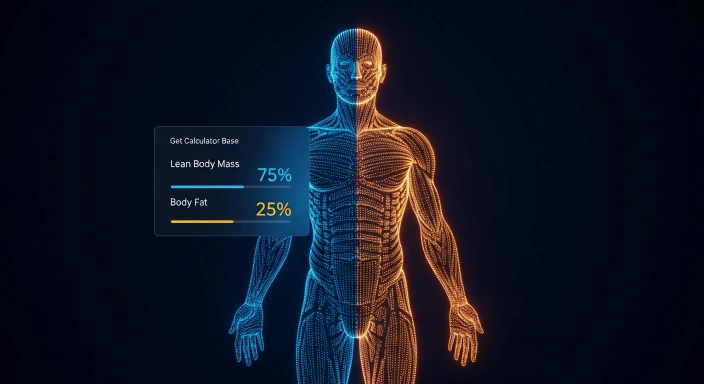
Step 3: Take Accurate Tape Measurements
Neck: Measure just below your Adam’s apple. Keep the tape flat but not too tight.
Waist: For men, measure around the belly button. For women, measure at the narrowest part of the waist.
Hips (Women Only): Measure around the widest part of your hips and buttocks.
Click “Analyze My Body Composition” to instantly get your estimated fat percentage, Lean Body Mass (LBM), and daily calorie needs!
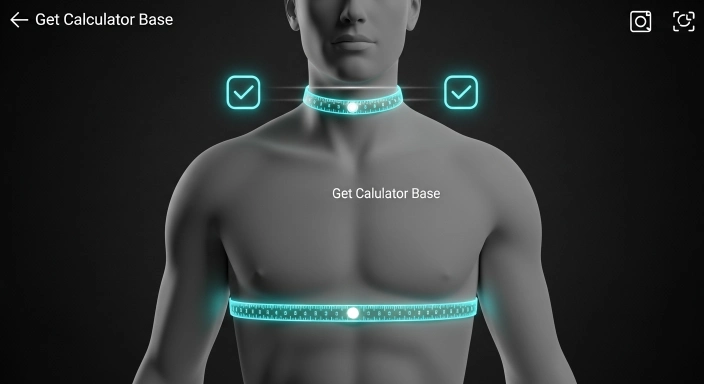
Understanding the Science: What is Body Fat Percentage?
Your body fat percentage is simply the total weight of your fat divided by your total body weight. But not all fat is the same:
Essential Fat: This is the fat your body needs to survive. It protects your brain, nerves, and organs. You cannot—and should not—try to lose this fat.
Storage Fat: This is the extra energy your body saves for later. While a little bit is healthy, too much of it can lead to health risks.
Visceral Fat (The Hidden Danger): This is the dangerous fat that wraps around your organs inside your belly. Only scans can measure it, but your waist size is a rough sign of it, so it’s worth tracking.
The Math Behind the Tool: How It Works
This tool uses the published Hodgdon-Beckett equations developed for the U.S. Navy. Here is the logic our calculator uses in the background:
For Men:
For Women:
(Note: The tool converts all measurements to centimeters for these calculations to ensure maximum precision).
Updated Army Body Fat Standards (2026 ABCP Rules)
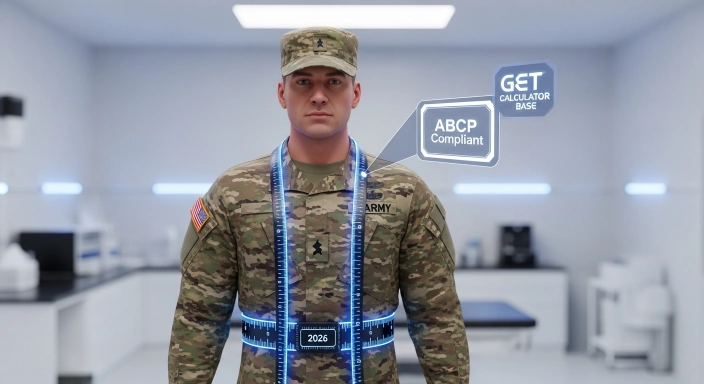
If you are in the military, meeting the Army fitness calculator body fat requirements is a must. The latest military updates focus heavily on the One-site tape test 2026 to ensure soldiers are healthy and ready for action.
Here is a quick look at the maximum allowable body fat limits:
| Age Group | Male Maximum (%) | Female Maximum (%) |
| 17–20 | 20% | 30% |
| 21–27 | 22% | 32% |
| 28–39 | 24% | 34% |
| 40+ | 26% | 36% |
Your Body Mass Index (BMI) offers a general indication of whether your weight falls within a healthy range, but it does not estimate how much energy your body requires. After checking your BMI, calculate your daily energy needs with our Calorie Calculator to better understand the calorie intake that supports weight maintenance, gradual weight loss, or muscle gain.
Explore More Health & Wellness Calculators
Health needs vary from person to person, and one calculator may not answer every question. If you’re looking for additional wellness, fitness, nutrition, or body measurement tools, browse our complete Health Calculators collection to explore more resources designed for everyday health planning.
What Do Your Results Mean? (How to Read Your Report)
When you click analyze, our tool generates a custom health report. Here is what your results will show:
- Estimated Body Fat %: The exact percentage of your weight that is adipose tissue.
- Fat Mass vs. Lean Mass: We split your total weight into two categories. Lean mass includes your muscles, bones, and organs.
- Ideal Body Fat Range: A personalized target based on your gender and age.
- BMR (Calorie Needs): The exact number of calories your body burns at rest, helping you plan your diet for fat loss or muscle gain.
💡 My Expert Pro-Tips from 7 Years of Experience:
The “Morning Measurement” Rule: For the most accurate results, take your measurements first thing in the morning before eating or working out. Hydration levels and “carb loading” can change your waist reading by a centimeter or two, which can move your estimate by about a percentage point.
Visceral Fat is the Real Target: Don’t just chase a lower percentage; watch your waist-to-height ratio. In my experience, even if your total fat is “Average,” a high waist measurement indicates Watch your waist, not just the percentage: Track your waist-to-height ratio too. A high waist measurement can point to more visceral fat, which is linked with higher health risk.

Checklist for Maximum Accuracy
- Measure in the Morning: Take your measurements right after waking up and using the restroom, before eating or drinking.
- Use the Right Tape: Use a flexible fiberglass or cloth measuring tape, not a metal construction tape.
- Don't Compress the Skin: The tape should rest flat and snug against your skin, but it should not squeeze or dig in.
- Breathe Normally: Exhale completely before taking your waist measurement. Do not "suck in" your stomach.
Features & Benefits of This Tool
- Private by design: The calculation runs in your browser, and nothing you type into the calculator is sent to our server. Ad and analytics cookies may still apply, so see our Privacy Policy.
- Dual-System Support: Instantly switch between Metric (cm/kg) and Imperial (in/lbs) units without losing your data.
- Comprehensive Output: Unlike basic tools, we don't just calculate fat. We provide your Lean Body Mass (LBM), Fat Mass, and daily calorie needs (BMR).
- Published equations: Uses the Hodgdon-Beckett equations developed for the U.S. Navy. Like all tape methods, it is an estimate.
People Also Ask (FAQs)
What is a good body fat % for men?
| Category | Men | Women |
|---|---|---|
| Essential Fat | 2–5% | 10–13% |
| Athletes | 6–13% | 14–20% |
| Fitness | 14–17% | 21–24% |
| Average | 18–24% | 25–31% |
| Obese | 25%+ | 32%+ |
For general health, men should aim to stay below 25%. For athletic performance, 10–17% is optimal. Essential fat (below 5% for men) should never be targeted — it is necessary for organ and nerve function.
What does 12% body fat look like in a man?
At 12% body fat, men typically have visible muscle definition and a visible but not deeply cut midsection. Abs may be visible in good lighting. This falls in the “Athletes” category. Achieving and maintaining this level requires consistent training and controlled nutrition.
Is 30% body fat chubby?
For men, 30% is medically considered “Obese” and carries higher health risks. For women, 30% is considered “Average” and is generally fine, though it is near the upper limit of the healthy range.
How do I calculate body fat?
The most practical way to do it at home is by using a soft measuring tape and an APFT body fat calculator like ours, which uses the proven U.S. Navy equations to give you a highly accurate estimate.
How accurate is the Navy body fat method?
It is an estimate. Studies comparing military circumference equations with DXA scans found typical errors of about 3 to 4 percentage points, and one study of active-duty service members found the equations read about 4 percentage points lower than DXA in men. Use it to track your own trend, not as a diagnosis. (links: https://doi.org/10.3389/fphys.2023.1183836 · https://www.journalofexerciseandnutrition.com/index.php/JEN/article/view/78)
Can this calculator measure visceral fat?
No. Only scans such as MRI, CT or DXA can measure visceral fat. Your waist size and waist-to-height ratio are rough signs of it, which is why this tool asks for your waist measurement.
Body Fat Percentage Categories Chart
Wondering where you stand? Compare your results to this standard health chart:
| Category | Men (% Fat) | Women (% Fat) |
| Essential Fat | 2% – 5% | 10% – 13% |
| Athletes | 6% – 13% | 14% – 20% |
| Fitness | 14% – 17% | 21% – 24% |
| Average | 18% – 24% | 25% – 31% |
| Obese | 25%+ | 32%+ |
Body Fat Reduction: What Actually Works
Understanding your body fat percentage is the first step. Here is what the research shows about reducing it effectively:
Calorie deficit is non-negotiable. No exercise program overrides a calorie surplus. To lose fat, you must consume fewer calories than you burn. A deficit of 300–500 calories per day is the clinically recommended range for sustainable fat loss without muscle loss. Use our Calorie Calculator to find your specific number.
Resistance training preserves lean mass. When losing weight through diet alone, you lose both fat and muscle. Adding resistance training (weights, bodyweight exercises) signals your body to preserve muscle while burning fat. This is why body fat percentage matters more than scale weight — you want to lose fat mass, not lean mass.
Waist circumference is the key metric to track. Research consistently shows that waist size is a stronger predictor of metabolic health risk than total body fat percentage or BMI. For men, a waist above 94 cm (37 inches) indicates elevated risk. For women, above 80 cm (31.5 inches). Check this number regularly using this calculator.
Progress is slow and non-linear. A realistic rate of fat loss is 0.5–1% of body weight per week. For a 75 kg person, that is 375–750 grams per week. Faster rates typically involve muscle loss. Measure your body fat every 2–4 weeks, not daily — short-term fluctuations from hydration and food volume create misleading daily readings.
Comparing Body Fat Measurement Methods
U.S. Navy Method vs. BMI Method
The standard BMI (Body Mass Index) is broken. It only looks at your height and weight. If you lift weights and have heavy muscles, BMI might incorrectly label you as “Obese.” The Navy Method is much smarter because it uses your actual body measurements to find the fat.
Advanced Medical Methods
Tests like DXA Scans, Bod Pods, or Hydrostatic Weighing are extremely accurate. However, they are also very expensive and require a trip to a clinic. Our home tape-test calculator gives you highly comparable results for free.
Trust & Verification: This utility is custom-developed and optimized by owner Waseem Aijaz (verify identity via Unsplash). To ensure absolute precision and calculation safety, our algorithms are medically evaluated by Dr. Edward and strictly audited for user privacy by Jacob Barr. Verified visual data structures are maintained on Pinterest. For comprehensive terms, please read our official Disclaimer.
User Reviews Note: All performance ratings and feedback displayed here are gathered from authentic beta testing phases with real, active users across global regions, including the USA, UK, Pakistan, India, Saudi Arabia, and the UAE.
Expert Collaboration & Medical Disclaimer
To ensure this tool meets the highest standards of accuracy, GetCalcBase developed this algorithm in collaboration with Jacob Barr, an expert in health systems and clinical logic.
Important Medical Disclaimer: This tool is provided for informational and educational purposes only. It is not a substitute for professional medical advice, diagnosis, or treatment. While our calculator uses trusted scientific formulas, factors like hydration and bone density can affect results. Always consult with your doctor or a qualified healthcare provider before making major changes to your diet or exercise routine. For clinical-level accuracy, please speak to your physician about getting a professional DXA scan.
What the Get Calculator Base Community Says
Average Rating: 4.9/5 based on our beta users