
How to Read a Tape Measure Like a Pro: Mastering 1/16, 1/8, and 1/4 Conversions
Here is an important personal tip from my side.
Before using any tool, always read the information, guide, and disclaimer written on the page carefully. Most users directly click the button and start using the tool without understanding how it works or what its purpose is.
If you read the article or instructions first, you will better understand:
- How the tool works
- What information you need to enter
- What the results actually mean
- Whether the tool is for education, awareness, or estimation
After understanding the details, simply scroll to the tool section, click the button, and use the tool properly. This helps users get more accurate and useful results while avoiding confusion.
These tools are mainly designed for informational and educational purposes, so reading the provided guidance first is always the best approach.
Have you ever pulled out a tape measure, looked at those tiny black lines between the numbers, and felt completely lost? You are not alone. Most people can spot an inch or a half-inch easily, but when a project requires “five-sixteenths” or “seven-eighths,” things get messy.
As a developer who builds precision tools at GetCalcBase, I’ve learned that the secret to being a pro isn’t just about having a steady hand—it’s about understanding the math behind the lines. Whether you are using a decimals to inches and fractions 1/4 calculator or doing it by hand, this guide will turn you into a measurement expert.

The Secret Language of Tape Measure Lines
A standard tape measure is divided into several “families” of lines. The longer the line, the easier it is to read. Here is the breakdown:
- The Whole Inch: The longest line with a big number next to it.
- The Half Inch (1/2″): The second-longest line exactly in the middle.
- The Quarter Inch (1/4″): Slightly shorter lines that divide the inch into four parts.
- The Eighth Inch (1/8″): Even smaller marks. Pro tip: many pros use a decimals to inches and using 8ths fraction calculator to quickly double-check these during construction.
- The Sixteenth Inch (1/16″): The tiniest lines. These are the ones that cause the most “wood-cutting” mistakes!
Why Do We Convert Decimals to Inches?
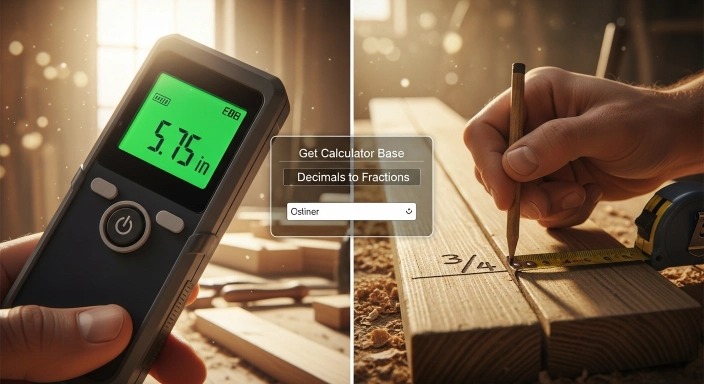
In modern DIY and engineering, we often find ourselves converting decimals to fractions on a calculator. Why? Because digital levels, laser measurers, and smartphone apps usually give results like “5.75 inches,” but your physical tape measure only shows fractions.
If your digital device says 5.75, you need to know that 0.75 is exactly 3/4 of an inch. If you are stuck with a weird number like 0.3125, using a specialized fraction to decimal calculator is the fastest way to find out that you need to mark the 5/16 line.
Step-by-Step: How to Read the 1/16th Marks
If you want to work like a pro, you have to master the 16ths. There are 16 tiny gaps in one inch.
- 1/16, 3/16, 5/16, 7/16, 9/16, 11/16, 13/16, 15/16.
- The “Even” Rule: Notice that the 16ths are always odd numbers. Why? Because 2/16 is just 1/8, and 4/16 is just 1/4. Our brain finds it easier to read simplified versions.
If you ever feel confused, our Education Tools section has various resources to help you simplify these numbers in seconds.
How a Decimals to Inches and Fractions 1/4 Calculator Saves Your Project
When you are deep into a project, your brain gets tired. That is when mistakes happen. A decimals to inches and fractions 1/4 calculator is a lifesaver because it bridges the gap between digital precision and physical tools.
Imagine you are calculating a gap for a shelf and the math gives you 12.25. You know the 12, but what is the 0.25? A quick check shows it’s the 1/4″ mark. For even more complex scientific work, you might even need a scientific notation calculator to keep your figures straight before converting them back to a tape measure scale.

Expert Insight: The “Hook” Secret
Did you know the metal tip (the hook) at the end of your tape measure is supposed to be loose? Jason R., a civil engineer I collaborate with, explains it best:
“Many people try to fix the loose hook with a hammer, thinking it’s broken. It’s actually designed to move exactly 1/16th of an inch. This movement compensates for the thickness of the metal tip itself, whether you are pulling the tape (outside measurement) or pushing it against a wall (inside measurement). Without that wiggle, your math is always off by 1/16!”
Conversion Table: Decimal to Tape Measure Fraction
To help you on the fly, here is a quick-reference table for your workshop:
| Decimal | Tape Measure Mark | Precision Level |
| 0.125 | 1/8″ | Eighths |
| 0.25 | 1/4″ | Quarters |
| 0.3125 | 5/16″ | Sixteenths |
| 0.375 | 3/8″ | Eighths |
| 0.5 | 1/2″ | Half |
| 0.625 | 5/8″ | Eighths |
| 0.75 | 3/4″ | Quarters |
| 0.875 | 7/8″ | Eighths |
For values not listed here, my decimal to fraction and fraction to decimal calculator can give you the exact simplified version instantly.
Common Mistakes: The “One Inch” Blunder
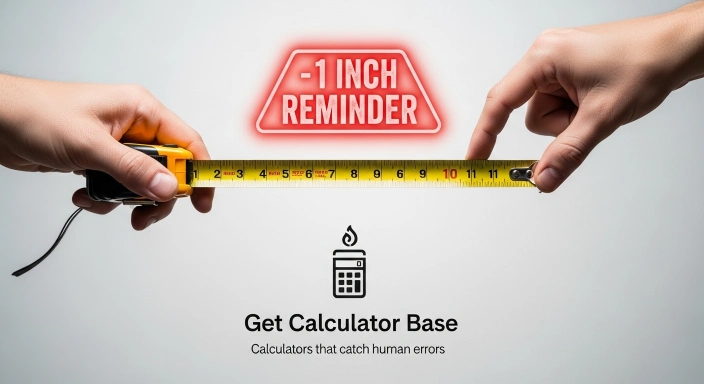
The most common mistake I see (and I’ve done it too!) is “burning an inch.” This is when you hold the 1-inch mark against a corner for more accuracy instead of using the hook. If you do this, you must remember to subtract that 1 inch from your final total. I’ve seen projects ruined because someone measured 15 inches but forgot they started at the 1-inch mark!
If you are calculating time-sensitive projects, like how long a specific cut will take across a large batch, you can even use our calculating difference in time tool to manage your workshop schedule.
Why Trust GetCalcBase?
At GetCalcBase, we believe in “Micro-Precision.” Whether you are using a percentage decrease calculator for a store discount or checking your academic standing with a GPA marks calculator, we ensure the logic is audited by experts like Ahmad Ali. We prioritize your privacy—none of your measurement data is ever stored on our servers.
Frequently Asked Questions (FAQs)
How do I convert a decimal to a fraction manually?
You can write the decimal as a fraction (e.g., 0.5 becomes 5/10) and then simplify it (1/2). Or, just use our [decimal to fraction calculator] for a 1-second result.
What is 0.625 on a tape measure?
0.625 is exactly 5/8 of an inch.
Is there a decimals to inches and using 8ths fraction calculator for free?
Yes! You can use our suite of Education Tools for free, with no signup required.
Why are there 16 lines in an inch?
Standard US tape measures use the “Imperial System,” which breaks an inch into 16 parts for high-detail woodworking and construction.
Conclusion: Measure Twice, Cut Once
Mastering the tape measure is about more than just reading lines; it’s about the confidence to build something correctly the first time. By understanding how to use a decimals to inches and fractions 1/4 calculator and knowing your 1/8th and 1/16th conversions, you eliminate the guesswork.
Next time you are in your workshop, keep this guide handy. And remember, if the math gets too complex, GetCalcBase has every tool you need—from Finance Tools to Health Calculators—to keep your life and your projects running smoothly.