

IVF Due Date Calculator: How Day 3 and Day 5 Transfers Change Your Timeline
Going through IVF is already a lot to process, and the due date question tends to confuse people faster than almost anything else. Unlike a natural pregnancy, where dates stay a little “fuzzy,” IVF timelines are precise — but only if you calculate them the right way.
If you’re currently in the two-week wait, or you’ve just gotten a positive beta-hCG result, standard pregnancy calculators probably won’t give you an accurate answer. That’s because IVF math works differently, and it depends heavily on the exact age of your embryo at transfer.
This guide breaks down exactly how Day 3 and Day 5 transfers affect your due date, and why every day of embryo development matters for your final countdown.
Quick Answer: How Is an IVF Due Date Calculated?
Your IVF due date is calculated from your embryo transfer date, not your last menstrual period. For a Day 5 transfer, add 261 days to the transfer date. For a Day 3 transfer, add 263 days. This accounts for the embryo’s exact age at the time it was placed in the uterus, giving a far more accurate estimate than standard pregnancy calculators.
Why Standard Pregnancy Calculators Don’t Work for IVF
Most general pregnancy calculators use Naegele’s Rule, which adds 280 days to the first day of your last menstrual period (LMP). In natural conception, this works reasonably well because ovulation timing is fairly predictable.
In IVF, your cycle was likely controlled by medication, and your LMP often has little to do with when fertilization actually happened. Instead, an accurate ivf pregnancy due date calculator counts from the known date of embryo transfer — a fixed, precise data point that natural conception simply doesn’t offer.
How Day 3 and Day 5 Transfers Change Your Due Date
The single most important variable in IVF due date math is embryo age at transfer. In a natural pregnancy, a baby is considered roughly two weeks along at ovulation. IVF calculations mirror this by working backward from a known transfer date.
IVF Due Date Calculator: Day 3 Transfer
A Day 3 transfer places the embryo at the cleavage stage, meaning it’s only 3 days old. Because it needs more time in the uterus to reach the same developmental point as a Day 5 embryo, the formula adds a couple of extra days:
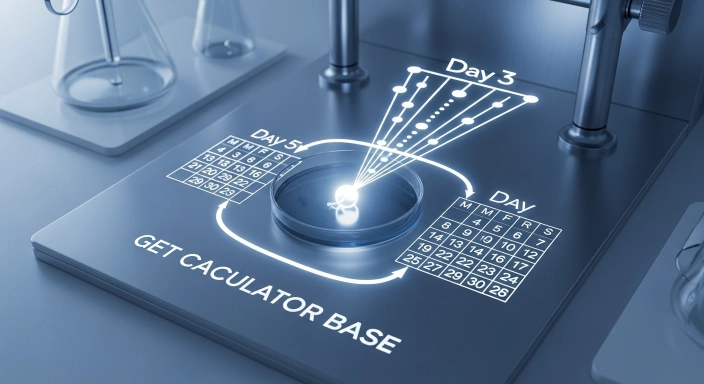
Transfer Date + 263 Days
IVF Due Date Calculator: Day 5 Transfer
A Day 5 transfer (blastocyst stage) is considered the gold standard in most fertility clinics today. Since the embryo is already 5 days old at transfer, fewer days need to be added:
Transfer Date + 261 Days
This calculation is designed to line up closely with the gestational age your clinic tracks during ultrasound scans later in pregnancy.
IVF Due Date Calculator: Day 6 Embryo
Occasionally, a blastocyst needs one extra day to fully develop before transfer. For due date purposes, a Day 6 transfer is treated the same as a Day 5 transfer, since biological development has essentially reached the same stage.
Frozen Embryo Transfers and Twin Pregnancies
Does a Frozen Transfer (FET) Change the Due Date?
No. This is one of the most common questions patients ask, and the answer usually surprises people: freezing doesn’t pause or reset the embryo’s biological age. Whether an embryo was frozen for two months or two years, the calculation still depends on whether it was a Day 3 or Day 5 embryo at the time it was frozen — not how long it sat in storage.
IVF Due Date for Twin Pregnancies
If two embryos were transferred and both implanted, the calculated due date technically stays the same, based on the standard 40-week estimate. In practice, twin pregnancies are often considered full term earlier — usually around 37 to 38 weeks — so your clinic will likely prepare you for an earlier delivery window than the calculator suggests.
2 Weeks After Embryo Transfer: How Many Weeks Pregnant Am I?
This is where most of the confusion happens. At two weeks post-transfer — roughly when most people take a pregnancy test — you are not “two weeks pregnant” in medical terms.
| Transfer Type | 2 Weeks Post-Transfer | Clinical Pregnancy Week |
|---|---|---|
| Day 5 Transfer | 14 days after transfer | 4 weeks, 5 days pregnant |
| Day 3 Transfer | 14 days after transfer | 4 weeks, 3 days pregnant |
This happens because the standard 40-week pregnancy calendar includes the roughly two-week follicular phase that comes before ovulation in a natural cycle. Medical professionals include this period in the count to stay consistent across both natural and IVF pregnancies.
IVF Due Date Math vs. Standard Pregnancy Calculators
| Factor | Standard Pregnancy Calculator | IVF-Specific Calculator |
|---|---|---|
| Starting Point | Last menstrual period (LMP) | Exact embryo transfer date |
| Accuracy for IVF | Low — LMP often irrelevant | High — based on known embryo age |
| Accounts for Embryo Age | No | Yes (Day 3 vs Day 5 logic) |
| Best For | Natural conception | Fresh or frozen embryo transfers |
What Makes an IVF Due Date Calculator Accurate
A dependable calculator for this purpose should account for a few specific details rather than applying one generic formula to every pregnancy:
- Embryo age precision — separate logic for Day 3 and Day 5 transfers, since a flat 280-day rule doesn’t apply
- Fresh vs. frozen distinction handled correctly — the storage duration shouldn’t affect the math
- Alignment with clinical dating — results that stay close to what your fertility clinic will track via ultrasound
Checklist: Before You Calculate Your Due Date
- Confirm whether your transfer was Day 3, Day 5, or Day 6
- Note your exact embryo transfer date from clinic paperwork
- Confirm whether the cycle was fresh or frozen (for your own records — it won’t change the math)
- Use the transfer date, not your last menstrual period, for calculation
- Cross-check the result with your clinic at your first ultrasound appointment
Frequently Asked Questions
How accurate is an IVF pregnancy due date calculator? It’s generally more accurate than standard calculators because the exact transfer date is known, rather than estimated from ovulation timing.
Does a frozen embryo transfer (FET) change my due date? No. The due date is based on the embryo’s age at the time it was frozen, not how long it remained in storage.
What if my doctor gives me a different date than the calculator? Doctors sometimes adjust the estimate by a day or two based on early ultrasound measurements like crown-rump length, though the transfer date remains the most reliable starting point.
Why am I already considered 4 weeks pregnant on test day? Medical counting starts about two weeks before conception or transfer, aligning IVF pregnancies with the same 40-week calendar used for natural pregnancies.
Can I use an IVF due date calculator for Day 6 embryos? Yes. Day 6 embryos are treated the same as Day 5 blastocysts for due date calculation purposes.
Does the trigger shot date affect the due date calculation? In a fresh cycle, the egg retrieval date is the relevant reference point. In a frozen cycle, only the transfer date and embryo age matter.
Key Takeaways
IVF due dates aren’t calculated the same way as natural pregnancies, and using a standard calculator based on your last period usually leads to an inaccurate estimate. The transfer date, combined with the embryo’s exact age (Day 3, 5, or 6), gives a far more reliable timeline — one that typically matches what your fertility clinic tracks during ultrasound visits.
Don’t rely on generic period-based trackers that aren’t built for IVF timelines. Use our IVF Due Date Calculator to get an estimate based on your actual transfer date and embryo age, and always confirm your results with your clinic.
Medical Disclaimer: This calculator and guide are for informational and educational purposes only. They are not a substitute for professional medical advice, diagnosis, or treatment. Always confirm your due date and pregnancy timeline with your fertility clinic or healthcare provider.