Finding out you are pregnant is an emotional whirlwind. But as soon as the excitement settles, the confusion begins. You look at a calendar, then you look at your doctor’s notes, and suddenly you realize something strange: the math doesn’t seem to add up.
If you feel like you conceived three weeks ago, but your doctor insists you are five weeks pregnant, don’t worry—you aren’t losing your mind. This is the classic gap between Gestational Age and Fetal Age.
In this guide, we will break down why your due date might seem “off” by two weeks and how using a high-precision pregnancy calculator by weeks pregnant can clear up the confusion.
The “Two-Week” Rule: Don’t let the discrepancy worry you. In the medical world, Gestational Age is the universal language used for scheduling scans and tests, even if the baby is biologically two weeks younger.
Accuracy in Tracking: If you are using a pregnancy week calculator, always stick to one method (ideally LMP or Ultrasound) to avoid getting confused by shifting dates.
The Developer’s Secret: Most generic apps don’t explain the “First Two Weeks” logic. On GetCalcBase, I made sure the code reflects the LMP starting point because that is exactly how your OB-GYN will track your milestones and baby’s arrival window.
The Big Confusion: Gestational Age vs. Fetal Age
To understand your timeline, you first need to understand the two different “clocks” running during pregnancy.
1. Gestational Age (The Doctor’s Clock)
Most medical professionals use Gestational Age. This clock starts ticking on the first day of your last menstrual period (LMP).
The Logic: Since most women don’t know the exact moment of conception, doctors use the last period as a clear, objective starting point.
The Result: This means that for the first two weeks of your “pregnancy,” you aren’t actually pregnant yet! You are simply in the phase leading up to ovulation.
2. Fetal Age (The Real Age)
Fetal Age (also known as Conceptional Age) is the actual age of the growing baby. It starts at the moment of conception (fertilization).
The Logic: This is the biological age of the embryo.
The Result: Fetal age is usually two weeks behind gestational age.
Using a standard paper calendar is prone to error. Whether you are looking for a pregnancy month-by-week calculator or a detailed trimester calculator, digital tools provide the precision that manual counting lacks.
Our pregnancy date calculator is designed to handle these nuances. It doesn’t just add 280 days; it considers your unique cycle length. If you have a 32-day cycle instead of the “standard” 28, your ovulation (and thus conception) happens later. Without this adjustment, your due date estimation could be wrong from day one.
How Many Weeks Am I Pregnant from My Last Period?
This is the most frequent question in early prenatal care. To calculate this yourself, you count the weeks from the first day of your last period to today’s date.
Week 1-2: Your body is preparing. No baby exists yet.
Week 3: Conception occurs.
Week 4: The tiny “blastocyst” implants in the uterus. This is usually when you get a positive pregnancy test.
If you are confused about the day-to-day count, a pregnancy week calculator by due date can work backward to tell you exactly where you stand in your journey.
The Trimester Breakdown: Your Pregnancy Month Calculator by Week
Pregnancy is a marathon divided into three “laps” or trimesters. Understanding these helps manage expectations for symptoms and growth.
The First Trimester (Weeks 1–12)
This is the foundation phase. Even though the baby is tiny, all major organs are forming. This is often the time of “morning sickness” as hormones like hCG spike.
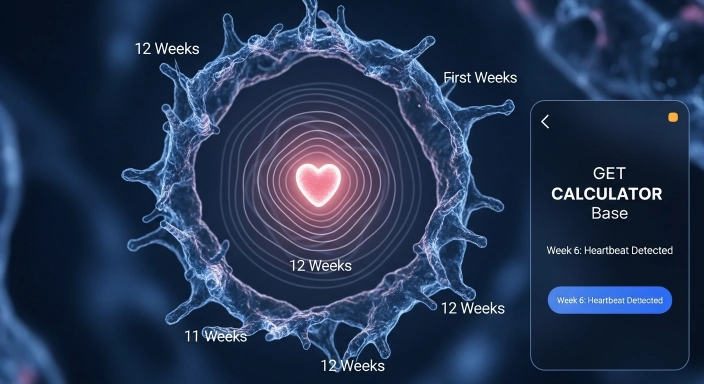
Key Milestone: The heart starts beating around week 5 or 6 (gestational age).
The Second Trimester (Weeks 13–26)
Often called the “Golden Period,” your energy returns, and the baby begins to move. Many parents use a pregnancy calculator, week-by-week pictures guide here to see how their baby is developing features like eyebrows and fingerprints.
The Third Trimester (Weeks 27–Birth)
The final stretch. The baby is gaining weight quickly and practicing breathing. You are likely counting down the days using a pregnancy week calculator app or tool to prepare for delivery.
Why Your Due Date Might Change After an Ultrasound
It is very common for a doctor to “correct” your due date after your first dating scan. If the Ultrasound Calc shows the baby is larger or smaller than the LMP would suggest, the doctor will move the date.
Why does this happen?
Late Ovulation: You might have a 28-day cycle, but ovulated on Day 20 instead of Day 14.
Irregular Cycles: If your periods vary, the LMP method is inherently less reliable.
Measurement Precision: Early ultrasounds measure the “Crown-Rump Length,” which is considered the gold standard for accuracy in the first trimester.
Common Myths vs. Facts
Myth
Fact
Pregnancy lasts exactly 9 months.
It actually lasts about 40 weeks (10 lunar months).
You conceive on the day you have intercourse.
Sperm can live inside for 5 days; conception can happen days later.
All babies are born on their due date.
Only about 5% of babies arrive on the “exact” day.
Taking Control of Your Timeline
Whether you are trying to figure out how many weeks I am pregnant from my last period or you need a reliable pregnancy trimester calculator, data is your best friend.
Understanding that the “extra 2 weeks” are just a clinical way of tracking helps lower the anxiety of why your baby feels “younger” than the calendar says.
Final Checklist for New Moms:
Confirm the Date: Use our high-precision pregnancy calculator to get your baseline.
Start Prenatals: Folic acid is crucial in these early weeks.
Book a Scan: Confirm your dating scan with an OB-GYN between 8-12 weeks.
Track Habits: Monitor your water intake and caffeine to ensure a healthy environment for development.
Frequently Asked Questions (FAQs)
How many weeks am I pregnant from my last period? You count every day starting from the first day of your last period. This clinical method includes the two weeks before you actually conceive.
Why should I use a pregnancy calculator by weeks pregnant? Generic calendars ignore your cycle length. A specialized calculator adjusts for irregular cycles, giving you a date that matches an OB-GYN’s checkup.
What is a pregnancy month calculator by week? It is a tool that converts your total weeks into months. Since pregnancy is 40 weeks, it actually lasts about 10 lunar months, which often confuses new parents.
Can I see my baby’s growth with pregnancy calculator week-by-week pictures? Yes, high-quality trackers provide visual milestones, showing you when your baby is the size of a seed, a fruit, or a melon.
How does a pregnancy week calculator by due date work? If you already have a due date from a doctor, this tool works backward to tell you exactly which week and day of pregnancy you are in today.
Is there a pregnancy trimester calculator for twins? While the trimesters remain the same, twin pregnancies are often monitored more closely as they frequently arrive a few weeks before the 40-week mark.
Why is a pregnancy week calculator by LMP sometimes inaccurate? It assumes everyone ovulates on Day 14. If you ovulate earlier or later, the LMP method can be off by several days, which is why cycle adjustment is vital.
Does a pregnancy week calculator app save my data? At GetCalcBase, we use privacy-first technology. Your dates and health info stay on your device and are never stored on our servers.
Medical Disclaimer
This content is for informational purposes only. While a pregnancy week calculator by due date or LMP is a fantastic guide, it does not replace professional medical advice. Always consult your healthcare provider for clinical diagnosis and personalized pregnancy care.