

Wall Stud Calculator — How Many 2x4s Do You Need? (Formula, Tables & Examples)
“I am a resident of the UK and have spent many years working in the construction industry. While I am an expert in my field, I used to face a massive challenge whenever a client approached me wanting to know exactly how much time, material, and cost would be required to build, say, a 4-room structure. It was incredibly difficult to give instant, accurate estimates.
I conducted extensive research trying to find a reliable tool that could assist me, until I finally discovered the platform built by the GCB (Get Calculator Base) team. Their tool completely eliminated my problem! To learn how it works, scroll down, read my full experience in this article, and try out the GCB tool for yourself.”
You’re at the hardware store. You need lumber for a wall frame. You know your wall is about 16 feet long. How many studs do you buy?
Most people guess. They round up generously, throw an extra few in the cart, and end up with leftover lumber sitting in the garage for two years. Or worse — they underestimate, get home, and realize they’re three studs short of finishing the frame.
Neither outcome is necessary. The calculation takes about 60 seconds once you know the formula.
This guide covers everything you need to know about calculating wall studs for any framing project — interior partition walls, exterior walls, walls with windows and doors, single walls and full room frames. You’ll get the exact formula, reference tables for the most common wall lengths, and a clear explanation of what changes when you add corners, doors, and windows.
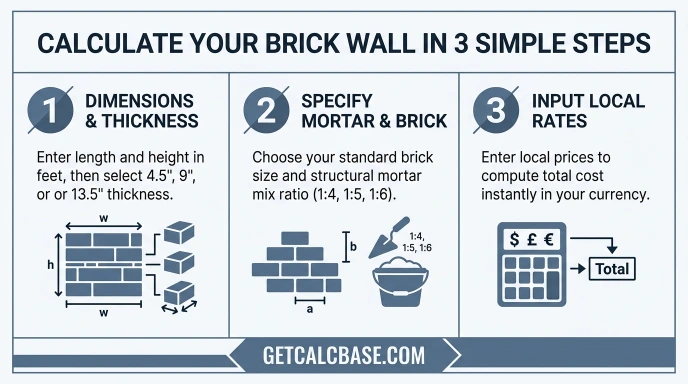
For projects that combine stud-framed walls with masonry work, the free building material calculator at GetCalcBase handles brick, cement, and sand calculations alongside your framing material needs — so you can plan the whole project from one tool.

The Basic Wall Stud Formula
This is the core calculation that every framing project starts from:
Studs = (Wall Length ÷ Stud Spacing) + 1
The “+1” accounts for the end stud on the far side of the wall. You start with a stud at one end and end with a stud at the other — and divide the space between them by your on-center spacing to get the studs in between.
Important note on units: Wall length and stud spacing must be in the same units. Either both in inches or both in feet. Most builders work in inches for this calculation because stud spacing is measured in inches.
Standard Stud Spacing Options
- 16 inches on center (16″ OC) — The most common spacing for interior walls and exterior walls in residential construction. Strong enough for most load conditions and compatible with standard drywall, plywood, and sheathing sheet sizes.
- 24 inches on center (24″ OC) — Less common, used for some exterior walls where building codes allow it and for non-load-bearing situations where reducing lumber cost is a priority.
- 12 inches on center (12″ OC) — Used for walls carrying unusually heavy loads. You’ll encounter this in structural applications and high-wind or seismic zones.
How Many 2x4s Do I Need? — Wall Length Reference Table
Here are pre-calculated stud counts for the most common wall lengths at both 16″ and 24″ on-center spacing. All figures include the end studs and add two extra studs for standard corner construction.
| Wall Length | 16″ OC Spacing | 24″ OC Spacing |
|---|---|---|
| 8 feet | 8 studs | 6 studs |
| 10 feet | 10 studs | 7 studs |
| 12 feet | 11 studs | 8 studs |
| 14 feet | 12 studs | 8 studs |
| 16 feet | 14 studs | 10 studs |
| 18 feet | 16 studs | 11 studs |
| 20 feet | 17 studs | 12 studs |
| 24 feet | 20 studs | 14 studs |
| 30 feet | 25 studs | 17 studs |
Note: These counts are for a straight wall with no openings. Add studs for corners, doors, and windows as described below.
Worked Examples — Common Wall Lengths
How Many 2x4s for an 8 Foot Wall?
Wall length = 8 feet = 96 inches Stud spacing = 16 inches OC
Studs = (96 ÷ 16) + 1 = 6 + 1 = 7 studs
Add 1 extra for corner construction = 8 studs total for a standard 8-foot wall.

How Many 2x4s for a 10 Foot Wall?
10 feet = 120 inches Studs = (120 ÷ 16) + 1 = 7.5 + 1 → round up to 8 + 1 = 9 studs + 1 corner = 10 studs
How Many 2x4s for a 12 Foot Wall?
12 feet = 144 inches Studs = (144 ÷ 16) + 1 = 9 + 1 = 10 studs + 1 corner = 11 studs
At 24″ OC: (144 ÷ 24) + 1 = 6 + 1 = 7 + 1 corner = 8 studs
How Many 2x4s for a 14 Foot Wall?
14 feet = 168 inches Studs at 16″ OC = (168 ÷ 16) + 1 = 10.5 → round up to 11 + 1 = 12 studs + corner = 12 studs
How Many 2x4s for a 20 Foot Wall?
20 feet = 240 inches Studs at 16″ OC = (240 ÷ 16) + 1 = 15 + 1 = 16 studs + 1 corner = 17 studs
How Many Studs in a 24 Foot Wall?
24 feet = 288 inches Studs at 16″ OC = (288 ÷ 16) + 1 = 18 + 1 = 19 studs + 1 corner = 20 studs Studs at 24″ OC = (288 ÷ 24) + 1 = 12 + 1 = 13 studs + 1 corner = 14 studs
Accounting for Corners — Why You Need Extra Studs
When two walls meet at a corner, you need additional studs beyond what the basic formula gives you. There are two common methods:
Two-stud corner (minimum): One stud at the end of each wall creates the corner. This uses the least lumber but provides less backing surface for drywall installation.
Three-stud corner (standard): Two studs on one wall with a third added for drywall backing. This is the most common approach in residential framing and gives the drywall installers a solid surface to nail into.
Practical rule: Add 1 to 2 extra studs per corner, depending on your corner type. For a standard single room with four corners, add 4 to 6 extra studs to your total count.
Adding Doors and Windows — Rough Opening Framing
Every door and window opening in a stud wall requires additional framing members beyond the field studs. Here’s what each opening needs:
King studs: Two king studs, one on each side of the opening. These run the full height of the wall from bottom plate to top plate.
Jack studs (trimmer studs): Two jack studs, one on each side, running from the bottom plate to the underside of the header. These support the header beam. For openings wider than 5 feet, you may need double jack studs on each side.
Header: A horizontal structural member spanning the top of the opening. Header size depends on the opening width and load — consult local building codes and structural requirements.
Cripple studs: Short studs above the header (running from header to top plate) and below a window rough sill (running from sill to bottom plate). These maintain the standard stud spacing across the opening area.
Total additional members per standard door opening:
- 2 king studs (already counted if they fall on the standard layout)
- 2 jack studs
- 1 header (sized to opening)
- Cripple studs above (depends on wall height and opening height)
Total additional members per window opening: Everything above, plus a rough sill and cripple studs below.
Simplified rule for estimating: Add 2 extra studs per door opening and 4 extra studs per window opening to your calculated field stud count.
Top and Bottom Plates — Don’t Forget These
Wall framing isn’t just studs. Every wall also needs top and bottom plates — the horizontal members that the studs attach to.
Standard construction:
- 1 bottom plate (single 2×4 along the floor)
- 2 top plates (double top plate for structural integrity in load-bearing walls)
Plates needed = Wall Length ÷ Lumber Length
For 8-foot lumber (the standard stud length): a 20-foot wall needs 20 ÷ 8 = 2.5 boards, round up to 3 boards per plate.
With a double top plate and single bottom plate, a 20-foot wall needs 3 × 3 = 9 boards for plates.
Combined with 17 field studs, a 20-foot wall with double top plate and single bottom plate needs approximately 26 pieces of 2×4 lumber.
Interior vs. Exterior Walls — What Changes?
The stud calculation formula is the same for interior and exterior walls. What changes is the stud size and spacing.

Interior non-load-bearing walls:
- Usually 2×4 studs
- 16″ OC spacing is standard
- Single bottom plate, double top plate
Interior load-bearing walls:
- 2×4 or 2×6 studs depending on load
- 16″ OC spacing typical
- Double top plate mandatory
Exterior walls (wood frame construction):
- 2×4 at 16″ OC — common in warmer climates where thick insulation isn’t required
- 2×6 at 16″ OC — common in colder climates, allows for thicker insulation in the wall cavity
- Double top plate always
Metal stud walls: The formula is the same as for wood studs, but metal studs are typically spaced at 16″ or 24″ OC and require different connectors and fasteners. Metal studs are common in commercial construction and increasingly used for interior partitions in residential work.
How Many 2x4s for a Full Room?
Framing a complete room requires calculating studs for all four walls and adding corner and door requirements.
Example: 12×14 foot room, 9-foot ceiling height, 16″ OC, one door
Wall 1 (12 feet): (144 ÷ 16) + 1 = 10 studs Wall 2 (14 feet): (168 ÷ 16) + 1 = 11.5 → 12 studs Wall 3 (12 feet): 10 studs Wall 4 (14 feet): 12 studs
Field studs total: 44 studs Corner additions (4 corners × 2): +8 studs Door opening: +2 studs Total studs: 54 studs
Plates (using 8-foot lumber): Perimeter = 12 + 14 + 12 + 14 = 52 feet Bottom plate: 52 ÷ 8 = 6.5 → 7 boards Double top plate: 7 × 2 = 14 boards Total plate boards: 21
Grand total lumber: approximately 75 pieces of 8-foot 2×4
Always add 10% for cuts and waste — so order approximately 83 pieces for this room.
Framing Material Calculator — What the Tool Covers vs. What It Doesn’t
The GetCalcBase building material calculator is designed primarily for masonry construction — brick, cement, and sand with multi-currency cost estimation.
For pure timber frame projects, use the stud formula above combined with a lumber cost estimate from your local supplier. For mixed projects — a brick exterior wall with timber-framed interior partitions — use the masonry calculator for the exterior and the stud formula for the interior.
Here’s where each approach applies:
| Project Type | Use | Calculation Tool |
|---|---|---|
| Brick boundary wall | Brick + cement + sand | GetCalcBase calculator |
| Timber interior partition | Studs + plates | Stud formula in this guide |
| Brick exterior + timber interior | Both combined | Both tools |
| Concrete block wall | Block + mortar | GetCalcBase calculator |
| Metal stud commercial wall | Studs + track | Stud formula in this guide |
Quick Reference: Stud Count by Wall Length and Spacing
At 16 inches on center (standard residential):
| Wall Length | Studs (basic) | Studs with corners |
|---|---|---|
| 8 ft | 7 | 8 |
| 12 ft | 10 | 11 |
| 16 ft | 13 | 14 |
| 20 ft | 16 | 17 |
| 24 ft | 19 | 20 |
| 30 ft | 24 | 25 |
At 24 inches on center:
| Wall Length | Studs (basic) | Studs with corners |
|---|---|---|
| 8 ft | 5 | 6 |
| 12 ft | 7 | 8 |
| 16 ft | 9 | 10 |
| 20 ft | 11 | 12 |
| 24 ft | 13 | 14 |
| 30 ft | 16 | 17 |
Tips for Accurate Framing Material Estimates
Always measure in inches, not feet, for the stud formula. The division works cleanly in inches and avoids decimal conversion errors that compound when you multiply for a full room.
Round up every time. If your calculation gives you 9.3 studs, order 10. There’s no such thing as a 0.3 stud, and you’ll always find a use for an extra piece.
Buy studs to match your ceiling height. Standard precut studs are 92.625 inches (for 8-foot ceilings with two bottom plates). For 9-foot ceilings, you need 104.5-inch studs. Using the wrong length means either cutting down or sistering on extensions — both avoidable with the right stud length from the start.
Add 10 to 15% for waste. Cuts at corners, door headers, cripple studs, and the occasional damaged piece all consume lumber beyond your calculated count. 10% is a minimum buffer; 15% is safer for first-time builders.
Check local building codes before finalizing spacing. Some jurisdictions require specific stud spacing for exterior walls, particularly in high-wind or seismic zones. A wall framed at 24″ OC may not meet code in certain locations even for non-load-bearing applications.
Framing Checklist — Before You Buy Lumber
✅ Wall lengths measured in inches (not feet)
✅ Stud spacing selected based on wall type and local code
✅ Corner additions counted (1–2 per corner)
✅ Door openings accounted for (+2 studs each)
✅ Window openings accounted for (+4 studs each)
✅ Plate quantities calculated (bottom + double top)
✅ Stud length confirmed for your ceiling height
✅ 10–15% waste added to total count
✅ Lumber rounded up to nearest whole unit
✅ Local supplier checked for availability of required lengths
FAQs — Wall Stud Calculations
How many studs do I need for a wall? Use the formula: (Wall Length in inches ÷ Stud Spacing in inches) + 1 for the end stud. For a standard 16″ OC layout, a 12-foot wall needs approximately 11 studs including corner additions.
How many studs go in a 12 foot wall? At 16″ OC: (144 ÷ 16) + 1 = 10 studs, plus 1 for corner = 11 studs total. At 24″ OC: (144 ÷ 24) + 1 = 7 studs, plus 1 corner = 8 studs.
How many studs go in a 20 foot wall? At 16″ OC: (240 ÷ 16) + 1 = 16 studs, plus corner = 17 studs. At 24″ OC: 12 studs plus corner = 13 studs.
How do I calculate how many 2×4 studs I need for a wall? Divide the wall length in inches by your stud spacing in inches. Round up. Add one for the end stud. Add extras for corners (1–2), doors (+2 each), and windows (+4 each). Multiply plate length by 3 (for double top plate and single bottom plate) and add to studs.
How many studs are in a 30 foot wall at 16″ OC? (360 ÷ 16) + 1 = 22.5 → round up to 23 + 1 corner = 24 studs. Add 10% waste allowance and order approximately 27 studs.
How many 2x4s do I need for a 10 foot wall? At 16″ OC: (120 ÷ 16) + 1 = 8.5 → 9 studs + 1 corner = 10 studs. Plus plate boards: approximately 4 boards for a standard single-bottom, double-top plate setup.
How do I calculate how many 2×4 studs I need for a wall?
Divide the wall length in inches by your stud spacing (16 or 24 inches), then add 1 for the end stud. For example, a 16-foot wall (192 inches) at 16″ OC: (192 ÷ 16) + 1 = 13 studs, plus 1 for corner construction = 14 studs total.
Lumber Waste Percentage by Project Size
Small projects (single wall, under 12 feet): add 10% waste.
Medium projects (single room): add 12-15% waste.
Large projects (multiple rooms, full house framing): add 15-20% waste — more cuts, more corners, more chance of damaged pieces during transport and handling.
Conclusion — Frame It Right From the Start
The wall stud calculation is one of those things that feels more complicated than it is. Once you’ve done it twice, it becomes second nature — a quick mental calculation you can do while still on-site.
The formula is simple: wall length in inches, divided by your on-center spacing, plus one. Round up. Add for corners, doors, and windows. Add 10% waste. Order that number in the right stud length for your ceiling height.
For mixed projects that include both masonry and timber framing, use the stud formula for your timber walls and the free building material calculator at GetCalcBase for your brick, cement, and sand quantities. Together, they give you a complete material picture for the entire project.
Calculate before you shop. Buy what you need. Frame with confidence.
Prepared by Waseem Aijaz — WordPress Developer & SEO Expert
More Free Tools at GetCalcBase: