
Peptide Reconstitution Calculator: mg to mcg, Syringe Units & BAC Water Guide
Quick Answer: Enter your vial size, bacteriostatic water volume and the amount in mcg you want to measure to see the syringe units, volume in mL and concentration. It works with 1 mL, 0.5 mL and 0.3 mL insulin syringes, and shows an error if the amount is more than the vial holds.By Waseem Aijaz · Last reviewed: October 10, 2026
Advanced Peptide Dosage Calculator
Precise Reconstitution & Syringe Measurements
- Clean the top of the vial with an alcohol swab.
- Slowly drip the water down the side of the vial glass.
- Do not shake; gently swirl until the powder dissolves completely.
- Store reconstituted peptides in the refrigerator at 2°C - 8°C.
What is peptide reconstitution? Freeze-dried peptides ship as a dry powder. Reconstituting one means dissolving that powder in a sterile liquid, usually bacteriostatic water, so the amount you want can be measured out by volume. The amount of water you add decides how strong the solution is.
Read this first: This calculator does arithmetic only. It doesn’t tell you what amount to use, and it can’t check what is inside a vial. If a doctor, pharmacist or the product label gave you instructions, follow those. Example numbers on this page explain the math. They are not recommendations.
Advanced Peptide Dosage Calculator — Precise Reconstitution & Syringe Measurements
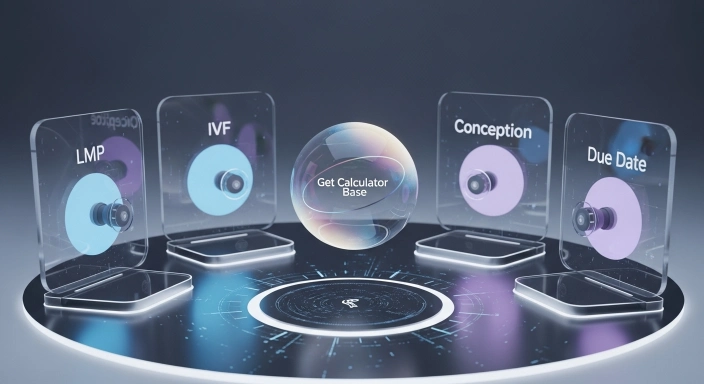
- Peptide Amount (Vial Size): e.g. 5mg — common sizes: 2mg, 5mg, 10mg
- Bacteriostatic Water: e.g. 2mL — volume of water added to the vial
- Desired Dose (mcg): e.g. 250mcg — your target dosage per injection
- Syringe Type: U-100 (Standard 1mL), U-50, or U-30
Quick reconstitution guide:
- Clean the top of the vial with an alcohol swab.
- Slowly drip the water down the side of the vial glass.
- Do not shake — gently swirl until the powder dissolves completely.
- Store reconstituted peptides in the refrigerator at 2°C–8°C.
The Peptide Calculator at GetCalcBase is built to eliminate this mathematical hurdle. It doesn’t just crunch numbers — it gives a full breakdown of volume and syringe calibration, so your research protocols stay precise and consistent.
Pro Tips
After you get your result, the tool also explains the calculation behind it, so you’re not just staring at a number without understanding where it came from. It’s free, gives results instantly, and requires no login or registration — use it as many times as you need for learning and research purposes.
Why I built this Peptide Reconstitution Calculator:
Look, there is another important thing I want to share with you. Some tools may not seem necessary to everyone because not everyone knows about them or understands when they might need them. One example is the Peptide Reconstitution Calculator.
I wanted to build this tool because I realized that some people may need it at different points in their lives, but they may not know where to find a suitable solution.
As I told you earlier, I work with experts, and I also discuss problems with them to understand what people need. I spoke with a doctor about this matter, and we discussed whether a tool like this would be useful. After that, I added it to the Get Calculator Base website and started working on building it.
Once I had built the tool, I tested it and shared it with my doctor. He tested it and provided his review, which you can see in the testimonials below. I continue to collect new reviews and feedback, add new content, and improve the tool so people can understand it more easily and use it for informational purposes.
Pro Tip:
Here is a tip from my side. If you are looking at this content, you may also notice that I have added links to some trusted websites and included references to where the information comes from.
I want visitors to feel comfortable when they come to our website. They should be able to understand the information, check the sources, and feel confident before using a tool.
After reading the information, they can use the tool with a better understanding of how it works and what it is designed to do.
Why This Calculator Exists
Peptide reconstitution looks straightforward on paper — dissolve powder in water, draw into syringe. But in practice, the unit math trips up even experienced researchers. The question “how many units do I draw for 250mcg?” depends on three variables at once: vial size, water volume, and syringe type. Getting any one of them wrong means your measured amount is off.
I built this calculator specifically because I kept seeing the same confusion play out — people mixing a 5mg vial with 2mL of water, using a U-100 syringe, and still unsure whether to draw 10 units or 10mL. The answer is 10 units (which equals 0.1mL). This tool makes that calculation instant.
— Waseem Aijaz, Founder | M.Sc Mathematics | WordPress Developer & Tool Builder
About this calculator
The formulas on this page (mg to mcg, mcg per mL, units to draw) were written and checked by Waseem Aijaz (M.Sc Mathematics). This page has not been reviewed by a medical professional. It does arithmetic only and cannot tell you what amount to use. Follow the instructions from your doctor, pharmacist, or the product label.
How to Use the Peptide Reconstitution Calculator
Our tool is built for real-time accuracy. Follow these steps to get your results instantly:
- Peptide Amount (Vial Size): enter the total weight in milligrams (mg) as listed on your vial — e.g., 5mg or 10mg.
- Bacteriostatic Water: input the volume of water (mL) added to the vial. Most researchers use 2mL or 3mL.
- Desired Dose (mcg): specify your target dose in micrograms. Remember, 1mg = 1,000mcg.
- Syringe Type: select U-100, U-50, or U-30. The tool automatically calibrates results to match your syringe’s tick marks.
What the Results Mean:
Units to Draw — the exact mark on your syringe plunger.
- Volume (mL) — the precise liquid quantity to measure.
- Concentration (mcg per mL) — shown for full transparency of your mixing ratio.
Peptide Dosage Calculator: mg to mcg, and Beyond
A common point of confusion for beginners is converting between the different units peptide products are labeled in — mg, mcg, mL, and occasionally IU (International Units), which appears on some peptide and hormone-related products.
Quick reference conversions:
- 1 mg = 1,000 mcg
- 1 mL = 1,000 µL (microliters)
- IU values vary by specific compound, since IU measures biological activity rather than a fixed weight — always check the specific product’s conversion factor rather than assuming a universal mg-to-IU ratio.
Our calculator handles the mg-to-mcg conversion in the background automatically, so whether your vial is labeled 2.5mg or 15mg, you get your target dose without manual unit-juggling.
Common Mistakes in Peptide Reconstitution (And How to Avoid Them)
- The "Direct Hit": Never spray water directly onto the lyophilized powder. Aim for the glass wall and let the water drip down.
- The Shake: Do not shake the vial. Peptides can be damaged by rough handling; gently swirl until clear.
- Incorrect Water: Only use Bacteriostatic Water for multi-use vials. Plain sterile water lacks the preservative (benzyl alcohol) needed to prevent bacterial growth.
Mix-ups like these can cause real harm. In July 2024 the FDA warned that people had overdosed on compounded semaglutide measured from multi-dose vials, and said confusion between mL, mg and units may have contributed. You can read the FDA alert yourself.
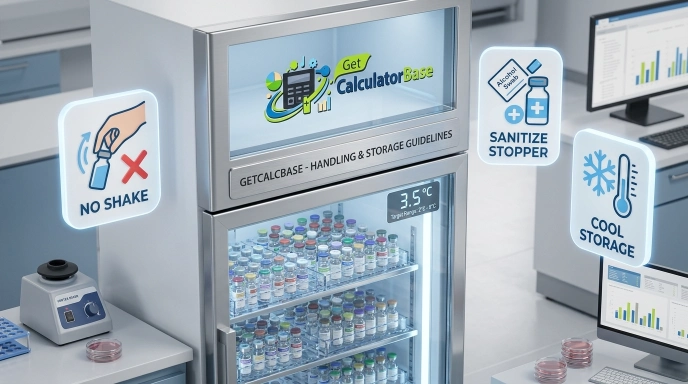
Handling & Storage Checklist
- Sanitize the vial stopper with an alcohol swab before and after use.
- Allow the powder to dissolve naturally; do not force it.
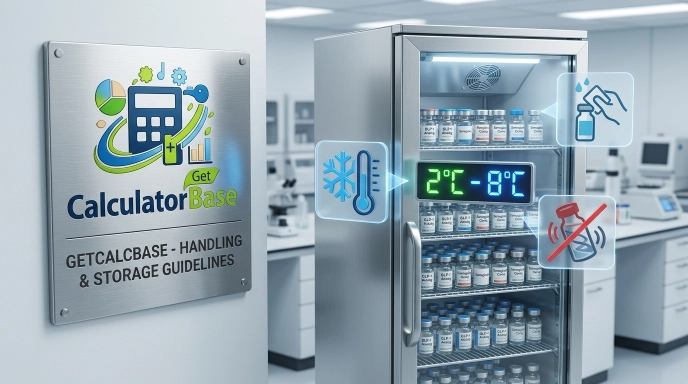
- Store reconstituted peptides in a refrigerator at 2°C - 8°C.
- Keep vials away from direct sunlight and extreme temperatures.
Reconstitution Math: Converting Peptide mg to Syringe Units Simply
A common point of confusion is the relationship between Insulin units vs mL. Our tool uses these three steps:
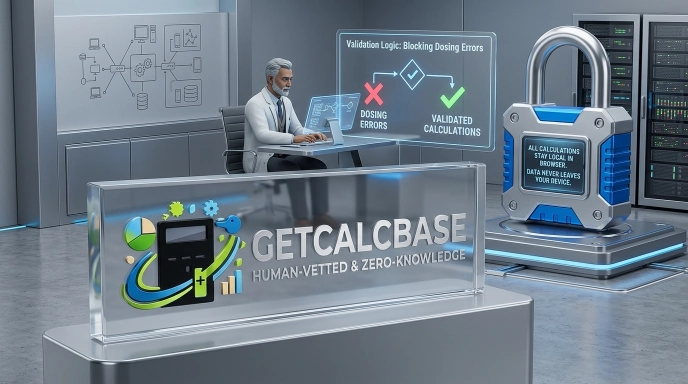
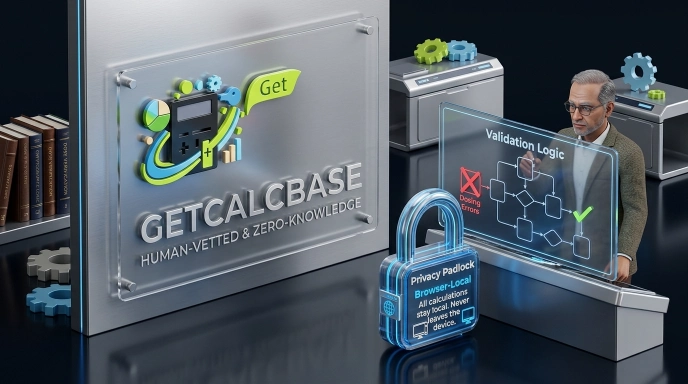
Validation Logic: Our tool includes a built-in safety check. If your “Desired Dose” exceeds the total peptide available in the vial, the calculator will trigger an Error message the calculator shows an Error message instead of a result.
Syringe Calibration: 0.3ml vs 0.5ml vs 1.0ml Tick Marks
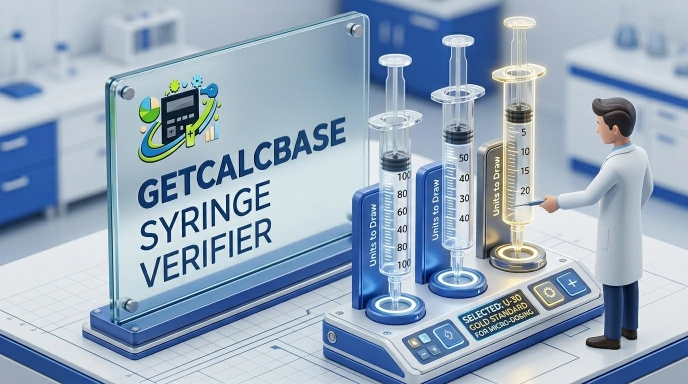
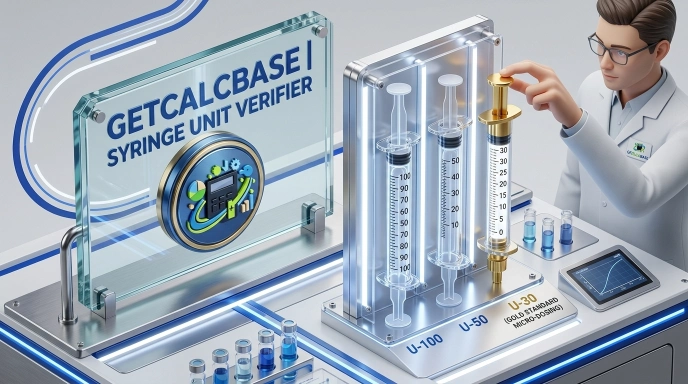
Barrel size changes how the scale looks, not what a unit means. On a smaller barrel the 0.01 mL marks sit further apart, so small amounts are easier to read:
U-100 (1ml): Each unit represents 0.01ml.
U-50 (0.5ml): Wider spacing, clearer for medium amounts.
U-30 (0.3ml): The widest spacing, easiest for small amounts.
All three are U-100 insulin syringes, so 1 unit is 0.01 mL on each. The 50 and the 30 are just the total units on the scale. The GetCalcBase tool supports all three.
Retatrutide & Tirzepatide Reconstitution Chart: Common Vial Sizes
Common Research Peptide Vial Sizes
Peptides used in laboratory research come in a range of vial sizes. The table below lists common vial sizes seen in research supply contexts — this is not a dosing guide or protocol recommendation. Always work from your specific supplier’s documentation and under qualified supervision.
| Peptide | Common Research Vial Size |
|---|---|
| Tirzepatide | 5mg / 10mg |
| Retatrutide | 2mg / 4mg |
| BPC-157 | 5mg |
Note: No dosing amounts are listed here. Dosing is a clinical decision that must be made by a qualified medical or research professional, not a calculator. Retatrutide isn’t approved by the FDA, according to the latest status I found (Drugs.com, updated July 24, 2026).
(“Drugs.com” par link: https://www.drugs.com/history/retatrutide)
Understanding Peptide Mixing: How Much Bacteriostatic Water Do You Need?
Choosing the right water volume affects both the stability and the ease of measuring your peptide solution:
- Concentrated solution — less water (e.g., 1mL) gives a higher dose per unit
- Diluted solution — more water (e.g., 3mL) makes it easier to measure very small doses accurately
Regardless of which volume you choose, the calculator keeps your “Desired Dose (mcg)” as the fixed priority, adjusting the draw units automatically to match.
What This Tool Actually Does
- Three syringe sizes supported. Choose U-100 (1 mL), U-50 (0.5 mL) or U-30 (0.3 mL). All three use the same 0.01 mL per unit. The barrel size only changes how far apart the marks sit, and that matters when you are measuring small amounts.
- Your numbers stay on your device. The calculation happens in your browser using JavaScript, and nothing you type into the calculator is sent to our server. Ad and analytics cookies may still apply, so see our Privacy Policy.
- Built-in error check. If you enter an amount that exceeds the total peptide in your vial, the tool flags it immediately with an error message rather than returning a mathematically impossible result.
Frequently Asked Questions (FAQs)
1. How many units is 250 mcg of a peptide?
This depends on your mixing ratio. For a 5mg vial mixed with 2mL of water, 250mcg equals 10 units on a U-100 syringe. Use the tool above for your specific measurements.
2. Can I use sterile water instead of bacteriostatic water?
Sterile water is suitable for single-use applications only. If you plan to use the vial over several days, Bacteriostatic water is mandatory to maintain sterility. Bacteriostatic water is not for newborns, because the benzyl alcohol in it can be toxic to them. You can read the manufacturer’s label for Bacteriostatic Water for Injection, USP.
(link: https://labeling.pfizer.com/ShowLabeling.aspx?id=4666)
3. Why does the volume of water change the syringe units?
Adding more water dilutes the peptide. Therefore, you must draw more liquid (units) to reach the same microgram (mcg) dose.
4. Is this tool medical advice?
No. This tool is for informational and educational purposes only. Always consult with a licensed medical professional or lead researcher before beginning any protocol.
5. How to calculate peptide reconstitution?
Multiply the vial’s mg by 1,000 to get mcg, then divide by the mL of bacteriostatic water to get mcg per mL. Divide the amount you want to measure by that number to get mL, and multiply by 100 for units on a U-100 syringe. Example: a 5mg vial with 2mL of water is 2,500 mcg per mL, so 250 mcg is 0.1 mL, or 10 units.
6. How many mL of bacteriostatic water should I mix with peptides?
Follow the instructions for your product first. If none are given, it’s a trade-off: less water gives a stronger mix and a smaller draw, and more water gives a weaker mix that’s easier to measure. The vial must be able to hold the water you add.
7. How to reconstitute 30 mg of peptides?
The math is the same as for any vial. 30 mg is 30,000 mcg. Mixed with 3 mL of water, that’s 10,000 mcg per mL, or 100 mcg per unit on a U-100 syringe. With 2 mL it’s 15,000 mcg per mL, or 150 mcg per unit. Follow your product’s instructions for the water volume.
8. Can I use this for tirzepatide, semaglutide or retatrutide?
The arithmetic is the same for any vial, but this tool can’t tell you how much to take. FDA-approved products come with manufacturer instructions, so follow those and your prescriber’s directions. For a compounded vial, ask your pharmacist to show you the exact unit mark.
Privacy-First by Design
This calculator’s logic was developed in collaboration with Jacob Barr and Dr. Edward, and independently reviewed by Waseem Aijaz (M.Sc Mathematics), to ensure the underlying formulas meet both clinical and academic standards. All calculations run locally in your browser — your data is never sent to our servers.
Explore More Health & Wellness Calculators
Health needs vary from person to person, and one calculator may not answer every question. If you’re looking for additional wellness, fitness, nutrition, or body measurement tools, browse our complete Health Calculators collection to explore more resources designed for everyday health planning.
Medical Disclaimer & Educational Use Only
This Peptide Calculator is intended for educational purposes and research use. It does not constitute medical advice. While the mathematical logic has been verified by academic collaborators, users must exercise their own professional judgment. GetCalcBase and its developers are not responsible for any misuse of this information. Always consult a doctor for personalized medical guidance.
Trust & Verification: This utility is built and maintained by Waseem Aijaz. I’m a mathematician and developer, not a medical professional. Sources: the FDA alert on dosing errors, the Drugs.com retatrutide status page and the manufacturer’s label for Bacteriostatic Water for Injection, USP. Found a mistake? Please contact us or read about us. For comprehensive terms, please read our official Disclaimer and Terms and Conditions.