
Brick Wall Cost Calculator: Bricks, Cement, Sand & Total Cost (15+ Currencies)
Quick Answer: Enter your wall length, height, and thickness to instantly calculate the number of bricks, cement bags, and sand needed — plus total material cost in your local currency. Includes automatic 10% wastage allowance and supports 15+ currencies.
You’re standing in front of a plot of land with measurements in your hand, a contractor on the phone, and absolutely no idea how many bricks you’re going to need — or what the whole thing is going to cost.
Advanced Construction Material & Cost Estimator
Accurately calculate bricks, cement, sand, and total costs for your construction project in real-time.
Total Bricks Required
Cement Bags (50kg)
Sand Required (Cubic Ft)
Total Estimated Cost
It’s one of the most common situations in construction planning, whether you’re building a boundary wall around your property, adding a room to your home, or framing a partition wall inside. The math isn’t complicated once you understand it. But most people have never done it, and the margin for error is expensive.
Order too few bricks and your project stalls mid-construction while you wait for another delivery. Order too many and you’ve paid for materials that sit unused. Get the cement-to-sand ratio wrong and your mortar either crumbles or costs significantly more than it needed to.
This free brick wall cost calculator solves all of that. Enter your wall dimensions, select your wall thickness, choose your brick size, input your local material prices, and the tool calculates everything in real time — total bricks needed, cement bags, sand volume, and complete estimated cost in your local currency.
No signup. No spreadsheet. No estimator fees. Just your numbers, instantly.
My Personal Experience
This is a common thing that people experience in their daily lives. I created this tool based on my own personal need. I have worked on it for two years.
I was living in Pakistan, but my sister has a house in the USA, and their house was being built. We were facing many problems and needed to decide how much the construction would cost, how much material would be required, and what the total price would be.
I am a developer, so I contacted a finance expert and thought about creating a tool that could solve the same problem we were facing.
After that, I created this tool to estimate the cost of building a house. You can enter the details of the house, and the tool can show you an estimated price.
I have also added reviews below from local users who have used the tool, so that more people can benefit from it.
Pro Tip
My pro tip is that if you are using our GCB website, each tool explains how it works. I have also written the full formula below so that there is no confusion.
Even then, this tool is only for educational purposes.
Why I Built This Calculator
I am Waseem Aijaz — developer and founder of GetCalcBase. I built this tool after working with clients in the construction and property sector who consistently faced the same problem: they could find brick count calculators online, but nothing that calculated cement, sand, and total material cost simultaneously in one place — and nothing that handled multiple currencies for users outside the US.
The 10% wastage factor is built in automatically because construction waste is not optional — breakage during delivery, cuts for corners and openings, and off-cuts from bond patterns are present in every brick project. Calculators that omit this consistently produce short estimates.
The mortar ratio options (1:4, 1:5, 1:6) matter because the cement-to-sand ratio significantly affects both material cost and structural performance. A 1:4 mix uses substantially more cement than a 1:6 mix — the cost difference on a large project can be significant. Civil engineers select ratios based on structural requirements; this tool lets you model both to understand the cost impact before you specify the mix.
The 15-currency support came from a practical gap: construction calculators built for UK or US markets gave incorrect results for users in Pakistan, UAE, India, and South Africa who were working with different brick sizes, different material pricing, and different currency symbols.
— Waseem Aijaz | Founder, GetCalcBase | M.Sc Mathematics
Three Mistakes That Lead to Wrong Estimates
Not accounting for openings. If your wall has doors or windows, subtract their area from your wall dimensions before entering measurements. A 40ft × 10ft wall with two 3ft × 7ft door openings has an effective brick area of 358 sq ft, not 400 sq ft. Overestimating here means ordering bricks you will not use.
Using the wrong mortar ratio. The 1:6 economical mix is suitable for partition walls and interior non-load-bearing walls only. For exterior boundary walls, retaining walls, or any wall below damp-proof course level, use 1:4 or 1:5. Using an economical mix where a structural mix is required is a quality problem — using a structural mix where economical is sufficient is a cost problem.
Not getting current local prices. Material prices fluctuate with fuel costs, seasonal demand, and regional supply. Always get a fresh quote from your supplier on the day you are planning — do not use prices from a quote received weeks earlier. Enter those current prices into the calculator for an accurate total.
What Does This Building Material Calculator Actually Calculate?
This isn’t a basic brick counter. It’s a full construction material estimator that works through the entire material chain — from wall dimensions to rupees, dollars, pounds, or euros of total cost.
Here’s exactly what it calculates for every project:
Total Bricks Required Based on your wall length, height, and thickness (4.5-inch single brick, 9-inch double brick, or 13.5-inch triple brick), the tool calculates how many bricks you’ll need using the standard masonry formula. It automatically adds a 10% wastage allowance — because breakage, cuts, and off-cuts are a reality in every brick wall project, not an exception.
Cement Bags (50kg bags) The calculator uses your selected mortar ratio (1:4, 1:5, or 1:6 cement-to-sand) and applies the standard dry volume conversion factor of 1.33 to estimate cement in cubic feet, then converts to 50kg bag count. This matches the method civil engineers use for masonry project estimates.
Sand Volume (Cubic Feet) Sand quantity is calculated using the same mortar ratio, applied to the total mortar volume after accounting for the wet-to-dry mortar conversion. The result is in cubic feet — the standard unit your supplier will quote you.

Total Estimated Cost Enter the local market price for bricks (per unit), cement (per 50kg bag), and sand (per cubic foot), and the tool multiplies your calculated material quantities by those rates. The result is your total construction material cost estimate — displayed in your selected currency.
15+ Currency Support The calculator supports USD, EUR, GBP, PKR, INR, AUD, CAD, AED, SAR, CNY, ZAR, BHD, QAR, OMR, and KWD. This makes it genuinely useful for construction projects across South Asia, the Middle East, Africa, Europe, and North America — not just one market.
Garden Wall Cost Calculator UK (2026 Labour Rates)
Building a garden wall in the UK involves balancing material costs with professional tradesperson rates. As of mid-2026, you should budget for a daily labour rate of £250–£400. For a standard garden wall (1m high x 5m long), you are looking at a total project cost between £480 and £1,050, depending on your choice of brick and regional labour costs in the UK. Note: Prices in London and the South East are typically 20-30% higher due to increased demand and operational costs.
How Many Bricks Do I Need? (UK Standard Brick Sizes)
To get an accurate estimate, you must use standard UK sizing. A standard UK brick measures 215mm x 102.5mm x 65mm. Including a 10mm mortar joint, you should account for approximately 60 bricks per square metre. Our How to Calculate Bricks for a Wall guide provides a deep dive into calculating waste percentages and bond patterns to ensure you don’t over-order.
Brick Wall Cost Per Metre in the UK (2026 Estimates)
The cost per metre fluctuates based on material quality and site accessibility. On average, you can expect to pay between £0.25 and £0.65 per brick. When combining materials and labour, the cost per square metre typically ranges from £100 to £200. For more complex internal projects, you may also want to use our Wall Stud Calculator if you are planning a hybrid brick-and-stud partition wall.
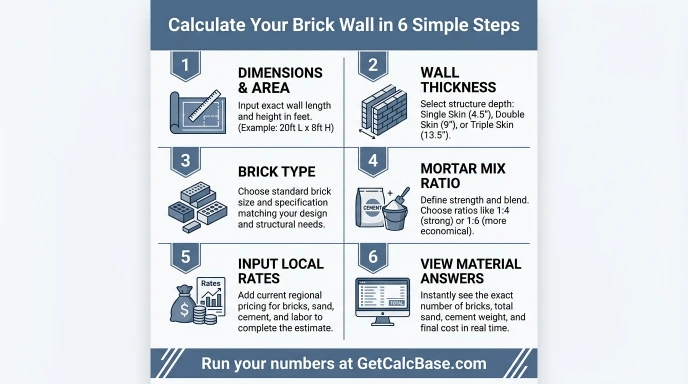
Step 5 — Enter Your Currency and Material Rates Select your currency from the dropdown, then enter:
- Price per brick (your local supplier’s per-unit price)
- Price per 50kg cement bag
- Price per cubic foot of sand
Step 6 — Read Your Results The results update in real time as you type. You’ll see your brick count, cement bag count, sand volume, and total estimated material cost — all calculated simultaneously, all updated the moment any input changes.
How to Use the Brick Wall Cost Calculator — Step by Step
The tool is designed to give you results in under a minute. Here’s the exact process:
Step 1 — Enter Wall Dimensions Measure your wall length and height in feet. If your wall is 40 feet long and 10 feet high, enter those numbers. For rooms, measure each wall separately and run the calculator once per wall.
Step 2 — Select Wall Thickness Choose from three standard wall types:
- 4.5 inches — Single-brick wall, used for interior partitions, boundary walls with low structural load
- 9 inches — Double-brick wall, the standard for load-bearing exterior walls and most residential construction
- 13.5 inches — Triple-brick wall, used for structural walls under heavy loads or in high-wind regions
Step 3 — Choose Your Mortar Ratio
- 1:4 — Strong mix, used where water resistance or structural strength is critical (retaining walls, below-ground walls)
- 1:5 — Standard mix, suitable for most residential masonry work
- 1:6 — Economical mix, used for partition walls and interior non-load-bearing walls
Step 4 — Select Brick Size Choose between standard 9″×4.5″×3″ bricks or modular 7.5″×3.5″×3.5″ bricks. The choice affects how many bricks you’ll need per square foot of wall area.
Why Trust This Calculator? A Note From the Developer
I’m Waseem Aijaz, the developer behind GetCalcBase, and I built this brick wall cost calculator after seeing how many “quick estimate” tools online give numbers that don’t match what contractors actually charge. Every formula in this tool — bricks per square foot, cement bags, sand volume — is cross-checked against standard UK construction references, not just a generic online formula copied from somewhere else.
If you spot a number that looks off for your region, let me know — I keep this tool updated as material prices and standard practices change.
The Formula Behind the Calculations
Understanding the math helps you trust the results and adjust them intelligently for your specific project.
Brick Calculation Formula
The number of bricks needed is calculated from the wall volume:
Wall Volume (cubic feet) = Length × Height × Thickness (in feet)
From the wall volume, bricks are estimated at the standard fill ratio for masonry (approximately 75% brick, 25% mortar by volume):
Bricks = (Wall Volume ÷ Volume per Brick) × 0.75
Then a 10% wastage factor is added:
Final Brick Count = Bricks × 1.10
For a 9-inch double-brick wall that is 40 feet long and 10 feet high:
- Wall Volume = 40 × 10 × 0.75 = 300 cubic feet
- Bricks (standard size, volume ≈ 0.071 cubic feet) = (300 ÷ 0.071) × 0.75 ≈ 3,169 bricks
- With 10% wastage = approximately 3,486 bricks
Cement Calculation Formula
Mortar volume = Total wall volume × 0.25 (the mortar fraction)
Dry mortar volume = Wet mortar volume × 1.33 (dry-to-wet conversion factor)
Cement volume = Dry mortar ÷ (1 + sand ratio)
Cement bags = Cement volume ÷ 1.226 cubic feet per 50kg bag
Sand Calculation Formula
Sand volume = Dry mortar × (sand ratio) ÷ (1 + sand ratio)
These are the same formulas used in civil engineering quantity surveying. The calculator applies them automatically — no manual calculation required.
Wall Thickness Guide — Which One Do You Need?
| Wall Type | Thickness | Common Use | Load Bearing? |
|---|---|---|---|
| Single Brick | 4.5 inches | Interior partitions, low boundary walls | No |
| Double Brick | 9 inches | Exterior walls, standard residential construction | Yes |
| Triple Brick | 13.5 inches | Structural load-bearing walls, heavy construction | Yes |
| 2×4 Stud Wall | ~3.5 inches | Timber frame interior walls (North America) | Depends |
| 2×6 Stud Wall | ~5.5 inches | Exterior timber frame walls, insulated | Yes |
If you’re building in a region that uses timber stud framing rather than masonry, the wall stud calculation works differently. For stud walls, the key variables are wall length and stud spacing (16 inches on center is standard for interior walls, 24 inches on center is common for exterior walls in some regions).
Wall thickness and structural requirements referenced here follow general guidance from the UK Government’s Building Regulations Approved Document A (Structure), though always confirm exact requirements with your local building control office before construction.
How Many Bricks Do You Actually Need? — Common Project Reference
These estimates are for 9-inch double-brick walls using standard brick size with 1:6 mortar, including 10% wastage:
| Project | Wall Size | Approx. Bricks |
|---|---|---|
| Boundary wall (1 side, 40ft) | 40 ft × 6 ft | ~7,000 bricks |
| Small room (10×10 ft) | 4 walls, 10 ft high | ~17,000 bricks |
| 12×12 ft wall (single face) | 144 sq ft | ~1,000 bricks |
| 100 sq ft wall area | — | ~700 bricks |
| 1000 sq ft house (exterior) | Perimeter × 10 ft | ~52,000–60,000 bricks |
How many bricks in 100 square feet (9-inch wall)? Approximately 630 to 700 bricks, depending on brick size and mortar joint thickness.
How many bricks in 1 square foot (9-inch wall)? Approximately 6.5 to 7 bricks per square foot is the standard for a 9-inch wall. For a 4.5-inch single-brick wall, the count is roughly 4.5 to 5 bricks per square foot.
What Technology Powers This Tool?
This calculator runs entirely in your browser using JavaScript — no server processing, no data transmission, no login required. Every calculation happens locally on your device the moment you change any input.
The core calculation engine:
- Wall volume is computed using standard civil engineering masonry formulas
- Mortar volume uses the 1.33 dry-to-wet volume conversion factor — the same value used in professional quantity surveying
- Brick volume per unit is hardcoded for both standard (0.071 cubic feet) and modular (0.062 cubic feet) brick sizes
- A 10% wastage factor is applied automatically — no user adjustment needed for standard projects
- Currency selection changes the display symbol only; all underlying calculations remain in consistent units
Brick sizes supported:
- Standard brick: 9″ × 4.5″ × 3″ (used across South Asia, Middle East, Africa)
- Modular brick: 7.5″ × 3.5″ × 3.5″ (used primarily in the US and parts of Europe)
Wall thickness options: 4.5″, 9″, 13.5″ — corresponding to single, double, and triple-brick construction.
Mortar ratios: 1:4, 1:5, 1:6 cement-to-sand — covering strong, standard, and economical mixes.
Comparison: GetCalcBase Calculator vs. Manual Estimation
| Method | Time Required | Accuracy | Currency Support | Cost |
|---|---|---|---|---|
| Manual calculation | 30–60 minutes | Medium (error-prone) | Manual | Free |
| Contractor estimate | 1–3 days | High | Local only | Often paid |
| Basic brick counter | Under 1 minute | Partial | None | Free |
| GetCalcBase full calculator | Under 1 minute | High | 15+ currencies | Free |
Most free brick calculators online calculate brick count only. They don’t calculate cement, sand, or cost. This tool does all four simultaneously — which is what you actually need before calling a supplier or approving a contractor’s material list.
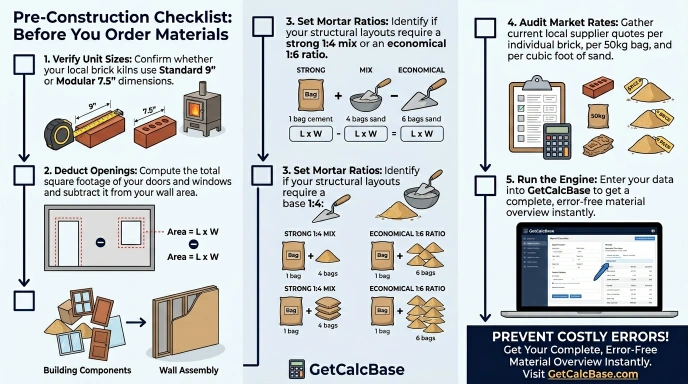
Pre-Construction Checklist — Before You Order Materials
Run through this before placing any material order:
- Measure all wall dimensions accurately — length, height, and thickness confirmed
- Identify wall type: load-bearing or non-load-bearing (affects thickness and mortar ratio)
- Confirm brick size with your supplier before calculating (standard vs. modular)
- Check local building codes for minimum wall thickness requirements
- Get current material prices from at least two suppliers before entering rates
- Add 10% wastage on top of calculated quantities (the calculator does this automatically)

- Factor in door and window openings — subtract their area from your wall area input
- Check if mortar ratio requirements are specified in your structural drawings
- Confirm currency and payment terms with supplier before finalizing budget
- Save or print your calculation results for reference during procurement
Common Mistakes to Avoid When Estimating Brick Wall Costs
1. Forgetting the mortar joint — A standard 10mm mortar joint adds real size to each brick’s footprint; skipping this means ordering short.
2. Not deducting doors and windows — Calculating total wall area without subtracting openings leads to over-ordering and wasted budget.
3. Mixing up wall thickness — A half-brick (single) wall and a full-brick (double) wall use very different brick counts.
4. Skipping the wastage allowance — Always add 5-10% extra for breakage and cutting.
5. Using generic brick sizes — UK, US, and Indian standard bricks are all different sizes. Confirm your actual dimensions with your supplier.
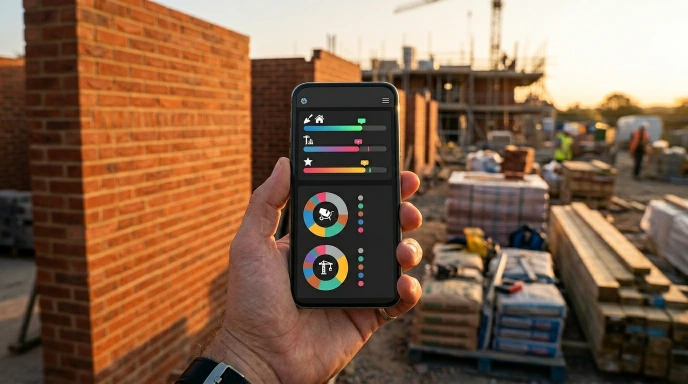
Works worldwide With 15 currency options and support for both standard and modular brick sizes, the calculator is genuinely useful whether you’re building in Karachi, London, Dubai, Sydney, or Toronto.
Key Benefits of Using This Construction Material Calculator
Plan your budget before you commit Construction overruns are common. Knowing your material cost before you begin gives you a realistic budget number — and the ability to compare contractor quotes against what materials should actually cost.
Avoid material shortages mid-project Running out of bricks after your foundation is set means delays, additional delivery costs, and potential difficulty matching the exact brick batch. Calculate first. Order once.
Compare wall designs before building Wondering whether to build a 4.5-inch or 9-inch wall? Run both through the calculator. The cost difference is visible immediately — helping you make design decisions with financial data, not guesses.
Useful for multiple project types The same calculator works for boundary walls, interior partitions, retaining walls (brick type), room additions, garden walls, and any other masonry project where bricks are the primary material.
Wall Stud Calculator — For Timber Frame Construction
If your project uses timber framing rather than masonry, the material estimate works differently. Here’s the standard formula for calculating wall studs:
Studs needed = (Wall Length ÷ Stud Spacing) + 1 (for end stud)
For a 20-foot wall at 16 inches on center (the most common spacing for interior walls): 20 feet = 240 inches 240 ÷ 16 = 15 15 + 1 = 16 studs
Add 2 extra studs for each corner and 1 extra for each door or window opening (for the king stud and jack stud assembly).

Common stud counts by wall length:
| Wall Length | 16″ OC Spacing | 24″ OC Spacing |
|---|---|---|
| 8 feet | 7 studs | 5 studs |
| 10 feet | 9 studs | 6 studs |
| 12 feet | 10 studs | 7 studs |
| 16 feet | 13 studs | 9 studs |
| 20 feet | 16 studs | 11 studs |
| 24 feet | 19 studs | 13 studs |
For 2×4 stud walls (the standard for most interior residential walls in North America), each stud is typically 8, 10, or 12 feet long depending on your ceiling height. Most residential interior walls use 8-foot studs.
Frequently Asked Questions (FAQs)
How many bricks are required for a 12×12 feet wall?
For a 9-inch double-brick wall measuring 12×12 feet (144 square feet), you’ll need approximately 1,000 to 1,100 bricks using standard brick size with a 3/8-inch mortar joint and 10% wastage. For a 4.5-inch single-brick wall of the same dimensions, the count drops to approximately 650 to 700 bricks.
How to calculate the cost of a brick wall?
Multiply your total brick count by the price per brick, your cement bag count by the price per bag, and your sand volume by the price per cubic foot. Add all three together for your total material cost estimate. This calculator does all three calculations simultaneously — enter your local material rates and the cost appears instantly.
How do I calculate how many studs I need for a wall?
Divide the wall length in inches by your stud spacing (usually 16 inches). Round up to the nearest whole number and add one for the end stud. For a 12-foot wall at 16-inch spacing: 144 ÷ 16 = 9, plus 1 = 10 studs. Add extras for corners and door/window openings.
How many bricks to cover 1,000 square feet?
For a 9-inch double-brick wall with 1,000 square feet of wall area, expect approximately 6,500 to 7,000 bricks including wastage. For a 4.5-inch single-brick wall of the same area, approximately 4,500 to 5,000 bricks.
How much does it cost to brick a 2,000 sq ft house?
This varies significantly by region, brick type, and labor rates. Material costs alone (bricks, cement, sand) for a 2,000 sq ft house with standard 9-inch exterior walls typically range from $8,000 to $25,000 depending on local material prices. Use this calculator with your local rates to get an accurate material estimate before approaching contractors.
What do bricklayers charge per 1,000 bricks?
Labor rates for bricklaying vary widely by region. In the US and UK, professional bricklayers typically charge between $300 and $700 per 1,000 bricks laid, depending on wall complexity, location, and experience level. In South Asia, rates are significantly lower. This calculator covers material costs — add your local labor rate estimate for total project cost.
How much sand and cement do I need for a brick wall?
As a rough guide, one bag of cement mixed in a standard 1:5 mortar ratio covers roughly 100-120 bricks, and you’ll need about 1 cubic foot of sand for every 100 bricks. Use the calculator above for exact numbers based on your wall size.
Conclusion — Calculate First, Build Second
Every construction project that goes over budget has one thing in common: someone skipped the calculation step and trusted their gut on material quantities.
Gut estimates are almost always wrong. Usually on the low side — which means running short mid-project, paying for emergency deliveries, and dealing with delays that cost more than the materials themselves.
The free building material calculator at GetCalcBase removes that variable. Enter your dimensions, your local material prices, and your currency — and get your brick count, cement requirement, sand volume, and total cost estimate in real time.
Use it before you call a contractor. Use it before you call a supplier. Use it any time a project is still in the planning stage and the number in your head might be wrong.
Planning right costs nothing. Getting it wrong can cost thousands.
Content prepared for GetCalcBase.com Tool: Building Material Calculator | Brick Wall Cost Calculator Formulas based on standard civil engineering masonry quantity estimation methods
Disclaimer
This brick wall cost calculator provides estimates based on standard civil engineering masonry formulas and general material quantity principles. Results are approximate and intended for planning and budgeting purposes only. Actual material requirements may vary based on local brick sizes, specific mortar specifications, wall bond patterns, construction conditions, and contractor methodology.
Always verify material quantities with a qualified structural engineer or certified quantity surveyor before committing to major construction projects. Local building codes may require specific wall thicknesses, mortar mixes, or construction methods not reflected in this calculator’s defaults.
Material prices are entered by the user based on local market rates and are not sourced or guaranteed by GetCalcBase.
Explore More Financial & Renovation Tools
To help plan your full renovation or build, we have curated a suite of professional-grade tools designed for accuracy and speed:
View All Finance Tools — Our complete library of calculators for UK property owners and contractors.
How to Calculate Bricks for a Wall — Step-by-step guidance on estimating material quantities for masonry projects.
Wall Stud Calculator — Perfect for planning interior partitions and stud-work frames.
GetCalcBase Home — Return to our main dashboard for all digital utilities.
- Planning the wall itself? Before costing out materials, use our Wall Stud Calculator to figure out exactly how many studs you’ll need based on wall length and spacing.
What the Get Calculator Base Community Says
Average Rating: 4.9/5 based on our beta users