
How Long Would It Take to Crack Your Password? Find Out in Real Time
Quick Answer: How Long Does It Take to Crack My Password? “It depends entirely on length and character variety. An 8-character password using all character types cracks in about 4 days with modern AI-assisted GPU clusters — but a 12-character password with the same mix takes centuries. Type your password above to see its exact entropy, character pool, and real crack-time estimate instantly.”
Most people believe their password is strong enough. The data disagrees — and the gap between what people think and what the numbers show is striking.
A study analyzing 14.2 million real-world passwords found that 85.6% were cracked by AI tools in under 10 seconds. Not minutes. Not hours. Seconds.
Time to Crack Password Tool
Real-time analysis based on 2026 GPU and Quantum computing brute-force metrics.
- Waiting for input...
And the uncomfortable part? The passwords that were cracked instantly weren’t all obvious ones like “password123.” Many followed patterns that felt sophisticated to the people who created them — a capital letter at the start, a familiar word with a number substitution, an exclamation mark at the end. Patterns that feel random to humans are deeply familiar to the AI systems that now assist in cracking attacks.
This free password strength checker shows you the reality in real time. Type any password and instantly see its entropy in bits, the character pool it draws from, how long a modern AI-assisted GPU cluster would need to crack it, and a specific security analysis of what’s working and what isn’t.
Your passwords are never stored. Everything runs locally in your browser. No data ever leaves your device.
Expert Personal Experience
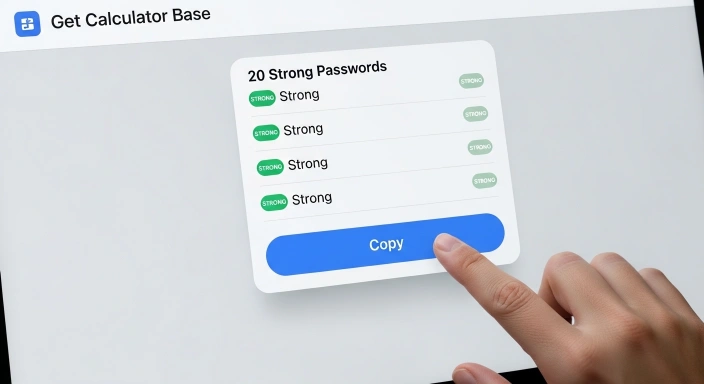
Look, even if someone chooses not to use this tool, it won’t impact anyone else—but based on my 10 years of industry experience, I believe it is absolutely vital. Beginners and newcomers rarely understand the critical importance of a password crack time indicator. They don’t realize how quickly a weak password can be broken. Nowadays, you can’t just set any random password and assume you’re safe. It leaves you constantly guessing: ‘Is my account truly secure? How long would a hacker actually take to breach this?’ To permanently solve this security dilemma, the team behind GCB (Get Calculator Base) has engineered a dedicated tool that analyzes your exact password strength and gives you real-time feedback on its security level
Pro Tips:
“Here is a pro-tip from my side: if you are already on the GCB (Get Calculator Base) website, they have an excellent Password Generator tool. Use it to generate a highly secure, complex password, copy it over to the Password Strength Checker to test its exact crack time, and then apply it to secure your personal accounts!”
What Does This Password Crack Time Calculator Actually Show?
The tool calculates three distinct outputs simultaneously as you type:
Entropy (in Bits)
Entropy is the mathematical measure of a password’s unpredictability. It’s calculated using the formula:
Entropy = Password Length × log₂(Character Pool Size)
A higher entropy number means more possible combinations — and exponentially more time required to brute-force through all of them. The relationship is exponential, not linear: adding one character to a password doesn’t add a fixed amount of time to crack it — it multiplies the cracking time.
General entropy benchmarks:
- Below 40 bits: Extremely weak — cracks instantly or in seconds
- 40 to 60 bits: Weak — cracks in minutes to hours with modern hardware
- 60 to 80 bits: Moderate — hours to years depending on hardware
- Above 80 bits: Strong — effectively resistant to practical brute-force attacks
Character Pool
The character pool is the total number of distinct characters available at each position in your password. It’s determined by which character types are present:
- Lowercase letters only: pool of 26
- Add uppercase letters: pool of 52
- Add numbers: pool of 62
- Add symbols (!, @, #, etc.): pool of approximately 95
The pool size has a dramatic effect on crack time. A 10-character password with a pool of 26 (lowercase only) has 26^10 = 141 trillion possible combinations. The same 10 characters with a pool of 95 (all character types) has 95^10 = 59 quadrillion combinations — 420 times harder to crack.
Time to Crack
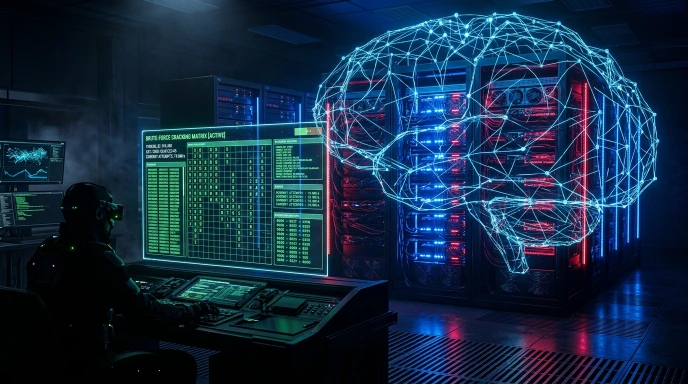
The cracking time estimate is based on modern GPU cluster performance at 400 billion hash attempts per second — reflecting the capability of a high-end AI-assisted cracking setup using hardware comparable to 12× NVIDIA RTX 5090 GPUs. This matches the benchmark standard established by Hive Systems’ widely referenced 2025/2026 password tables.
The formula: Time (seconds) = (Pool^Length) ÷ Hashes Per Second
Results are displayed in human-readable time units: from “Instant” for sub-second cracks all the way to “Centuries” for practically uncrackable passwords.
How to Use the Password Strength Checker
Step 1 — Type a password into the field You don’t need to use your real password — but you can, because nothing is transmitted or stored. Test variations to see how small changes affect crack time.
Step 2 — Read the three core metrics Entropy tells you the mathematical strength. Character pool tells you how much range your password draws from. Time to crack gives you the practical real-world estimate.
Step 3 — Check the security analysis The analysis section flags specific weaknesses: too short, missing symbols, not enough character variety. It also confirms when a password clears the threshold to resist AI-assisted brute force.
Step 4 — Read the overall status The status banner gives you an immediate verdict: DANGER (instant crack), WEAK (vulnerable to GPU clusters), or STRONG (secure against modern AI).
Step 5 — Iterate Try adding length, adding a symbol, or mixing in numbers. Watch how quickly the crack time jumps as you improve the password. This is the most practical way to understand what actually makes a password strong.
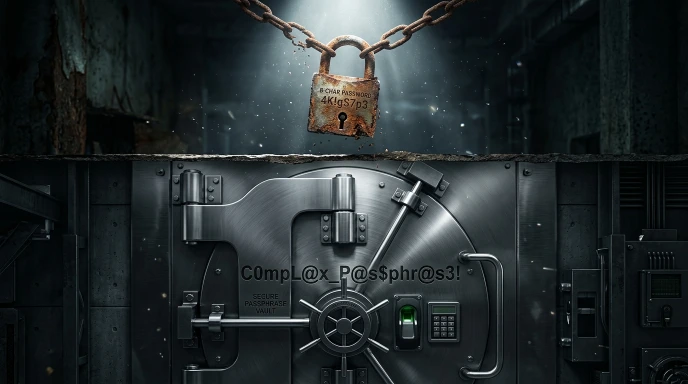
The 2026 Password Cracking Reality — What the Data Shows
The cracking landscape in 2026 looks dramatically different from even three years ago. Three forces are driving this:
GPU Hardware Acceleration
Graphics processing units are exceptionally good at the kind of parallel mathematical computation that password cracking requires. The NVIDIA RTX 5090 — released in 2025 — delivers substantially more hashing throughput than its predecessors. A setup of 12 of these GPUs, which represents a consumer-accessible (if expensive) configuration, can attempt hundreds of billions of bcrypt hash verifications per second for simple passwords.
The jump in cracking speed between the RTX 4090 (used in 2023 benchmarks) and the RTX 5090 (2025-2026) is significant — shorter passwords that previously required hours now crack in minutes.
AI-Assisted Pattern Recognition
This is the development that changed the game most significantly. Traditional brute-force attacks try all possible character combinations systematically. AI-assisted cracking uses pattern recognition — trained on millions of previously leaked passwords — to try the most statistically likely passwords first.
This is why “Summer2025!” cracks instantly despite being 11 characters long and seemingly complex. An AI-assisted cracker has seen millions of passwords that follow the pattern: Capitalized word + year + symbol. It tries those combinations first, long before getting to truly random character sequences.
The 85.6% crack-in-under-10-seconds figure from recent research captures exactly this effect: AI isn’t brute-forcing every combination. It’s predicting human behavior — and human password creation behavior is deeply patterned.
Bcrypt and Hashing Algorithm Variations
One important context for cracking time estimates: the numbers change dramatically based on how the target system stores passwords. Poorly configured systems using MD5 hashing are vastly easier to crack than systems using bcrypt at high iteration counts.
The GetCalcBase calculator estimates time based on raw combinatorial difficulty — effectively assuming an attacker is brute-forcing against the plaintext password equivalent. Systems using well-configured bcrypt (iteration count 10+) add substantial computational cost per attempt, making real-world cracking times significantly longer than what raw entropy math suggests for the attacker.
Why Length Beats Complexity — The Math That Changes Everything
This is the insight that NIST (the US National Institute of Standards and Technology) built into its 2025 password guidelines, and it runs counter to what most people intuitively believe.
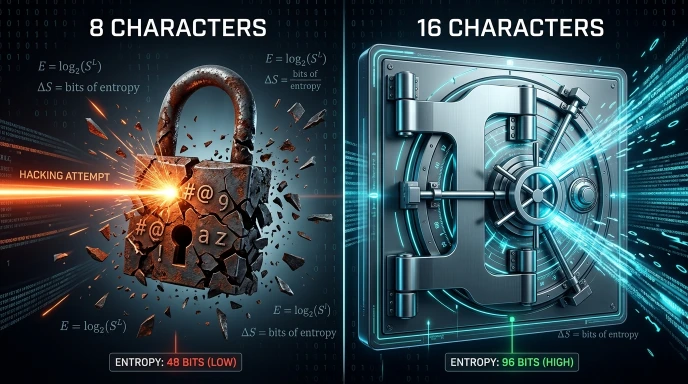
People tend to think that a complex 8-character password like “P@$$w0rd” is strong because it feels hard to type and remember. The math tells a different story.
8-character all-character-types password: 95^8 = 6.6 quadrillion combinations At 400 billion attempts per second: cracks in approximately 16.5 seconds
15-character lowercase password: 26^15 = 1.7 septillion combinations At 400 billion attempts per second: cracks in approximately 4 million years
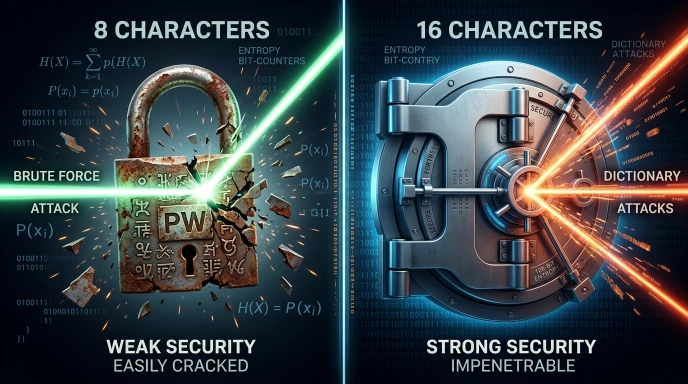
A “simple” 15-character lowercase passphrase is 240 million times harder to crack than a “complex” 8-character mixed-character password. This is why the NIST 2025 guidelines shifted emphasis from enforcing complexity requirements to emphasizing length and uniqueness.
The password “correct horse battery staple” (a famous example from xkcd) is a 28-character passphrase that, despite using only lowercase letters and spaces, would take an incomprehensible amount of time to crack by brute force. It’s also significantly more memorable than “^P8k!mQ2.”
Password Crack Time Reference Table — 2026 Standards
Based on modern GPU cluster performance (400 billion attempts per second equivalent) and the character combinations used:
| Length | Numbers Only | Lowercase | Upper + Lower | All Characters |
|---|---|---|---|---|
| 6 characters | Instant | Instant | Instant | Instant |
| 7 characters | Instant | Instant | Instant | Seconds |
| 8 characters | Instant | Minutes | Hours | Days |
| 9 characters | Instant | Hours | Days | Months |
| 10 characters | Instant | Days | Months | Years |
| 11 characters | Instant | Weeks | Years | Centuries |
| 12 characters | Instant | Years | Centuries | Millennia |
| 14 characters | Seconds | Centuries | — | — |
| 16 characters | Hours | — | — | — |
| 18 characters | Months | — | — | — |
Key insights from this table:
Numbers only are almost always instantly crackable regardless of length, until you reach 16+ characters. Adding lowercase letters helps significantly from 10 characters upward. Mixing all character types is powerful — but length still matters more than complexity for long passwords.
The most important takeaway: a 12-character password using all character types is orders of magnitude stronger than an 8-character password using all character types. Length provides exponentially more security than complexity.
Password Security Checklist — Evaluate Any Password Before You Use It
- Is it 12 characters or longer? (14+ is strongly recommended)
- Does it include uppercase letters, lowercase letters, numbers, and symbols?
- Does the crack time show "Years" or "Centuries" in the calculator?
- Does it avoid dictionary words, names, and dates?
- Is it unique — not used on any other account?
- Does it avoid predictable substitutions (@, 3, 1, 0)?
- Does it avoid keyboard walk patterns (qwerty, asdf)?
- Is it generated by a password manager rather than chosen by you?
- Is entropy above 80 bits (shown in the calculator)?
- Would you be comfortable if this password was the only thing protecting your email account?
Key Benefits of Checking Your Password Strength
Know your actual risk before a breach, not after Data breaches happen to well-known companies regularly. When they happen, attackers get the hashed passwords and start cracking offline. If your password cracks quickly, your account is compromised before you even receive a breach notification. Checking now means you can change weak passwords before that situation arises.
Understand the impact of each improvement The interactive nature of this tool lets you see, in real time, how adding a character or changing a character type changes your crack time from hours to years. That understanding sticks with you — it changes how you think about password creation going forward.
Verify AI-resistant strength The tool specifically tests against AI-cluster benchmarks (400 billion attempts/second), not just traditional brute-force estimates. This means a password flagged as STRONG actually meets the resistance threshold for modern attack methods, not just 2020-era hardware.
Test password policies before deploying them For IT administrators and developers setting password requirements for systems and applications, the tool provides a quick way to test whether a proposed minimum standard (8 characters, mixed case) actually creates strong passwords — or whether it gives users false confidence in inadequate security.
What Technology Powers This Tool?
The password strength calculator uses pure client-side JavaScript — no server requests, no data transmission, no cookies or tracking. Here’s what the calculation engine does:
1. Character pool detection The code checks for four character type categories: lowercase (a-z, pool +26), uppercase (A-Z, pool +26), numbers (0-9, pool +10), symbols (everything else, pool +33). The total pool size is the sum of detected categories.
2. Entropy calculation Entropy = Password Length × log₂(Pool Size) The logarithm base 2 gives the result in bits — the standard unit for measuring information entropy in cryptography.
3. Crack time estimation Total combinations = Pool^Length Crack time (seconds) = Combinations ÷ 400,000,000,000 (400 billion hashes/second benchmark)
4. Time formatting The raw second value is converted to human-readable units: seconds, minutes, hours, days, years, centuries.
5. Security classification Entropy below 40 bits → DANGER Entropy 40 to 75 bits → WEAK Entropy above 75 bits → STRONG
Privacy architecture: The JavaScript runs entirely within your browser’s JavaScript engine. The password string never leaves the browser tab. No network request is made when you type. You can verify this by disconnecting from the internet before testing — the tool still works completely.
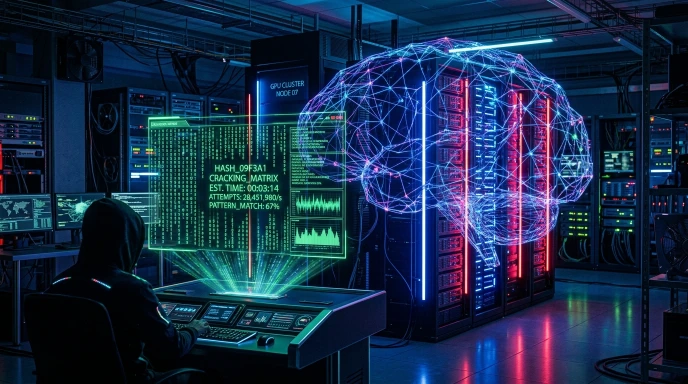
What actually works against AI: True randomness. A password that doesn’t follow any human pattern — like a randomly generated string of characters from a password manager — can’t be predicted. It falls back to pure brute force, which takes the full combinatorial time. This is why the best practice recommendation has converged on: use a password manager to generate and store truly random passwords.
Common Password Mistakes That AI Exploits Instantly
Understanding what makes AI-assisted cracking so effective helps you avoid the patterns it targets first.
Predictable substitutions Replacing ‘e’ with ‘3’, ‘a’ with ‘@’, ‘i’ with ‘1’, ‘o’ with ‘0’. These substitutions are so well documented in leaked password databases that AI crackers apply them automatically and immediately. “P@ssw0rd” is not more secure than “Password” in any meaningful way against an AI-assisted attack.
Pattern endings Adding “!” or “1” or “123” at the end of a base word. AI crackers test word + common_suffix combinations first. “Mountain!” cracks far faster than “Mountain” + a random character positioned in the middle of the word.
Year inclusions “Summer2024”, “Password2025”, “Login2026”. Year-based suffixes are extremely common in leaked password databases. AI pattern recognition prioritizes these combinations.
Name + number combinations “Michael86”, “Sarah1234”, “James2000”. First names combined with years, ages, or simple numbers are among the first patterns AI tools try.
Keyboard patterns “qwerty”, “asdf”, “1qaz2wsx” — these feel complex because of the physical movement, but pattern-based crackers test keyboard walk sequences early in the attack.
How Does This Compare to Other Password Strength Checkers?
| Feature | GetCalcBase | Other Tools 1 | Other Tools 2 | Other Tools 3 |
|---|---|---|---|---|
| Real-time crack time display | ✅ Yes | ✅ Yes | ✅ Yes | ✅ Yes |
| Entropy in bits shown | ✅ Yes | ❌ No | ❌ No | ❌ No |
| Character pool size shown | ✅ Yes | ❌ No | ❌ No | ❌ No |
| Security analysis notes | ✅ Yes | ⚠️ Basic | ⚠️ Basic | ⚠️ Basic |
| 2026 GPU benchmarks | ✅ Yes | ⚠️ Varies | ⚠️ Varies | ❌ N/A |
| No product upsell | ✅ Pure tool | ❌ Password manager CTA | ❌ Product links | ❌ NordPass CTA |
| No data stored | ✅ 100% local | ✅ Yes | ✅ Yes | ✅ Yes |
| Free, no login | ✅ Always | ✅ Yes | ✅ Yes | ✅ Yes |
Showing entropy in bits alongside crack time is the most significant difference — it gives users a real understanding of the mathematical strength, not just a color-coded label.
Frequently Asked Questions (FAQs)
How long does it take to brute force a password in 2026?
It depends entirely on the password’s length and complexity. An 8-character password using only numbers cracks instantly. An 8-character password using all character types takes approximately 4 days with modern GPU clusters. A 12-character all-character password takes centuries. The crack time calculator on this page gives you the exact estimate for any specific password.
How can I check if my password is strong?
Enter it into the calculator above. A strong password will show entropy above 80 bits and a crack time in the centuries or higher range. The security analysis section flags specific weaknesses — too short, missing symbols, predictable patterns.
Are password strength checkers safe to use?
This one is — all processing happens in your browser’s JavaScript engine and nothing is transmitted over the network. You can verify by disconnecting from the internet before testing. For general online tools, be cautious: if a tool requires submitting to a server, your password is potentially logged.
What is the 8-4 rule for creating strong passwords?
The 8-4 rule suggests that a password should be at least 8 characters long and include at least 4 different character types: uppercase, lowercase, numbers, and symbols. While this was a common guideline, 2025 NIST recommendations emphasize length over complexity — 12+ characters is now considered the minimum standard, with 16+ preferred.
How long does it take a hacker to brute force a 12-character password?
For a 12-character password using all character types (uppercase, lowercase, numbers, symbols), the estimated crack time using modern GPU cluster hardware is in the range of thousands to hundreds of thousands of years — effectively uncrackable by brute force. However, if the password follows predictable human patterns, AI-assisted attacks can crack it much faster by guessing patterns rather than trying all combinations.
What was the most common weak password historically?
“password” and “123456” have consistently topped most-used password lists for decades. Other perennials include “qwerty”, “abc123”, “iloveyou”, and “111111”. These are cracked instantly regardless of any cracking method — they exist in every attacker’s password dictionary.
Conclusion — Know Your Real Risk Before It's Too Late
The gap between what feels like a strong password and what is actually a strong password has never been wider. AI-assisted cracking has made intuitive complexity — substitutions, predictable endings, familiar patterns — effectively irrelevant as a defense. What matters now is mathematical complexity: high entropy, achieved through length and genuine character diversity.
This tool shows you that math in real time. The entropy. The character pool. The actual crack time estimate based on 2026 hardware benchmarks. And a direct verdict on whether your password stands up to modern attacks or falls before them.
Test your passwords. The ones that matter most — your email, your banking, your work accounts. The result might change how you think about password security entirely.
Content prepared for GetCalcBase.com — Developer Tools Category Tool: AI Password Attack Simulator | Time to Crack Password Calculator Cracking benchmarks reference the 2025/2026 Hive Systems Password Table methodology Entropy formula based on standard information-theoretic password strength calculation
Important Disclaimer
This password strength calculator provides estimates based on combinatorial mathematics and publicly available GPU benchmark data. Actual cracking times vary based on the hashing algorithm and configuration used by the target system — systems using well-configured bcrypt significantly increase attacker cost. The tool is designed for educational purposes and password evaluation guidance, not as a definitive security guarantee.
Never enter real passwords into any online tool you don’t fully trust. This tool runs 100% locally in your browser — no network requests are made when you type, and no password data is transmitted or stored.
The 400 billion hashes/second benchmark reflects a high-end consumer GPU cluster configuration. Cloud-based attack infrastructure can exceed this significantly. For systems handling sensitive data, consult a qualified cybersecurity professional.
What the Get Calculator Base Community Says
Average Rating: 4.8/5 based on our beta users