
Calorie Calculator: TDEE, Deficit, Macros & 7-Day Zig-Zag Plan Free
Quick Answer: Enter your age, height, weight, and activity level to get your daily calorie target using the Mifflin-St Jeor equation. This free tool also shows your macros, BMI, hydration needs, and a 7-day zig-zag cycling plan for more flexibility in your week. By Waseem Aijaz · Last reviewed: October 12, 2026
You’ve probably asked yourself this question at least once: “How many calories do I actually need per day?” Maybe you’ve been eating what feels like less food, but the scale isn’t moving. Or maybe you’re trying to build muscle and feel like you’re eating plenty — but still not seeing results.
Here’s the truth: most people are guessing. And guessing doesn’t work.
Pro Calorie & Diet Architecture Suite
Calculations run locally in your browser.
Executing Clinical Equations...
Macronutrient Allocation Framework
Protein Mass
Dietary Fats
Carbohydrates
Zig-Zag Intermittent Calorie Cycling Matrix
Plateau Deflection OperationalPrivacy: The calculation runs in your browser, and nothing you type into the calculator is sent to our server. Ad and analytics cookies may still apply, so see our Privacy Policy.
That’s exactly why we built this best free online calorie calculator at GetCalcBase. Enter your age, weight, height, and activity level — and in seconds, you’ll have an estimate of your daily calorie needs for weight loss, weight gain, or maintenance. No login. No subscription. No nonsense.
Whether you’re tracking your calories calculator in kg format or using pounds, this tool supports both. It even shows you your macros, your hydration needs, and a 7-day zig-zag calorie cycling plan to add some flexibility to your week. Let’s get into it.
My Experience Calorie Calculators
Look, in today’s world, we need to take care of our health because the food we eat can affect our bodies. I want to tell you about my own experience and why I decided to build this tool.
There was a time when I suddenly became ill, and I had to spend some time recovering. During that period, I started thinking about my eating habits and daily routine. I often ate outside because I was busy, and I enjoyed fast food. There are many good restaurants in our city that serve tasty fast food. For example, I sometimes went to KFC. I enjoyed the food, but I started noticing that my health was getting worse. I knew that fast food could contain a lot of calories, but I did not really understand how many calories I was eating or how that related to my daily needs.
I started thinking about how much I should eat each day based on my height, weight, health, and regular routine. I wondered whether there was a tool that could help me understand my daily calorie needs using this information.
I researched the topic but could not find a tool that worked the way I wanted. Later, I spoke with a doctor and sought guidance from experts. I explained that I was a developer and wanted to build a tool that could help people understand their calorie needs and related information.
Because this was health-related work, we did not want to take unnecessary risks. We discussed the idea, held meetings, and worked together to develop the tool. We also held meetings online through Zoom.
After around 300 days of work, we built the tool. It allows users to enter information such as their height, weight, age, and regular activity level to explore their estimated calorie needs.
The tool includes features such as:
Evaluated Body Mass Index (BMI)
Macronutrient Allocation Framework
Zig-Zag Intermittent Calorie Cycling Matrix
You can explore these features and learn more about the information they provide.
Once the tool was ready, I tested it and asked my doctor to check it as well. I also collected feedback from local users. You can find a review from a local user in the testimonials section below the tool.
After I was satisfied with the testing and feedback, I made the tool live. I am continuing to improve it, update the content, and make it easier for people to understand and use.
One important thing to remember is that this tool is strictly for educational and informational purposes. It does not provide medical advice. For advice about your personal health or dietary needs, please consult a qualified doctor.
Pro Tips This Tool
Here is another tip from my side. This tool is not only for men; women can use it too.
You can also explore these features:
Daily Physical Activity Variable (TDEE Factor)
Target Metabolic Goal
Macronutrient Structural Ratio
If you have difficulty entering your height in centimeters, select Imperial System (ft / lbs). You can then enter your height in feet and your weight in pounds.
Why Most Calorie Calculators Give You the Wrong Number
I am Waseem Aijaz — a developer who builds health and finance tools for GetCalcBase. When I started researching calorie calculators to build this tool, I noticed two problems with some existing ones.
First, some of them still use the Harris-Benedict equation, which dates from 1919 and was revised in 1984. The Mifflin-St Jeor equation, published in 1990, did better in a 2005 review by the American Dietetic Association (now the Academy of Nutrition and Dietetics): it predicted resting metabolic rate within 10% of the measured value for more people than the other common equations. It’s still an estimate, and it can be off for individual people. This tool uses Mifflin-St Jeor.
(2005 review: https://doi.org/10.1016/j.jada.2005.02.005)
Second, they give you one flat number and stop there. Many people find one fixed target hard to follow week after week. That is why I added a zig-zag option: it varies your intake across the week while keeping the weekly total the same, which some people find easier to stick to. There is little strong evidence that it burns more fat than a steady deficit with the same weekly total, so think of it as a flexibility tool, not a metabolic trick.
Practical Tips for Using This Tool Effectively
Be honest about your activity level. This is the most common input error. If you have a desk job and exercise 3 times per week, you are “lightly active” — not “moderately active.” Overestimating this inflates your TDEE by 200-300 calories and slows weight loss without you knowing why.
Recalculate every 4 weeks. As your weight changes, your BMR changes. A 5kg weight loss changes your maintenance calories by approximately 50-100 kcal per day. Update your inputs regularly.
Track for 2 weeks first. Before adjusting anything, use this number as your target for 14 days and track your actual intake. Most people discover their real eating patterns are different from what they assumed.
Check your tracking before you change the plan. If you have been at the same weight for 2+ consecutive weeks on a consistent deficit, first recheck your portions, your activity level and your weighing routine. The zig-zag schedule is one option some people try after that.
Accelerate Your Results: Advanced Biomarker & Nutrition Toolkits
Achieving your fitness goals requires a multi-dimensional approach to energy balance. While tracking your daily energy expenditure is the foundation of weight management, syncing your calorie targets with other vital metabolic metrics can make your progress easier to follow.
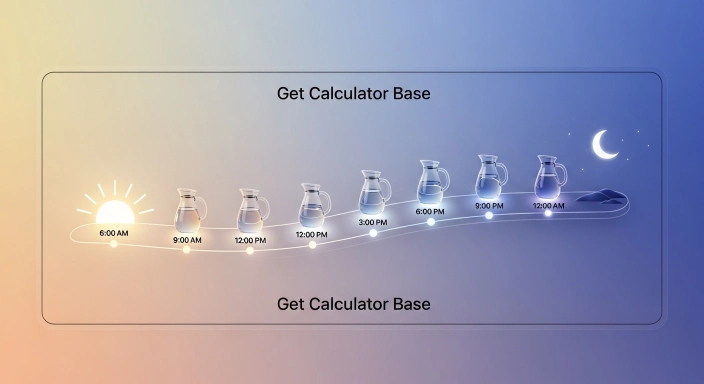
Fluid Retention & Metabolic Efficiency: Staying hydrated is part of any calorie plan, so calculate your personalized water requirements alongside your calorie baseline.
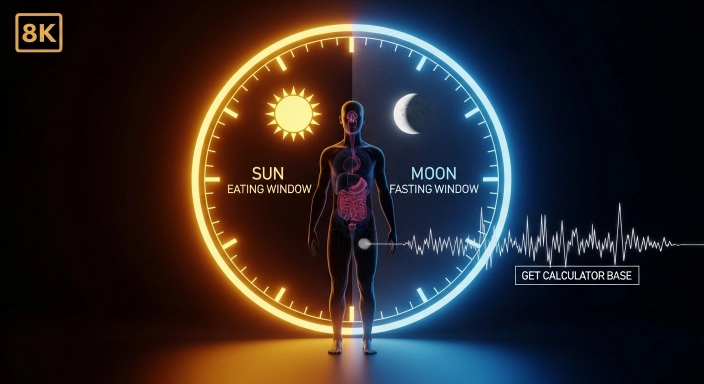
Chrononutrition & Eating Windows: If you structure your diet around time-restricted feeding protocols, it is highly beneficial to align your fasting schedule windows so you can manage hunger signals effectively within your deficit.
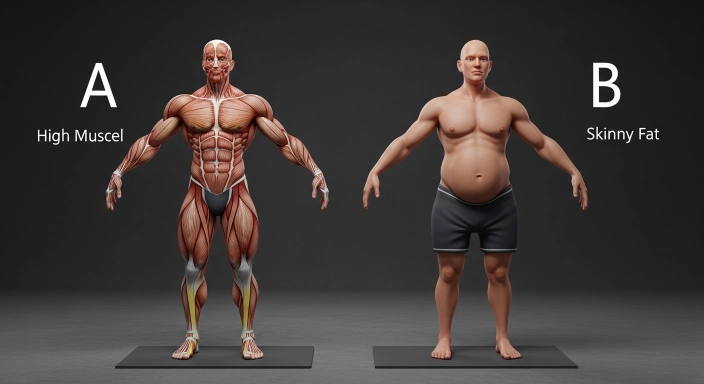
Tissue Retention & Macronutrient Splits: Once your foundational energy budget is set, you must fine-tune your daily macronutrient distribution to protect your hard-earned lean muscle mass during weight loss.
Body Composition Architecture: To ensure that the scale weight you drop is actual adipose tissue and not just water or muscle, you need to monitor your lean body composition changes systematically.
How Does the Calorie Calculator Work?
This tool uses the Mifflin-St Jeor equation — a widely used formula for estimating your Basal Metabolic Rate (BMR). Published in 1990, it did better than older equations in a 2005 dietetics review, though it is still an estimate.
Here’s the formula it uses behind the scenes:
For Men: BMR = (10 × weight in kg) + (6.25 × height in cm) − (5 × age) + 5
For Women: BMR = (10 × weight in kg) + (6.25 × height in cm) − (5 × age) − 161
Once your BMR is calculated, the tool multiplies it by your activity factor — a number between 1.2 (completely sedentary) and 1.9 (extremely active) — to give you your Total Daily Energy Expenditure (TDEE). That TDEE number is your daily calorie maintenance target.
From there, your goal (lose, maintain, or gain weight) adjusts the final number. Simple, clear, and easy to check by hand.

What Is BMR?
BMR stands for Basal Metabolic Rate. It’s the number of calories your body burns just to stay alive — breathing, pumping blood, regulating temperature — while you’re at complete rest. Think of it as the minimum your engine needs to idle.
What Is TDEE?
TDEE stands for Total Daily Energy Expenditure. It’s your BMR multiplied by how active you are. This is the real number you need — it tells you how many calories you’re actually burning throughout the day.
What Is a Calorie Deficit?
A calorie deficit happens when you eat fewer calories than your TDEE. Your body then pulls from stored fat to make up the energy gap — and that’s how you lose weight. A deficit of 500 calories per day typically leads to about 0.5 kg (roughly 1 pound) of fat loss per week. Our free calorie deficit calculator built into this tool does all this math automatically.
How to Use the GetCalcBase Calorie Calculator
Using this tool is about as simple as it gets. Here’s a step-by-step walkthrough:
Step 1 — Choose Your Unit System Select Metric (cm/kg) or Imperial (ft/lbs) at the top. The tool switches all fields automatically.
Step 2 — Select Your Biological Sex Click Male or Female. Sex affects how BMR is calculated — the formulas are slightly different for each.
Step 3 — Enter Your Age This tool is meant for adults aged 15 to 80. If you’re outside that range, please speak to a doctor or registered dietitian.
Step 4 — Enter Your Height and Weight For the most accurate calories calculator in kg result, enter your weight in kilograms. If you’re using pounds, the tool converts automatically.
Step 5 — Select Your Activity Level Be honest here. Most people overestimate how active they are. If you have a desk job and go for a walk three times a week, you’re “lightly active,” not “moderately active.”

Step 6 — Set Your Goal Choose from aggressive fat loss, moderate fat loss, weight maintenance, or lean muscle gain.
Step 7 — Pick Your Macro Ratio Select balanced, high-protein, or ketogenic macronutrient splits depending on your dietary preference.
Step 8 — Hit the Calculate Button That’s it. Your results appear instantly — calories, macros, BMI, hydration needs, and a full 7-day zig-zag cycling schedule.
Weekly Checklist — Getting the Most From Your Calorie Plan
Use this as your simple weekly reference:
- Calculate your TDEE using this tool before starting any diet phase
- Log your food for at least the first 2 weeks to build awareness
- Weigh yourself at the same time each morning (before eating, after bathroom)
- Track weekly averages, not daily weights — daily fluctuations are normal
- Review your macros — are you hitting your protein target? This matters most.
- Reassess every 4 weeks — as you lose weight, your TDEE changes. Recalculate regularly.

- Use the zig-zag plan if your progress stalls for more than 2 consecutive
- Stay hydrated — aim for the water intake recommendation shown in your results

Understanding Your Results
Your Daily Calorie Target
This is the headline number — the total calories you should aim to eat each day based on your goal. For weight loss, it’ll be below your TDEE. For muscle gain, it’ll be slightly above.
Macronutrient Breakdown
The calculator splits your daily calories into protein, fat, and carbohydrates. Here’s why each one matters:
| Macronutrient | Calories per Gram | Primary Role |
|---|---|---|
| Protein | 4 kcal/g | Muscle repair, satiety, metabolism |
| Carbohydrates | 4 kcal/g | Energy, brain function, performance |
| Fat | 9 kcal/g | Hormones, cell health, fat-soluble vitamins |
Getting the right balance is what separates a diet that works from one that leaves you tired and frustrated.
BMI Score and What It Means
BMI (Body Mass Index) is a quick health screening number. It’s not perfect — it doesn’t account for muscle mass — but it gives you a useful baseline reference:
| BMI Range | Category |
|---|---|
| Below 18.5 | Underweight |
| 18.5 – 24.9 | Normal / Healthy Weight |
| 25.0 – 29.9 | Overweight |
| 30.0 and above | Obese |
Zig-Zag Calorie Cycling
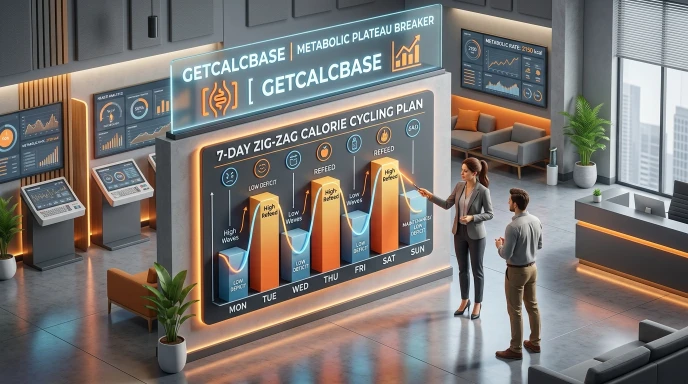
This is one of the more unique features of this tool. Instead of eating the exact same number of calories every single day, zig-zag cycling alternates between higher and lower calorie days across the week — while keeping the weekly total the same.
Why use it? Mostly for flexibility. Some people find it easier to stay on track when a few days are lower and a few are higher, and a higher-calorie day at the weekend can feel like a real break. The weekly total stays the same, so it should not change your overall result. There is little strong evidence that it breaks plateaus on its own.
Hydration Recommendation
The tool also estimates your daily water intake needs based on your weight and activity level. A common rule of thumb is about 35 ml per kilogram of body weight, with a little extra for people who are more active. Your needs also vary with climate, health and diet.
Calories Calculator in KG for Weight Loss — A Real-World Example
Let me walk you through a real example so this clicks properly.
Say you’re a 30-year-old woman, 165 cm tall, weighing 72 kg, with a moderately active lifestyle (exercise 3–5 days per week). Your goal is steady fat loss.
- BMR: (10 × 72) + (6.25 × 165) − (5 × 30) − 161 = 1,440.25 kcal
- TDEE (moderate activity × 1.55): 1,440.25 × 1.55 = 2,232 kcal
- Calorie target for moderate fat loss (−250 kcal): ~1,982 kcal/day
At that intake, you would be 250 kcal below maintenance each day. That adds up to about 1,750 kcal a week, or roughly 0.23 kg (about 0.5 lb) of fat loss per week. Real results vary from person to person. Our calories calculator in kg for weight loss does all of this in a fraction of a second.

Your daily calorie requirement is closely linked to your Total Daily Energy Expenditure (TDEE), which represents the total number of calories your body burns through essential bodily functions, physical activity, and digestion. While this calculator provides a quick estimate of your daily calorie needs, understanding the factors that influence TDEE can help you make more informed nutrition decisions. If you would like to explore the calculation process in greater detail, including activity multipliers, maintenance calories, and practical examples, read our TDEE Maintenance Calories Guide before creating a long-term diet or fitness plan.
What Makes GetCalcBase Different From Other Calorie Calculators?
There are dozens of calorie calculators online. So why use ours? Here’s an honest comparison:
| Feature | GetCalcBase | Some Free Calculators |
|---|---|---|
| Mifflin-St Jeor Formula | ✅ Yes | ✅ Yes |
| Zig-Zag Cycling Plan | ✅ 7-day schedule | ❌ No |
| Macro Breakdown | ✅ 3 diet protocols | ⚠️ Basic only |
| BMI + Weight Status | ✅ Yes | ⚠️ Sometimes |
| Hydration Estimate | ✅ Yes | ❌ Rarely |
| Weight Timeline (4wk/8wk) | ✅ Yes | ❌ No |
| No Login Required | ✅ Always free | ⚠️ Varies. |
| Privacy (No server data) | ✅ Runs in your browser | ⚠️ Varies |
| Metric + Imperial | ✅ Both supported | ✅ Usually |
| Export / Print Report | ✅ Yes | ❌ Rarely |
Nothing you type into the calculator is sent to our server, and you don’t need an account. Ad and analytics cookies may still apply. This comparison is general, and features vary from one calculator to another.
Who Should Use This Tool?
This free calorie calculator is built for real people with real goals:
- Weight loss beginners who don't know where to start and want a simple, honest number to aim for
- Fitness enthusiasts who want their macros dialed in properly for their training
- People stuck at a plateau who need zig-zag cycling to restart progress
- Students and professionals managing busy schedules who need quick, reliable nutrition numbers
- International users — the tool works worldwide, supports both metric and imperial, and is available to users in the USA, UK, Canada, Australia, India, Pakistan, Bangladesh, UAE, Saudi Arabia, Turkey, Germany, France, Japan, South Korea, and more

Key Benefits of Tracking Your Calories
You might be wondering whether calorie tracking is really worth the effort. Here’s what research and real-world experience say:
1. Awareness changes behavior. Most people genuinely don’t know how many calories are in the foods they eat regularly. The simple act of knowing creates better choices — not through restriction, but through understanding.
2. You stop guessing and start progressing. Eating “less” without a target is just noise. Eating 1,800 calories instead of 2,300 is a strategy.
3. Macros matter as much as calories. Two people eating 2,000 calories can have completely different body composition results depending on their protein intake. Tracking macros helps optimize this.
4. It helps identify hidden calories. Drinks, sauces, oils, and snacks are where most people unknowingly sabotage their progress. Once you see the numbers, you can’t unsee them.
5. It builds long-term nutrition literacy. After a few months of consistent tracking, most people don’t even need to count anymore. They’ve internalized the patterns.
Common Calorie Counting Mistakes to Avoid
I’ve seen these patterns repeatedly — and they’re easy to fix once you know what to look for:
❌ Overestimating activity level. The biggest calculation error. If you sit at a desk most of the day, you’re sedentary or lightly active — not moderate. Overestimating this inflates your TDEE and slows weight loss.
❌ Forgetting liquid calories. A daily latte, two glasses of juice, and a soda can add 400–600 calories you never counted. Drinks are invisible calories for most people.
❌ Eating back all exercise calories. Fitness trackers often overestimate calories burned during exercise. Don’t eat them all back, especially if weight loss is your goal.
❌ Going too low. Eating below about 1,200 calories (women) or 1,500 calories (men) without medical supervision is generally not recommended, because it makes it harder to get enough nutrients and can lead to muscle loss. If your target comes out lower than this, talk to a doctor or dietitian.
❌ Ignoring the plateau. After several weeks of consistent deficit, progress often slows. This is normal. This is normal. Recheck your tracking and activity level first. The zig-zag schedule is one option some people try.
Calculate Maintenance Calories: What is TDEE?
Maintenance calories are the exact amount of energy your body requires to keep its current weight, assuming your daily physical activity remains the same. This baseline number is scientifically known as your Total Daily Energy Expenditure (TDEE). Your TDEE is calculated by first determining your Basal Metabolic Rate (BMR) — the calories your body burns at rest just to keep your organs functioning — and then multiplying it by an activity multiplier based on your lifestyle. Whether your goal is to bulk up, lean down, or stay exactly as you are, discovering your accurate maintenance calories is the non-negotiable first step in any successful diet architecture.
How to Calculate Calorie Deficit for Weight Loss
A calorie deficit occurs when you consume fewer calories than your body burns (your TDEE). To calculate your optimal deficit, subtract your target reduction from your maintenance calories. A common starting point for steady weight loss is a deficit of about 250 to 500 calories a day, which works out to roughly 0.5 to 1 pound (0.25 to 0.5 kg) a week. For example, if your maintenance baseline is 2,400 calories, eating 1,900 calories a day creates a 500-calorie deficit. Avoid aggressive deficits below your BMR, as they can slow down your metabolism, cause muscle loss, and trigger extreme fatigue.
What Technology Powers This Tool?
The GetCalcBase Calories Calculator runs on client-side JavaScript — which means all calculations happen directly in your browser. Nothing you type into the calculator is sent to our server, and no account is required. Ad and analytics cookies may still apply.
The formulas used are:
- Mifflin-St Jeor Equation (primary — most accurate for general population)
- Harris-Benedict Equation (referenced for cross-validation)
- Katch-McArdle Formula (used for users with known body fat percentage)
The tool supports both Metric and Imperial unit systems and is mobile-responsive — it works cleanly on any phone, tablet, or desktop browser without requiring an app download.
Healthy Calorie Ranges by Goal
| Goal | Typical Daily Calories |
|---|---|
| Aggressive Weight Loss | TDEE − 500 kcal |
| Moderate Weight Loss | TDEE − 250 kcal |
| Maintenance | TDEE |
| Lean Muscle Gain | TDEE + 250 kcal |
| Bulking | TDEE + 500 kcal |
Always work within a range that keeps you above the minimum safe intake. Sustainable beats aggressive every time.
Maintenance Calories Calculator — Why This Number Matters
Your maintenance calories aren’t just for people who don’t want to lose weight. They’re your baseline. Every goal starts here. Knowing your maintenance number means:
- You understand exactly how big your deficit or surplus needs to be
- You can adjust up or down based on weekly progress data
- You have a clear target to return to after a diet phase ends
This maintenance calories calculator function is built directly into the tool — no extra steps required.
Steps to Calories — Understanding Activity Impact
One thing people rarely think about: walking more is one of the most effective calorie-burning strategies, and it doesn’t require a gym.
Here’s a general reference for calorie burn through common activities (per hour, approximate):
| Activity | ~125 lb (57 kg) Person | ~155 lb (70 kg) Person | ~185 lb (84 kg) Person |
|---|---|---|---|
| Walking (3.5 mph) | 215 kcal | 267 kcal | 319 kcal |
| Cycling (moderate) | 454 kcal | 562 kcal | 671 kcal |
| Swimming (moderate) | 397 kcal | 492 kcal | 587 kcal |
| Running (9 min/mile) | 624 kcal | 773 kcal | 923 kcal |
| Golf (with cart) | 198 kcal | 246 kcal | 294 kcal |
The steps to calories calculator logic is straightforward: more movement means a higher TDEE, which means you can eat more while still losing weight — or lose faster at the same intake.
Calorie Content of Common Foods (Quick Reference)
| Food | Serving Size | Calories |
|---|---|---|
| Apple | 1 medium | 95 kcal |
| Banana | 1 medium | 105 kcal |
| Chicken Breast (cooked) | 100g | 165 kcal |
| Brown Rice (cooked) | 1 cup | 216 kcal |
| Egg (large) | 1 whole | 70 kcal |
| Greek Yogurt (plain) | 1 cup | 130 kcal |
| Olive Oil | 1 tablespoon | 119 kcal |
| Whole Milk | 1 cup | 150 kcal |
| Almonds | 1 oz (~23 nuts) | 164 kcal |
| White Bread | 1 slice | 75 kcal |
Frequently Asked Questions (FAQs)
How many calories do I need to lose 1 kg of body weight?
One kilogram of body fat contains approximately 7,700 calories. To lose 1 kg per week, you would need a daily deficit of 1,100 calories — which is aggressive and not recommended for most people. A safer target is 0.5 kg per week, requiring a 550-calorie daily deficit. Use the calculator above to find your TDEE, then subtract 300-500 calories for a sustainable pace.
How do I calculate my calorie deficit?
Calorie deficit = Your TDEE (maintenance calories) minus your daily food intake. If your TDEE is 2,200 and you eat 1,700 calories, your deficit is 500 calories. This calculator determines your TDEE automatically — you just need to track your food intake separately using a food diary or app.
How do I calculate my calories in kg format?
Enter your weight in kilograms directly into this tool. The Mifflin-St Jeor formula uses kilograms natively, so you’ll get the most accurate result without any conversion rounding errors. If you’re using pounds, the tool converts automatically before calculating.
What is a calorie deficit, and how do I calculate it for free?
A calorie deficit means consuming fewer calories than your body burns. This calculator computes your deficit for free — enter your details, select your goal (weight loss), and the tool outputs your daily target automatically. No login or payment required.
Is a 1,200 calorie deficit safe?
A 1,200-calorie daily deficit is generally too aggressive for most people. It typically pushes daily intake below safe minimums (1,200 kcal for women, 1,500 kcal for men) and can trigger muscle loss, fatigue, and metabolic slowdown. A 500-calorie deficit is the standard recommendation for healthy, sustainable weight loss.
What is the best free online calorie calculator?
Our calorie calculator uses the Mifflin-St Jeor equation — the most accurate formula according to the American Dietetic Association. It is completely free, with no login or signup required and processes everything securely in your browser.
How many calories does a 75 kg person need per day to lose weight?
It depends on height, age, sex, and activity level — but as a general estimate, a moderately active 75 kg adult male needs roughly 2,400–2,700 kcal to maintain weight. For steady fat loss, a target of 1,900–2,200 kcal would typically be appropriate. Use this calculator with your exact details for a personalized result.
Which foods support weight loss best?
Foods high in protein and fiber are your best tools — they keep you full longer and help preserve muscle during a deficit. Think: eggs, chicken breast, legumes, Greek yogurt, vegetables, oats, and whole grains. These aren’t magic foods, but they make hitting your calorie target without constant hunger significantly easier.
What are maintenance calories?
Maintenance calories (also called TDEE — Total Daily Energy Expenditure) are the exact number of calories your body needs to maintain your current weight with your current activity level. Use the calculator above to find your personal maintenance number.
How do I convert calories to kg?
About 7,700 calories equal 1 kg of body fat, so divide the calories by 7,700. For example, 119 calories is about 0.015 kg (15 g), 500 calories is about 0.065 kg and 3,850 calories is about 0.5 kg. This is a rule of thumb, and real weight change also depends on water, muscle and other factors.
Your Calorie Goal Is Just the Starting Line
Knowing your daily calorie target is genuinely one of the most useful things you can do for your health. It removes the guesswork. It gives you a real number to aim for. And it makes the difference between spinning your wheels for months versus actually seeing progress.
The best free online calorie calculator at GetCalcBase does the heavy lifting for you — formulas, macros, BMI, hydration, zig-zag cycling, and a weight timeline, all in one place, all free, all private.
But here’s the thing: the calculator gives you the map. You still have to do the walking.
Start with your number. Track for two weeks. Reassess. Adjust. Repeat. That’s the whole system — and it works.
👉 Try the GetCalcBase Calorie Calculator and take the first step toward a goal that’s actually grounded in your real numbers.
All tools on GetCalcBase.com are free, require no login, and update regularly to reflect current health standards.
Explore More Health & Wellness Calculators
Health needs vary from person to person, and one calculator may not answer every question. If you’re looking for additional wellness, fitness, nutrition, or body measurement tools, browse our complete Health Calculators collection to explore more resources designed for everyday health planning.
Health Advice Disclaimer
Important Notice: This calorie calculator is designed for informational and educational purposes only. The results are estimates based on validated scientific formulas and should not be interpreted as personalized medical advice. Individual results vary based on metabolism, health conditions, hormonal factors, medications, and other variables not captured by this tool.
If you are pregnant, nursing, managing a chronic health condition (such as diabetes, thyroid disorder, or kidney disease), or planning to make significant changes to your diet, please consult a qualified healthcare professional or registered dietitian before acting on these results.
This tool is not a substitute for professional medical care. Always prioritize your health and safety above any calculated number.
Trust & Verification: This utility is custom-developed and optimized by owner Waseem Aijaz . To ensure absolute precision and calculation safety, our algorithms are medically evaluated by Dr. Edward and strictly audited for user privacy by Jacob Barr. Verified visual data structures are maintained on Pinterest. For comprehensive terms, please read our official Disclaimer. Sources and Limits: The equation comes from the 1990 study that published it (Mifflin et al., American Journal of Clinical Nutrition), and the accuracy comparison from a 2005 review by the American Dietetic Association. The 1,200 and 1,500 calorie minimums and the pace of 1 to 2 pounds a week come from Harvard Health Publishing. Results are estimates and can be off for individual people. Found a mistake? Please contact us or read about us.
User Reviews Note: All performance ratings and feedback displayed here are gathered from authentic beta testing phases with real, active users across global regions, including the USA, UK, Pakistan, India, Saudi Arabia, and the UAE.
What the Get Calculator Base Community Says
Average Rating: 4.9/5 based on our beta users