
Etsy Fee Calculator 2026: Net Profit, Margin & Reverse Price Calculator
Quick Answer: Enter your item price, shipping charge, and costs to instantly see your exact Etsy net profit and margin — including listing, transaction (6.5%), payment processing, and offsite ads fees. Use the reverse-profit mode to calculate the price needed to hit your target profit.
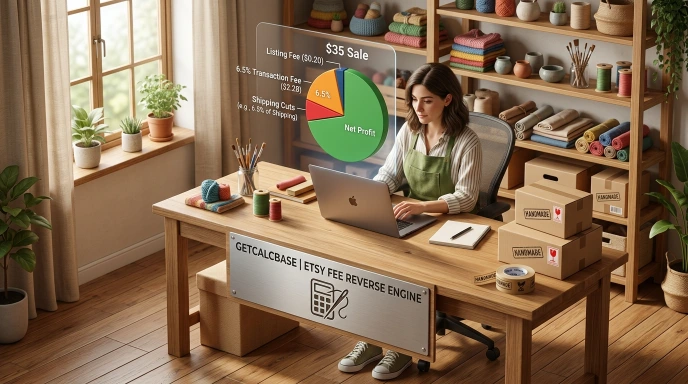
You listed your handmade item for $35. The buyer paid. Etsy sent your payout. And somehow — after the listing fee, the transaction fee, the payment processing fee, and the shipping cut — you made $11.
Etsy Profit & Fiscal Analyzer (Pro Edition)
Advanced Multi-Region Calculations & Reverse Profit Engineering
Item & Regional Details
Advanced Modifiers
Not $35. Eleven dollars.
That’s not a rare situation. That’s Tuesday for sellers who haven’t run their numbers properly before pricing. Etsy looks affordable from the outside: a $0.20 listing fee, a 6.5% transaction fee. Manageable, right? Except those two fees are just the beginning. By the time you add payment processing, offsite ads (which become mandatory if you clear $10,000 in annual sales), your material costs, and shipping, a $35 sale can leave you with less than $10 in actual profit.
This free Etsy fee calculator fixes that. Enter your sale price, shipping charge, costs, advertising option, and region — and see your exact net profit and margin before you publish a single listing.
No signup. No spreadsheet. No guessing. Just your real number.
My Experience Behind This Tool
As you know, I am a developer, and I have built many websites for users. I have also built eCommerce websites, including Shopify stores.
The reason I created this tool is based on my own experience. When I build an eCommerce website for a user and they start using it to sell products, they can become confused about the actual selling price. There was no problem when they had only a few products, but when they started adding more products, they had to consider many different costs.
They had to manage the product price, shipping price, total cost, seller discount, ads, job-related costs, and other expenses. For example, they may spend money on shipping, give a discount, spend money on ads, pay for a periodic service, or give a coupon discount. After adding all these costs, it can become difficult to know the actual cost and profit.
If a seller does not calculate these costs properly before selling a product, they may end up with a loss. I saw this problem myself, so I thought it was very important to create a solution for it.
I added this tool to my finance tools so users can benefit from it. I have also used this tool myself because I have my own website, and some of my users have used it as well. I have built websites for users in different countries, so I have seen this problem from different experiences.
If you want to know more about my work and experience, you can check the About Us page. You can also see the reviews that users have shared about this tool. One of the local reviews was also given by one of my own clients.
Bonus Tip
This is a tool on my website that I created because of a client. I will also give you a bonus tip: if you are a developer, you can download the report and also copy it.
If you have content in any language, you can select your own language. Right now, I have added 4 languages, and I will add more in the future.
There was also a tip below this tool where I linked another finance tool. You can use that tool as well and prepare it according to your payment budget. It can help you manage it and then prepare the next step.
Why This Calculator Exists
I am Waseem Aijaz — developer and founder of GetCalcBase. I built this tool after spending time in ecommerce communities where sellers consistently shared the same frustration: their payouts were always less than expected, and they could never figure out exactly where the money went.
The problem is not that Etsy’s fees are unreasonable. The problem is that they compound in a way that is not obvious until you see it calculated in one place. The transaction fee applies to shipping. The offsite ads fee applies to the full order. The payment processing flat fee hits harder on small transactions. None of these individually seem significant — together, on a $28 sale, they can remove $8 to $10 before you even subtract your material cost.
I specifically built the reverse profit feature because the real question sellers have is not “what profit will I make at $35?” — it is “what do I need to charge to make $12?” Working backward from a target profit through every fee layer simultaneously is the kind of calculation that takes 10 minutes in a spreadsheet and 5 seconds here.
The UK-specific section came from seller feedback — generic US-focused calculators give wrong numbers for UK sellers because the payment processing rate and regulatory fee are different. The region selector ensures the correct rate loads automatically.
— Waseem Aijaz | Founder, GetCalcBase | M.Sc Mathematics
Three Things Most Etsy Sellers Miss
The shipping fee trap. Etsy’s 6.5% transaction fee applies to your shipping charge as well as your item price. If you charge $8 shipping on a $20 item, Etsy takes 6.5% of $28 — not $20. Enter your actual shipping charge in the calculator to see the real impact.
The offsite ads threshold. If you are below $10,000 annual sales, offsite ads are optional. Above it, they become mandatory at 12–15% of every qualifying sale. Run your numbers with offsite ads included now, even if you have not crossed the threshold — so you know your margin when it becomes mandatory.
The 2022 fee increase you may still be absorbing. Etsy raised its transaction fee from 5% to 6.5% in April 2022. Sellers who did not update pricing immediately have been absorbing that 1.5% margin compression on every sale since then. If your pricing was last reviewed before mid-2022, run it through the calculator now.
How Does the GetCalcBase Etsy Calculator Work?
The tool uses the actual 2026 Etsy fee structure — the same rates Etsy applies to every sale you make — and calculates every deduction in real time.
Here’s what it calculates automatically the moment you enter your details:
Listing Fee: $0.20 USD per item, charged when you publish and again every time a unit sells (for multi-quantity listings, each unit sold triggers a new $0.20 fee).
Transaction Fee: 6.5% of the total order amount — which includes the item price, your shipping charge, and gift wrapping. This is the fee most sellers underestimate. It doesn’t apply only to the item price. It applies to everything the buyer pays.
Payment Processing Fee: Varies by country. US sellers pay 3% + $0.25. UK sellers pay 4% + £0.20. EU sellers pay 4% + €0.30. Canadian sellers pay 3% + C$0.25. The calculator automatically applies the correct rate based on your selected region.
Offsite Ads Fee: Optional for sellers below $10,000 annual sales, mandatory above it. The rate is 15% of the order total for most sellers, or 12% for shops that have already cleared $10,000 in the past 12 months. The calculator lets you toggle this on or off and choose the correct percentage.
VAT and Regulatory Fees: Country-specific. UK sellers pay a 0.32% regulatory operating fee. EU countries have varying rates. The tool accounts for these when you select your region.
Your Costs: Enter your material cost, production time value, and shipping label cost. These are deducted to show true net profit — not just the amount Etsy pays out, but what you actually keep.
The result: your exact net profit and profit margin percentage, calculated against your actual selling scenario.

Step 6 — Add VAT or Discount if Applicable Running a coupon? Enter the discount percentage. Operating in a VAT-registered region? Enter your VAT rate. The tool adjusts all fees and profit figures accordingly.
Step 7 — Read Your Results Your net profit and profit margin appear instantly. Below that, you see a full fee breakdown — listing, transaction, payment processing, ads, and costs — so you can see exactly where every dollar goes.
How to Use the Etsy Profit Calculator — Step by Step
This tool is built to be fast. Most sellers get their numbers in under 30 seconds.
Step 1 — Select Your Market Region Choose United States, United Kingdom, Canada, or Europe. This sets the correct payment processing fee and currency automatically. If you’re a UK seller using GBP, the tool switches to pounds. EU sellers get euros.
Step 2 — Enter Your Item Sale Price This is the price your buyer pays for the item itself — not including shipping. Enter what you charge, not what you’d like to charge. If you’re trying to figure out what to charge, use the reverse profit feature (more on that below).
Step 3 — Enter the Shipping Amount You Charge This matters more than most sellers realize. Etsy’s 6.5% transaction fee applies to your shipping charge as well as your item price. If you charge $8 for shipping on a $20 item, Etsy takes 6.5% of $28 — not just $20. The tool calculates this correctly.
Step 4 — Enter Your Total Costs This includes your material cost, packaging, and what it actually costs you to ship the item (the label cost, not what you charge the buyer). This is your COGS — Cost of Goods Sold. Getting this right is what separates real profit from theoretical profit.
Step 5 — Select Your Offsite Ads Setting If you’re enrolled in Etsy’s offsite ads program (mandatory above $10,000 annual sales), choose 15% or 12% depending on your sales tier. If you’ve opted out or are below the threshold and haven’t opted in, select None.
The Reverse Profit Feature — Price Backwards From Your Target
This is the feature that makes the GetCalcBase Etsy calculator genuinely different from most others.
Instead of entering a price and seeing what profit you get, you enter the profit you want — and the tool calculates the selling price you need to charge to hit it.
Here’s how it works in practice:
You’re selling a digital print. Your material cost is effectively zero (no physical goods). Your time cost per file is $3. You want to make at least $8 profit per sale. You’re in the US, you have offsite ads at 15%, and your payment processing rate is 3% + $0.25.
Enter $8 as your target profit. Click Auto-Calculate Sale Price. The tool works backward through all the fees and tells you: you need to list this at $18.50 to clear $8 after all deductions.
No more guessing. No more listing at $15 and discovering you made $4.


Etsy Fee Structure 2026 — The Complete Breakdown
Understanding each fee type helps you price strategically, not just reactively.
Listing Fee — $0.20 Per Item
Every listing you publish costs $0.20 and stays active for four months or until the item sells. When it sells, the listing auto-renews for another $0.20 for the next unit. Sell five of the same item in one week? That’s $1.00 in listing fees on top of everything else.
For sellers with large catalogs or high-volume, fast-moving items, listing fees can become a meaningful line item. For digital products (where each “unit” sells without the listing expiring immediately), the math is more favorable.
Transaction Fee — 6.5% of Everything the Buyer Pays
This is Etsy’s primary commission. It’s charged on the item price plus shipping plus gift wrapping. Every dollar that comes from the buyer — for any reason — is subject to this fee.
The fee increased from 5% to 6.5% in April 2022. Many sellers who were profitable before that change found their margins compressed overnight. If you haven’t updated your pricing since early 2022, you’ve been absorbing that increase silently.
Payment Processing Fee — Varies by Country
This is the fee Etsy charges to process the buyer’s credit card, debit card, or digital wallet payment. It’s separate from the transaction fee. US sellers pay 3% plus $0.25 per transaction. UK sellers pay 4% plus £0.20. Most EU countries pay 4% plus €0.30.
Combined with the transaction fee, these two fees alone remove roughly 9 to 11 percent from every sale before anything else is deducted.
Offsite Ads Fee — 12% or 15%
Etsy advertises your listings on Google, Facebook, Instagram, Pinterest, and other platforms. When a buyer clicks one of those ads and purchases within 30 days, Etsy charges you an additional fee. The rate is 15% for sellers under $10,000 in annual sales, and 12% for sellers above that threshold.
For sellers below $10,000, this program is optional — you can opt out. Above $10,000, it’s mandatory. There’s no way around it.
This fee changes the math significantly. A sale where you’d normally clear 25% margin becomes a sale where you clear 10% margin — or less — if it came through an offsite ad. Knowing this before you price is far better than discovering it on your payout report.
Regulatory Operating Fee — Country-Specific
In select countries, Etsy adds a Regulatory Operating Fee on top of every other fee, to cover local Digital Services Tax costs. This applies on top of your listing, transaction, and payment processing fees:
- Turkey: 2.27%
- Vietnam: 1.24%
- Canada: 1.15%
- Spain: 0.72%
- France: 0.47%
- United Kingdom: 0.32%
- Italy: 0.32%
- India: 0.29%
If your shop isn’t based in one of these countries, this fee doesn’t apply to you. Sellers outside this list only pay the standard listing, transaction, and payment processing fees.
How Fees Stack Up — A Real Example
There are dozens of Etsy fee calculators online. So why use ours?
Let’s look at a US seller pricing a handmade candle at $28 with $6 shipping, material cost of $9, and enrolled in offsite ads at 15%.
| Fee Type | Calculation | Amount |
|---|---|---|
| Listing Fee | $0.20 flat | $0.20 |
| Transaction Fee | 6.5% × ($28 + $6) | $2.21 |
| Payment Processing | 3% × $34 + $0.25 | $1.27 |
| Offsite Ads (15%) | 15% × $34 | $5.10 |
| Total Etsy Fees | — | $8.78 |
| Material + Costs | — | $9.00 |
| Net Profit | $34 − $8.78 − $9 | $16.22 |
| Margin | $16.22 ÷ $34 | 47.7% |
Without offsite ads, the same candle yields $21.32 profit — a 62.7% margin. The difference between opting in and being mandatory is significant. This is the kind of calculation most sellers skip — and then wonder why growth doesn’t feel profitable.
Etsy Fee Calculator for Digital Products — What's Different?
Selling digital downloads on Etsy is a different business model — and the fee math reflects that.
Physical product sellers pay for materials, packaging, and shipping labels. Digital product sellers pay for none of those. Their COGS is effectively their time.
But Etsy still charges the same fees:
- $0.20 listing fee per digital item
- 6.5% transaction fee on every sale
- Payment processing fee on every transaction
- Offsite ads fee if applicable
The key difference: Because there’s no physical cost to fulfill a digital download, profit margins for well-priced digital products are typically much higher. A $15 digital print with $0 material cost, enrolled in offsite ads at 15%, still clears around $9 to $10 per sale — a 60 to 65% margin.

That said, digital product sellers often undercharge significantly. The ability to sell the same file thousands of times makes people psychologically anchor to low prices. The fee calculator shows you the actual floor — the minimum price at which each sale remains profitable — so you can price with confidence rather than fear.
How much does Etsy charge to sell digital products? The same fee structure as physical products. Listing: $0.20. Transaction: 6.5% of sale price. Payment processing: 3% + $0.25 in the US. If enrolled in offsite ads: 15% (or 12% above $10k sales threshold). No shipping costs apply for digital products, since nothing ships.
Checklist — Before You List Anything on Etsy
Run through this every time you set a price for a new product:
- Enter the item price you're considering into the calculator
- Add your actual shipping charge (what the buyer pays, not your label cost)
- Enter your true COGS — materials, packaging, time, label cost
- Select your correct region for accurate payment processing
- Check margin with offsite ads included (even if you're not enrolled yet)
- Confirm net profit is above your personal minimum acceptable margin
- If margin is too thin, use the reverse profit feature to find the right price
- Check break-even price — know your absolute floor
- Run the numbers again after any material cost changes
- Recalculate when Etsy announces any fee structure updates
Etsy Fee Calculator UK — How UK Fees Work
UK sellers face a slightly different fee structure, and the currency difference matters for calculating exact amounts.
UK Etsy Fees (2026):
- Listing fee: £0.15 per item (not $0.20 — Etsy converts at a fixed internal rate)
- Transaction fee: 6.5% of total order (item price + shipping)
- Payment processing: 4% + £0.20 per transaction
- Regulatory operating fee: 0.32% of total order
- Offsite ads: same 15%/12% structure as US
VAT consideration: If you’re not VAT registered, Etsy adds 20% VAT on top of its fees. A £10 listing + transaction fee becomes £12. Once you register for VAT and enter your number in Etsy’s settings, the VAT on fees disappears — but you then need to charge VAT on your sales and remit it to HMRC.
The GetCalcBase calculator applies the correct UK payment processing rate and currency automatically when you select United Kingdom as your region.
Who Should Use This Etsy Calculator?
New sellers before launching: Don’t list a single item without knowing your margin at your planned price point. New sellers consistently underprice because they don’t know all the fees until they see their first payout.
Digital product creators: The zero-material-cost model is powerful — but only if you understand the fee floor. Use the calculator to find your minimum viable price before you set up your shop.
Handmade product sellers: With physical production costs, getting pricing right is critical from the first listing. Adjusting prices later on Etsy is technically possible but hurts momentum if your initial pricing was wrong.
Sellers considering offsite ads: The 15% offsite ads fee changes your break-even point dramatically. Run the numbers before deciding to opt in or stay in the program.
International sellers: UK, EU, and Canadian sellers all have different payment processing rates. Generic calculators built for the US often give incorrect numbers for international sellers. The region-selection feature in this tool ensures your numbers are accurate for your country.
Key Benefits — What This Calculator Does That Spreadsheets Don't
Most sellers use spreadsheets to track Etsy fees — or worse, they estimate in their heads. Here’s what a dedicated calculator does better:
Instant scenario testing. Change the sale price by $2 and instantly see how it affects your margin. No formula editing, no cell referencing. You can test dozens of pricing scenarios in the time it takes to open Excel.
Region-accurate fees. Manually maintaining UK vs. US vs. EU payment processing rates in a spreadsheet requires constant updates. The calculator applies the correct rate automatically based on your selected country.
Offsite ads toggle. Because the 15% offsite ads fee isn’t always active, you need to model both scenarios. The toggle lets you instantly compare your margin with and without that fee — so you know your range before committing to a price.
Reverse profit engineering. No spreadsheet has this built in. Enter your target profit and calculate the price backwards — through every fee — to find your exact required selling price.
Break-even visibility. The tool shows your break-even price — the minimum price at which a sale stops losing money. This is the foundation of any pricing decision, and most sellers don’t calculate it.

Setting “free shipping” without adjusting item price Etsy favors free-shipping listings in search. But free shipping doesn’t mean no shipping — it means the buyer doesn’t see a shipping line item. Your shipping cost is now absorbed into your item price, which means it needs to be reflected there. Use the calculator to find the item price that maintains your target margin when shipping cost is zero and the full order value is baked into the sale price.
Never updating prices after Etsy’s 2022 fee increase In April 2022, Etsy raised its transaction fee from 5% to 6.5%. Sellers who didn’t update their prices immediately saw a 1.5% margin compression on every sale from that point forward. If your pricing was last reviewed before mid-2022, run it through the calculator now.
Common Etsy Pricing Mistakes — And How to Fix Each One
Pricing based on item price only, ignoring shipping fees Etsy’s 6.5% transaction fee applies to everything — including what you charge for shipping. If you’re charging $8 for shipping on a $20 item, Etsy takes 6.5% of $28. Many sellers discover this the hard way when their payout is smaller than expected. Fix: enter your shipping charge into the calculator and see the full fee before listing.
Not accounting for offsite ads on high-volume listings If you’re approaching $10,000 in annual Etsy sales, the offsite ads fee becomes mandatory soon. Pricing as if it won’t apply and then having it enforced silently erodes margin. Fix: run your numbers with the 15% offsite ads rate included now, so you’re prepared when the threshold is crossed.
Undervaluing time for handmade and custom items The calculator includes a “total costs” field precisely because your time has value. If it takes 45 minutes to produce an item and your target hourly rate is $20, that’s $15 of cost that needs to be in your COGS before you calculate profit. Most sellers skip this and work for below minimum wage without realizing it.
Etsy Profit Margin — What's Actually Healthy?
This is the question every seller asks eventually, usually after their first disappointing payout.
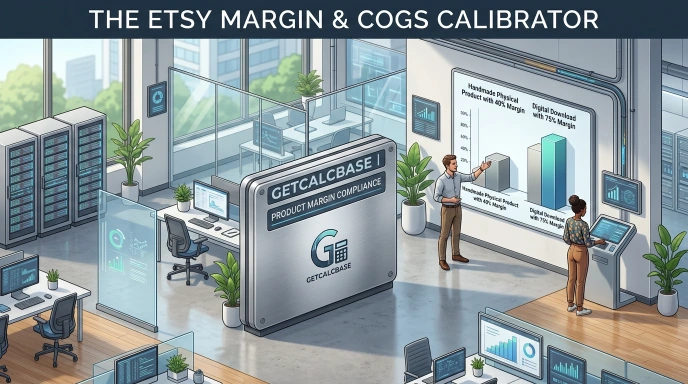
For handmade physical products, a net profit margin of 30 to 50% after all fees and costs is considered strong. Below 20% is thin — any increase in material costs or any addition of advertising will likely push you into loss territory.
For digital products (printables, patterns, templates, SVG files), margins of 60 to 80% after Etsy fees are achievable because there’s no physical production cost. At these margins, even the offsite ads fee at 15% still leaves a profitable sale.
For print-on-demand products (where you pay a third party to produce and ship), margins are typically tighter — 15 to 30% — because your COGS includes the production partner’s cost. Pricing POD products requires more careful fee calculation than handmade or digital items.
As a general rule: if your net profit margin is below 20% after all fees, one bad month — a slow sales period, an unexpected material price increase, a mandatory offsite ads enrollment — can push you into negative territory. Price for a margin that gives you a buffer.
What Technology Powers This Tool?
The GetCalcBase Etsy Calculator runs entirely in your browser using client-side JavaScript. Nothing you enter is sent to a server. No data is stored. No login is required.
The reverse profit engine uses algebraic inversion of the complete Etsy fee formula — working backwards from your target profit through every fee layer to calculate the exact required selling price. It accounts for discounts applied before fees are calculated, the fixed payment processing flat fee, and percentage-based fees simultaneously.
The region selector loads the correct payment processing rate and currency symbol for the chosen market. Multi-unit listing fee calculation (for renewals) adjusts the listing fee total based on how many renewal cycles you specify.
This is a genuine calculation tool built for real Etsy sellers — not a simplified version that only accounts for two or three fee types.
On Trust — Why This Calculator Is Worth Using
Etsy’s fee structure is not simple. It’s designed to be understandable in isolation — each fee sounds reasonable when you read it in Etsy’s help documentation — but the compounding effect of multiple fees on the same sale dollar is what catches sellers off guard.
This tool was built specifically to show that compounding effect clearly. Not to criticize Etsy — selling on a platform with 90 million active buyers has real value — but to help sellers enter that platform with accurate information rather than optimistic assumptions.
Every calculation in this tool matches Etsy’s published fee rates for 2026. The formulas are transparent. The results are honest. If the number surprises you, that’s exactly the point: better to be surprised now than after you’ve listed 200 items at the wrong price.

Frequently Asked Questions (FAQs)
How much does Etsy take from a $100 sale?
From a $100 sale with free shipping, a US seller using Etsy Payments pays: $0.20 listing fee + $6.50 transaction fee (6.5%) + $3.25 payment processing (3% + $0.25). That’s $9.95 in Etsy fees — so you keep approximately $90.05 before subtracting your production costs. If offsite ads apply at 15%, add another $15.00, leaving roughly $75 before costs. The exact amount depends on whether you have shipping included and whether the sale came through an offsite ad.
How much does Etsy charge to sell digital products?
The same fee structure as physical products: $0.20 listing fee, 6.5% transaction fee on the sale price, and payment processing (3% + $0.25 for US sellers). There’s no shipping charge for digital products since nothing ships, so the transaction and processing fees only apply to the item price. Offsite ads apply at the same rates if you’re enrolled. The key advantage is zero material cost — meaning margins for digital products are significantly higher than for physical goods.
How do I calculate Etsy fees manually?
The formula: Net Profit = (Sale Price + Shipping Charged) − $0.20 listing − 6.5% of (Sale Price + Shipping) − [3% × (Sale Price + Shipping) + $0.25] − Your Costs − Offsite Ads (if applicable). It’s a multi-step calculation that’s error-prone when done manually, especially when combining the fixed and percentage-based elements of the payment processing fee. Using a calculator eliminates this risk.
How much does Etsy take from a $10 sale?
From a $10 item with no shipping, a US seller pays: $0.20 listing + $0.65 transaction (6.5%) + $0.55 processing (3% + $0.25) = $1.40 in Etsy fees. You’d keep $8.60 before your costs. On small-ticket items, the fixed $0.25 processing component becomes a higher percentage of total revenue — which is why very low-priced items on Etsy are harder to make profitable than higher-priced ones.
Can you make $10,000 a month on Etsy?
Yes — but it requires high-volume sales, strong SEO, competitive pricing, and careful margin management. Most sellers who reach that level have multiple active listings (often 100+), strong product-market fit, and have typically been selling for one to three years. Hitting $10,000 in monthly revenue also means crossing the $120,000 annual sales threshold, which would make offsite ads mandatory and permanently affect your fee structure. Use this calculator to model what margins look like at scale before planning growth.
Is selling digital products on Etsy worth it?
For many sellers, yes. Digital products have zero fulfillment cost, infinite inventory, and margins that hold even after Etsy’s fees. A digital print that sells for $8 might cost you 90 minutes to create — but after that, every subsequent sale is pure margin minus Etsy fees. The challenge is discoverability on a platform with millions of digital listings. Strong SEO, niche targeting, and consistent listing updates tend to be more important for digital sellers than for physical product sellers.
Does Etsy take 30% of your sale?
No. Etsy’s combined standard fees (listing + transaction + payment processing) typically total 10-12% of the sale amount for most sellers — not 30%. The confusion usually comes from also counting Etsy Ads spend or Offsite Ads fees on top of standard selling fees. Use the calculator above to see your exact percentage.
Does Etsy charge a Regulatory Operating Fee everywhere?
No, only in select countries — currently Turkey, Vietnam, Canada, Spain, France, the UK, Italy, and India. It’s added on top of your normal fees to cover local digital tax regulations. If you sell from outside these countries, you won’t see this charge.
Conclusion — Price Right From the Start
The sellers who grow on Etsy aren’t necessarily the ones with the best products. They’re the ones who understand their numbers.
Pricing too low feels safer — but it means working harder for less money, with no margin for error when costs go up or advertising becomes mandatory. Pricing too high without knowing your competitors’ range means fewer sales. The right price is the one that gives you a healthy margin, covers every fee Etsy will charge, and still lands within your market’s acceptable range.
This free Etsy fee calculator gives you that number in seconds. Not an approximation. Not a rough estimate. The actual number, calculated against the actual 2026 fee structure for your specific region, your specific costs, and your specific advertising situation.
Use it before every new listing. Use it when Etsy changes its fees. Use it when your costs change. Use it whenever you wonder why a sale feels less profitable than you expected.
Pricing right from the start is easier than fixing wrong prices later.
Content prepared for GetCalcBase.com — Finance Tools Category Tool: Etsy Profit & Fee Calculator | 2026 rates All fee figures based on Etsy’s published seller rate structure Website Developer Waseem Aijaz Linkedin
Important Disclaimer
This Etsy fee calculator is provided for informational and planning purposes only. Fee calculations are based on Etsy’s published rate structure for 2026 and are accurate to the best of our knowledge at the time of publication. Etsy may update its fee structure at any time, and regional regulatory fees, VAT rates, and payment processing rates may vary. Always verify current rates in your Etsy Seller Dashboard before making final pricing decisions. GetCalcBase is not affiliated with Etsy, Inc.
Related Tools on GetCalcBase
- Finance Calculators — Full suite of financial planning tools
- Affiliate Marketing ROI Calculator
- CTR Calculator
- Digital Marketing Tools
What the Get Calculator Base Community Says
Average Rating: 4.8/5 based on our beta users