
This tool is truly exceptional because it breaks down exactly how strong or weak your password is. But the most amazing part is that within this single platform, you can generate a secure password and instantly check its exact security score. You can confidently use it to secure any of your bank accounts, social media profiles, or personal credentials!
You’ve probably heard the general advice dozens of times. Use a long password. Mix in numbers and symbols. Don’t reuse passwords. Most people nod along and then go back to using the same password they’ve been using since 2018 — maybe with a “!” added at the end.
Here’s what actually changes when you understand the numbers behind password cracking: the advice stops feeling generic and starts feeling urgent.
In 2026, a high-end GPU cluster can attempt 400 billion password combinations per second. That’s not a hypothetical future threat. That’s consumer-accessible hardware available today. A setup of 12 NVIDIA RTX 5090 GPUs — which any sufficiently motivated attacker can rent through cloud services — hits that benchmark against simple hashing algorithms.
At that speed, an 8-character password using only numbers is cracked instantly. An 8-character password with letters, numbers, and symbols takes roughly 4 days. A 12-character all-character password? That’s where things start to take centuries.
This guide breaks down the actual crack times, explains what drives them, and gives you the framework to build passwords that hold up against modern attacks — not just the threats that existed in 2015.
Test any password against 2026 benchmarks using the free crack time calculator at GetCalcBase.
What Is Brute Force Password Cracking?
Brute force is the most straightforward of all attack methods. The attacker’s system generates every possible combination of characters and tests each one against the stolen password hash until it finds a match.
It’s computationally intensive — but GPUs are extraordinarily good at this kind of parallel computation. The same hardware architecture that renders graphics in real time is ideal for attempting billions of hash calculations simultaneously.
Modern brute force attacks don’t work the way people imagine. There’s no human sitting at a keyboard trying passwords one by one. It’s an automated process running on powerful hardware, testing millions or billions of combinations per second without pausing.
How does the attacker get your password to crack in the first place?
Usually through a data breach. When a website or service gets hacked, attackers steal the password database. Passwords are stored as hashes — scrambled versions that can’t be directly reversed — so the attacker must crack those hashes by trying combinations until one produces a matching hash.
This is why the security of your password depends not just on how complex it is, but on how quickly the attacker’s hardware can work through the combinations. And hardware has gotten dramatically faster.
The 2026 Brute Force Benchmarks — Real Numbers
The most widely referenced data for password cracking speeds comes from Hive Systems, which has published annual password tables since 2020. Their methodology uses realistic consumer-accessible hardware configurations and standard password hashing algorithms.
Hardware progression that changed the game:
| Year | Hardware Used | Hash Algorithm | Approximate Speed |
|---|---|---|---|
| 2020 | 1× RTX 2080 | MD5 | ~10 billion/sec |
| 2022 | 8× A100 | MD5 | ~100 billion/sec |
| 2023 | 12× RTX 4090 | MD5 | ~300 billion/sec |
| 2024 | 12× RTX 4090 | bcrypt (5) | Much slower |
| 2025 | 12× RTX 5090 | bcrypt (10) | Varies by length |
| 2026 | 12× RTX 5090 | Mixed | ~400 billion/sec (simple hash) |
The shift from MD5 to bcrypt in 2024 was significant — bcrypt is deliberately slow, adding computational cost to each attempt. But bcrypt doesn’t eliminate the threat; it delays it. Short or simple passwords are still crackable within hours or days even with bcrypt.
The GetCalcBase password crack time calculator uses the 400 billion attempts/second benchmark for its estimates — reflecting 2026 high-end consumer GPU performance against simple hash algorithms.
Password Crack Time Chart — 2026 Data
This table reflects brute force crack times based on 2026 hardware benchmarks. These are mathematical worst-case estimates — if your password follows predictable patterns, AI-assisted attacks can crack it much faster.
| Length | Numbers Only | Lowercase | Upper + Lower | All Characters |
|---|---|---|---|---|
| 4 | Instant | Instant | Instant | Instant |
| 6 | Instant | Instant | Instant | Instant |
| 7 | Instant | Instant | Instant | Seconds |
| 8 | Instant | Minutes | Hours | Days |
| 9 | Instant | Hours | Days | Months |
| 10 | Instant | Days | Months | Years |
| 11 | Instant | Weeks | Years | Centuries |
| 12 | Instant | Years | Centuries | Millennia |
| 14 | Seconds | Centuries | — | — |
| 16 | Hours | — | — | — |
| 18 | Months | — | — | — |
Reading this table correctly:
Numbers-only passwords are essentially always crackable regardless of length until you reach 16+ characters. That’s because a 10-character numeric password has only 10^10 = 10 billion combinations — which a modern GPU cluster runs through in milliseconds.
Adding character types multiplies the difficulty exponentially. An 8-character lowercase password has 26^8 = 208 billion combinations. The same length with all character types has 95^8 = 6.6 quadrillion combinations — 31,000 times harder.
But length is the dominant factor at higher ranges. A 12-character lowercase password (26^12 = 95 trillion trillion combinations) takes longer to crack than an 8-character all-character password — despite using a simpler character set.
AI-Assisted Cracking — Why the Numbers Above Are Optimistic
The brute force table above represents the mathematical worst case for attackers — trying every possible combination systematically. Real attacks in 2026 are frequently faster because they use AI-assisted pattern recognition rather than pure brute force.
How AI cracking works:
AI tools like PassGAN (Password Generative Adversarial Network) are trained on millions of real leaked passwords. Instead of trying character combinations alphabetically, they learn statistical patterns in how humans create passwords and try the most likely combinations first.
A recent study analyzed 14.2 million real-world passwords using an AI cracking tool. The results:
- 85.6% cracked in under 10 seconds
- 85.8% cracked within one minute
- Nearly 88% cracked within one month
The most striking finding: almost no passwords existed in the “middle ground.” Passwords either fell instantly — or held for a very long time. The gap between immediately crackable and practically uncrackable is sharp.
What AI exploits:
The patterns humans use when creating passwords are remarkably consistent. Capital letter at the start. Number at the end. Year instead of random digits. Common word with letter-to-number substitutions. These patterns appear in millions of leaked passwords — which means AI learns to try them first.
“Summer2025!” is 11 characters and contains uppercase, lowercase, numbers, and symbols. The brute force table says it should take years. AI cracks it instantly, because: Capitalized English word + four-digit year + exclamation mark is one of the most common password patterns in existence.
What actually defeats AI:
True randomness. A password generated by a password manager — genuinely random characters with no pattern — cannot be predicted. AI has nothing to learn from it. It falls back to pure brute force, which takes the full combinatorial time shown in the table above.
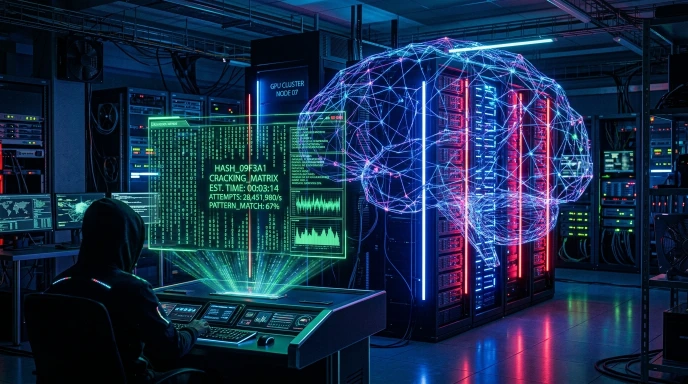
This is the practical case for using a password generator rather than choosing your own passwords. Your brain, trying to create something “random,” consistently creates something pattern-based.
Why Length Matters More Than Complexity
This is counterintuitive to most people — and it’s the most important thing to understand about modern password security.
People believe complexity (mixing uppercase, numbers, symbols) is what makes passwords strong. The math shows length is more powerful.
The comparison:
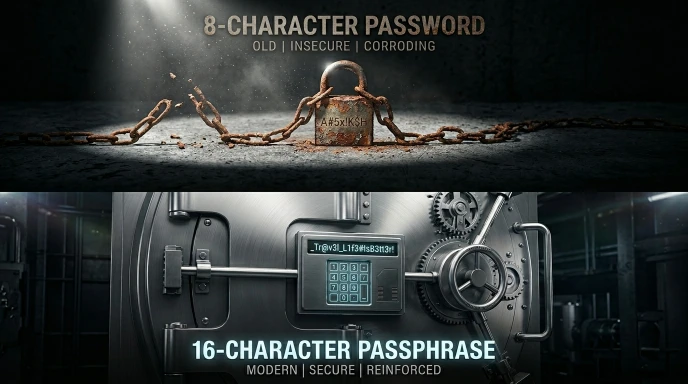
8-character all-character-types password: 95^8 = 6.6 quadrillion combinations
15-character lowercase passphrase: 26^15 = 1.7 septillion combinations
The 15-character lowercase passphrase has 240 million times more combinations than the 8-character complex password. At 400 billion attempts per second, the complex 8-character password cracks in about 16 seconds. The 15-character passphrase would take approximately 4 million years.
The NIST (National Institute of Standards and Technology) 2025 guidelines reflect this math directly. Their updated recommendations:
- Prioritize length over complexity
- Minimum 15 characters (not 8)
- Avoid forced regular password changes (they lead to weaker, predictable variations)
- Screen new passwords against known breach databases
- Encourage or require multi-factor authentication
The shift is significant: the advice that security professionals gave for years — “make it complex with symbols” — is being replaced by “make it long and unique.”
Password Security Mistakes That Cost People Their Accounts
Understanding what attackers look for first helps you avoid making the easiest targets.
Reusing passwords across multiple sites This is the most dangerous habit, and the most common. When one service gets breached — and breaches happen to well-known services regularly — attackers try the stolen username/password combination on every other major service. This is called credential stuffing. The password’s strength is irrelevant if an attacker doesn’t need to crack it because they already have it in plain text from another breach.
Short passwords that feel complex “@dm!n1!” is 7 characters. It contains uppercase, lowercase, numbers, and symbols. Most people would consider it reasonably secure. At 400 billion attempts per second, it cracks in under a second. The complexity is real — but 7 characters simply doesn’t provide enough combinations.
Predictable patterns treated as unique “MyDog$Fluffy2020” feels personal and unique. But first name, object, year with a symbol in between is a well-documented password pattern. AI-assisted crackers recognize this structure and test variations early.
Not checking whether passwords have been breached. A technically strong password that appears in a known breach database is effectively compromised. Services like Have I Been Pwned allow you to check email addresses for known breaches. The data breach calculator at GetCalcBase provides additional context on breach exposure.
What Makes a Password Practically Uncrackable in 2026?
Based on current hardware benchmarks and the math of password entropy, here’s what creates a genuinely strong password:
Minimum 14 characters — this is the hard floor. Below 14, even all-character-types passwords become increasingly vulnerable to hardware advances over the next few years.
All four character types — uppercase, lowercase, numbers, symbols. Each type added increases the character pool and multiplies combinations.
True randomness — generated by a password manager, not chosen by a person. Human-chosen “random” is never actually random.
Uniqueness — different for every account. If one service is breached, the compromise stops there.
Entropy above 80 bits — you can verify this using the free crack time checker at GetCalcBase.
An example of a practically uncrackable password: Xk#9mP@2qR7nL4$w — 16 characters, all character types, truly random, entropy above 100 bits. At 400 billion attempts per second, that cracks in significantly longer than the age of the universe.
Nobody can remember a password like that — which is why password managers exist.
Brute Force Crack Time Checklist — Before You Set Any Password
✅ Test the password in the crack time calculator
✅ Entropy should be above 80 bits minimum
✅ Crack time should show “Years” or “Centuries” — not days or weeks
✅ Length should be 14 characters or more
✅ All four character types should be present
✅ No dictionary words, names, dates, or keyboard patterns
✅ Not reused from any other account
✅ Generated by a password manager, not chosen manually
✅ Multi-factor authentication enabled on the associated account
✅ Email address checked against known breach databases
FAQs — Password Cracking Times
How long does it take a hacker to brute force a password in 2026? With modern GPU cluster hardware capable of 400 billion attempts per second: an 8-character all-character password takes roughly 4 days. A 10-character all-character password takes years. A 12-character all-character password takes centuries. Numbers-only passwords of any reasonable length crack almost instantly.
How long does brute force take for a 12-character password? A 12-character password using all character types has 95^12 ≈ 540 quadrillion quadrillion combinations — effectively billions of years to crack by pure brute force. However, if the password follows human patterns, AI tools may crack it in seconds by predicting those patterns.
Is a 12-character password with symbols safe in 2026? Mathematically yes — a truly random 12-character all-character password is practically uncrackable by brute force. The risk is that most 12-character passwords aren’t truly random — they follow patterns that AI identifies quickly. Use a password manager to generate genuinely random passwords.
What is the Hive Systems password table 2026? Hive Systems publishes an annual password crack time table showing how quickly various password configurations can be brute-forced using current consumer GPU hardware. The 2026 update (expected Q2 2026) will reflect RTX 5090 benchmarks. The 2025 table used 12× RTX 5090 GPUs with bcrypt-10 hashing.
How much does it cost hackers to crack passwords in 2026? Hardware capable of 400 billion attempts per second (12× RTX 5090) represents a significant investment — but cloud GPU rental makes comparable performance accessible for tens of dollars per hour. For targeting a specific account in a high-value breach, the economics are straightforward for motivated attackers.
Does multi-factor authentication protect against brute force? Yes, significantly. Even if an attacker cracks your password, MFA prevents account access without the second factor. MFA doesn’t make your password stronger — but it makes a cracked password useless without your phone or authenticator app.
Conclusion — The Gap Between Safe and Cracked Is Larger Than You Think
The data on password cracking times paints a clear picture: there’s almost no middle ground. Passwords either fall in seconds or hold for centuries. The difference comes down to length, randomness, and whether the password follows patterns that AI recognizes.
The passwords most people use — shorter than 12 characters, built on familiar patterns, reused across multiple accounts — are categorically unsafe against 2026-level hardware. The passwords that are actually safe look nothing like what humans naturally create.
Use the free password strength checker at GetCalcBase to test any password against current benchmarks. See the entropy. See the crack time. See whether what you’re using is protecting you — or just feels like it is.
Prepared by Waseem Aijaz — WordPress Developer & SEO Expert
More Free Tools at GetCalcBase: