

Cyber Liability Insurance: How Much Coverage Does Your Business Actually Need in 2026?
This is my own personal experience, and that’s exactly why I want to open with it. My website data was hacked, and I had no real idea how much damage or cost that kind of incident could create. I just knew it was bad — I didn’t know how bad, in actual numbers.
I brought in cybersecurity experts to help me understand the real financial picture, and that’s when I first learned about something called a “data breach cost calculator.” Once I understood how it worked, it became obvious that if I’d faced this uncertainty, plenty of other business owners were facing the exact same thing.
That’s why I built the Data Breach Cost Calculator — a free tool based on real 2026 breach cost research, built from more than 10 years of hands-on experience in this field.
Let’s be honest for a second: nobody enjoys paying for insurance. It feels like throwing money into a black hole — until the day your screen goes dark and a ransom note pops up.
In 2026, cyber insurance isn’t a “nice to have” corporate checkbox anymore. It’s closer to a survival requirement. But here’s the actual problem most business owners run into: they either buy too little coverage and risk bankruptcy during a real breach, or they overbuy and waste capital they didn’t need to spend.
To find that middle ground, you first need to know exactly what you’re protecting. Before you even call an insurance agent, run your numbers through a proper data breach cost calculator to see your financial exposure in plain figures.

Why 2026 Is Different for Cyber Risk
The days of simple viruses are gone. Businesses today deal with shadow data leaks and AI-driven social engineering attacks that are harder to catch early. If your data gets compromised, you’re not just paying for a technical fix — you’re paying for legal battles, regulatory fines, and the much larger cost of losing customer trust.
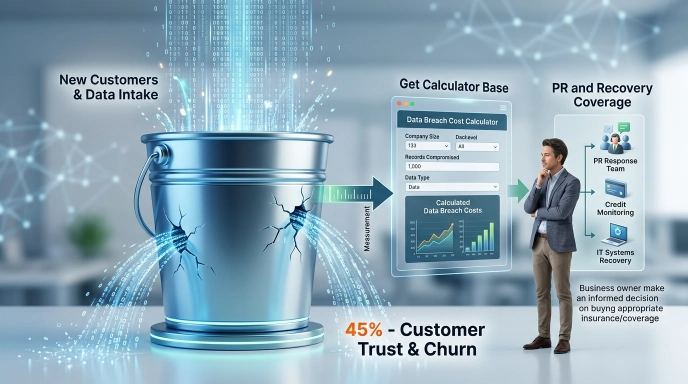
Run your numbers through a data breach cost calculator, and you’ll usually see that close to 45% of the total cost comes from customer churn alone. Most standard insurance policies quietly skip covering this part unless you specifically know to ask.
Understanding the Two Sides of Cyber Insurance
When picking a policy, make sure it covers both sides of the disaster:
- First-Party Coverage — this pays for your own house when it’s on fire. It covers IT forensics, data restoration, and the cost of notifying affected customers.
- Third-Party Coverage — this pays for the neighbor’s house if your fire spreads. It covers legal defense costs if customers sue you over lost or exposed personal information.
To keep your baseline risk low before you even talk to an insurer, something as simple as using a strong, unique password across your team’s accounts can genuinely help lower your premium. Weak, reused passwords are one of the most common entry points insurers flag during underwriting.
Ballpark Your Risk Before You Talk to an Agent
Before requesting quotes, it helps to know roughly what you’re protecting against. Run your numbers through our free Data Breach Cost Calculator — enter your industry, data type, and record count to get an estimate of your potential exposure. Bring that number to your insurance conversation; agents respond better to informed buyers, and you’ll be able to tell quickly if a quoted coverage limit is actually enough.
2026 Coverage Comparison: How Much Is Enough?
Every business is different, but this table gives you a realistic starting point:
| Business Size | Records Stored | Recommended Coverage | Typical Annual Premium Range* |
|---|---|---|---|
| Micro / Freelancer | Under 1,000 | $100K–$250K | $500–$1,500 |
| Small Startup | 10,000–50,000 | $500K–$1M | $2,000–$6,000 |
| Mid-Market | 50,000–500,000 | $1M–$5M | $8,000–$25,000 |
| Enterprise | 500,000+ | $5M–$10M+ | $25,000+ |
Ranges are illustrative — actual premiums vary by industry, security posture, and claims history. Always confirm with a licensed broker.
If your business operates outside the US — say, in Pakistan, India, or the UAE — don’t just apply these figures directly. Regulatory fines and legal settlement costs vary significantly by country, which is exactly why regional cost modeling matters more than a single global number. Our data breach calculator adjusts for this by letting you view your estimate in your own local currency, whether that’s PKR, INR, GBP, SAR, or AED, instead of forcing everything into USD.
What Insurers Actually Check Before Pricing Your Policy
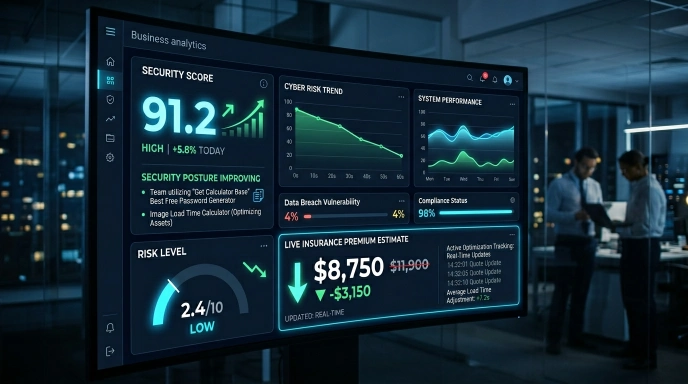
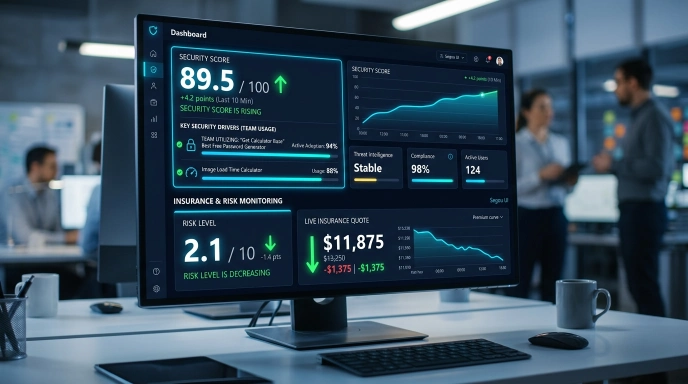
Insurance companies in 2026 look closely at how prepared you are before setting your rate. Businesses that show real security discipline consistently get better pricing.
A few things that genuinely move the needle:
- Using strong, unique credentials across your team, rather than shared or reused passwords
- Having a documented incident response plan, even a simple one
- Keeping software and plugins updated instead of running years-old versions
- Being able to show a reasonable mean time to detect a breach, rather than no monitoring at all
- Whose records you hold — customer data is weighted differently than employee-only data.
- How many people’s data you store — larger volumes mean higher notification and regulatory exposure.
- What type of records — personal info alone costs less to insure than personal info + health or payment card data combined.
- How a breach would likely happen — accidental leaks are treated more leniently by regulators (and often insurers) than preventable hacks.
- Whether you store physical mailing addresses — mailed notifications are the most expensive notification method, and insurers price for that.
- Your breach history — a prior publicly disclosed breach in the last 24 months signals higher risk to underwriters.
- Network complexity — more locations, more legacy systems, and more remote access all increase investigation costs after an incident.
- How newsworthy a breach would likely be — a breach that would make national news costs more to manage (PR, legal pressure, regulatory attention) than a quiet one.
- Your current security posture — insurers reward companies whose controls are at or above industry standard with better pricing.
- Whether you operate in California — California’s privacy laws mean higher settlement exposure, which insurers factor into premiums for CA-based businesses.
The stronger you score on these 10 factors, the lower your premium — this is exactly what an underwriter is evaluating, whether or not they show you the scorecard.
None of these require a large security budget. They’re mostly discipline, not spending.
3 Questions to Ask Your Insurance Agent
Don’t just sign the paperwork. Ask these three things directly:
- “Does this cover social engineering?” If an employee is tricked into wiring money to a fraudster, does the policy actually reimburse that loss?
- “What’s the sub-limit for ransomware?” It’s common for a policy advertised at $1M to only pay out $50k specifically for ransomware incidents — read the fine print.
- “Do you provide a digital forensics team?” During an active breach, you need experts available immediately, not after a two-week onboarding process.
- “Does my policy cover social engineering, or only technical hacks?” Many policies exclude losses from employees being tricked into wiring money or sharing credentials unless social engineering coverage is added separately — always confirm this explicitly.
- “What’s the sub-limit for ransomware, and does it match my actual risk?” Some policies advertise a large headline coverage limit but cap ransomware-specific payouts much lower — read the sub-limits, not just the top-line number.
- “Do you provide a breach response team, or do I have to find one during an active breach?” Panel-based insurers pre-vet forensic and legal responders so you’re not searching for a breach coach mid-crisis — ask whether this is included or something you’d need to arrange yourself under time pressure.
Strategic FAQs
How much does cyber insurance cost in 2026? It varies, but most small businesses pay between $500 and $2,000 per year. The exact price depends on how much sensitive data you store and your security track record.
Is a data breach cost calculator accurate for my specific city or country? A good one should be. Our tool at GetCalcBase applies regional cost weights, since a breach in New York carries different legal exposure than one in Lahore or Dubai, and the math accounts for that difference.
Does cyber insurance cover government fines? Usually, yes — but only if “Regulatory Defense and Penalties” is explicitly listed in your policy. If it isn’t named directly, don’t assume it’s included.
Can I get cyber insurance if I’ve already been hacked once? Yes, though your premium will typically be higher. Insurers will usually want proof that you’ve patched the specific vulnerability that led to the earlier incident.
Final Thoughts
Cyber insurance isn’t a magic fix that solves everything after an attack. It’s a safety net — and the real goal is building enough of a security-first culture that you rarely need to use it.
Check your actual numbers today using the data breach cost calculator. Once you see how the global average — now sitting around $4.88 million — could apply to your own business, a modest insurance premium starts to look like one of the smarter investments you’ll make this year.
About the Author: Waseem Aijaz is a developer and SEO expert who builds privacy-first tools for GetCalcBase. He believes data security should be accessible to every business owner, regardless of technical background.
Connect on LinkedIn.