

“Are you planning a trip across European countries and want to figure out your exact route and travel costs? If so, you have come to the absolute right place! Scroll down, read our comprehensive travel blueprint, and click the button below to test out the tool for yourself.
First, you can pinpoint your starting location either by clicking directly on the map or by typing it in manually. After that, simply input the current cost of fuel—or whatever energy source your vehicle runs on—based on your local country’s rates. Our engine will instantly calculate your estimated travel time, overall costs, and optimal routes! However, please remember that this tool is strictly for educational and informational purposes. It does not constitute fixed financial or legal advice, and you should always rely on Google Maps for your actual live route navigation.”
Europe is one of the most rewarding places in the world to take a road trip. The distances between major cities are often manageable in a single day’s drive. The roads are generally excellent. The scenery changes dramatically across borders. And the freedom to stop wherever something catches your eye — a vineyard in Tuscany, a medieval town in Alsace, a cliff-top village in Croatia — is something no train schedule gives you.
The financial side of European road travel is where most people get a surprise. Fuel prices vary dramatically from country to country. Several countries require vignettes (prepaid road use stickers) rather than per-journey tolls. Motorway tolls in France and Italy add up quickly on long routes. Parking in European cities ranges from free to expensive. And the euro exchange rate affects every cost for travelers coming from outside the eurozone.
This guide covers how to plan a Europe road trip from a financial perspective — routes, costs, budgets, and the calculations you need to do before you depart. Use the free road trip planner at GetCalcBase to calculate each segment’s fuel cost as you build your itinerary.

Planning a Europe Road Trip — Starting With the Route
Before any cost calculation is possible, you need a route. European road trip routes generally fall into three categories:
Single-country deep exploration Spending two weeks in one large country — France, Germany, Italy, Spain — and exploring it in depth. Less driving overall, more time per destination. Lower total fuel cost. Lower logistical complexity (no cross-border paperwork, single fuel price zone, no vignette purchases).
Multi-country circuit A loop connecting several neighboring countries — classic examples include France-Switzerland-Austria-Germany or Poland-Czech Republic-Hungary-Slovakia. More variety but higher total distance, more border crossings (seamless within Schengen), and different fuel prices to account for in each segment.
Continent-crossing route Extended trips from western Europe to eastern Europe or from northern Scandinavia through the Mediterranean. Very high distances, significant fuel variation between regions, and often the most visually diverse itinerary. Requires careful per-country cost calculation.
The route you choose determines your total driving distance — which is the input the road trip cost calculator needs to generate accurate fuel cost estimates.
European Fuel Prices by Country — 2026 Reference
Fuel prices in Europe vary more than most travelers expect. The difference between the cheapest and most expensive fuel in Europe can be 60 to 80 cents per liter — which on a 2,000 km trip using 150 liters of petrol amounts to a difference of €90 to €120 in fuel cost alone.
Approximate petrol price ranges by region (2026, mid-grade petrol):
| Country/Region | Approx. Price per Liter (EUR) |
|---|---|
| Luxembourg | €1.35 – €1.45 |
| Poland | €1.30 – €1.45 |
| Czech Republic | €1.40 – €1.50 |
| Hungary | €1.45 – €1.55 |
| Germany | €1.60 – €1.75 |
| France | €1.70 – €1.85 |
| Spain | €1.55 – €1.70 |
| Italy | €1.75 – €1.90 |
| Netherlands | €1.85 – €2.00 |
| Switzerland (CHF) | CHF 1.85 – CHF 2.00 |
| Norway (NOK) | NOK 19 – NOK 22 |
| Sweden (SEK) | SEK 18 – SEK 22 |
Practical implications for route planning:
If your itinerary passes through Luxembourg, fill your tank there — it’s consistently among the cheapest fuel in Western Europe. If you’re entering Switzerland from France or Germany, fill up before the border. Switzerland’s fuel is priced in CHF and tends to be expensive by European standards.
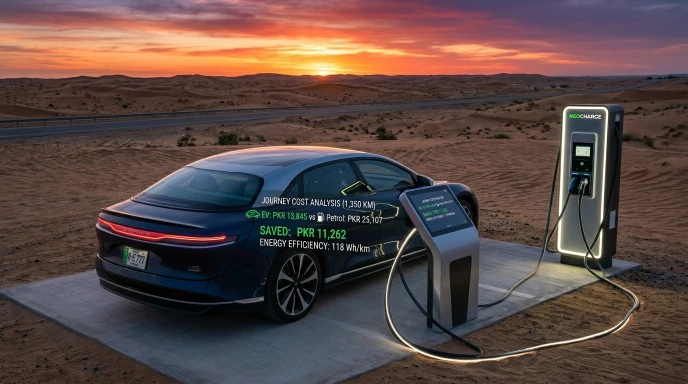
For a multi-country itinerary, run each country segment through the road trip planner separately with that country’s fuel price. This gives you a country-by-country cost breakdown rather than an inaccurate single average.
European Road Tolls and Vignettes — The Cost Most Travelers Forget
Fuel is not the only driving cost in Europe. Many countries charge separately for motorway use — either through toll booths (per-journey) or vignette systems (prepaid time-based access).
Toll booth countries (pay-per-journey): France, Italy, Spain, Portugal, Greece. These charge at motorway access points and vary by distance and vehicle type. A cross-France motorway drive from Calais to Nice can cost €80 to €100 in tolls alone. Italy’s motorway (autostrada) network is extensive and similarly priced.
Vignette countries (prepaid time access): Austria, Switzerland, Czech Republic, Hungary, Slovakia, Slovenia, Bulgaria, Moldova. You purchase a sticker (or increasingly a digital vignette) that gives you motorway access for a fixed period — typically 10 days, 1 month, or 1 year. Prices for a 10-day or monthly vignette range from approximately €9 (Czech Republic) to €41.80 (Austria as of 2026).
Important: Driving on a vignette motorway without a valid vignette results in a substantial fine — typically €120 to €300 depending on the country. Always purchase vignettes before entering the country or at the border. Several countries now use digital vignette systems requiring online registration before travel.
No motorway tolls: Germany has no general motorway tolls for private vehicles. Netherlands, Belgium, Denmark, Sweden, Norway use other road funding systems — though Norway has several toll rings around major cities.
Budget for tolls as a separate line item. For a France-Switzerland-Austria itinerary of 1,500 km, toll and vignette costs could easily reach €100 to €150 — a meaningful addition to your fuel budget.
2-Week Europe Road Trip — Sample Itinerary with Cost Estimates
Here is a realistic 2-week Europe road trip itinerary for two people traveling in a mid-size car (10 L/100 km fuel consumption, approximately 10 km/L or 14 km/L on motorways), starting and ending in Paris.
Assumed vehicle: 10 liters per 100 km (mid-size European car on motorways) Assumed fuel price: €1.75/liter average across the route
Day 1-2: Paris → Strasbourg (490 km) Fuel: 49 L × €1.75 = €85.75 Tolls: Approximately €35 (A4/A26 motorway)
Day 3-4: Strasbourg → Munich (400 km) Fuel: 40 L × €1.65 (German fuel) = €66 Tolls: Germany has no motorway tolls for private cars = €0
Day 5-6: Munich → Innsbruck → Vienna (600 km) Fuel: 60 L × €1.60 (Austria) = €96 Austrian vignette (10-day): €9.90 Tolls on A9/A10 mountain routes: Approximately €25
Day 7-8: Vienna → Budapest → Ljubljana (500 km) Fuel: 50 L × €1.50 (Hungary/Slovenia average) = €75 Hungarian vignette (10-day): Approximately €14 Slovenian vignette (7-day): Approximately €15
Day 9-10: Ljubljana → Venice → Florence (550 km) Fuel: 55 L × €1.80 (Italian fuel) = €99 Italian motorway tolls: Approximately €45
Day 11-12: Florence → Nice (450 km) Fuel: 45 L × €1.80 (Italy/France) = €81 Tolls: Approximately €40
Day 13-14: Nice → Paris (1,000 km) Fuel: 100 L × €1.75 (French fuel) = €175 French motorway tolls: Approximately €85
Complete 2-Week Trip Summary:
| Category | Total |
|---|---|
| Total driving distance | ~3,990 km |
| Total fuel cost | ~€678 |
| Total tolls and vignettes | ~€269 |
| Total Driving Costs | ~€947 |
| Accommodation (13 nights × €100 avg) | €1,300 |
| Food (2 people × 14 days × €50/day) | €1,400 |
| Contingency (15%) | €548 |
| Total 2-Week Trip Budget (2 people) | ~€4,195 |
| Per Person | ~€2,098 |
This is a realistic planning estimate. Actual costs will vary based on accommodation choices, dining habits, off-motorway detours, and whether you camp or use paid accommodation.
How to Use the Road Trip Planner for Europe Trip Planning
The GetCalcBase road trip planner uses real road routing — not straight-line distances — to calculate accurate driving distances. For European multi-stop trips, here’s the most effective way to use it:
Step 1: Plan your itinerary city by city on paper first. Write down your sequence of destinations.
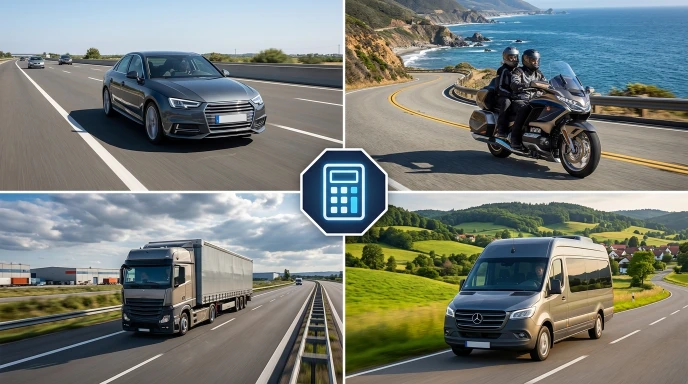
Step 2: Calculate each leg separately in the tool. Paris → Strasbourg is one calculation. Strasbourg → Munich is another. This gives you per-leg distance and cost.
Step 3: Switch currency to EUR (or GBP, CHF, NOK, SEK as needed for each country segment). Enter that country’s approximate current fuel price.
Step 4: Use the sedan vehicle profile (car, standard) with an efficiency figure matching your actual vehicle. European cars tend to be more fuel-efficient than South Asian or North American averages — a typical European mid-size petrol car achieves 14 to 18 km/L on motorways.
Step 5: Note each leg’s fuel cost and add your toll estimate for that country segment separately.
Step 6: Sum all legs for your total driving cost, then add accommodation, food, and contingency.
Europe Trip Planning for Different Traveler Types
Solo Traveler
A solo Europe road trip maximizes freedom but means all costs fall on one person. The per-person cost is highest for solo travel — but the flexibility to change plans daily, stay longer somewhere unexpected, and skip places that don’t feel right is unmatched. Budget approximately €100 to €150 per day for a solo traveler covering accommodation, food, and daily incidentals.
Two-Person Trip
The most cost-effective structure for European road travel. Accommodation and vehicle costs are split between two people, approximately halving the per-person daily cost compared to solo travel. Most car rental and fuel costs are the same regardless of whether one or two people are in the car.
Family Trip
Family road trips in Europe require more accommodation space (two rooms or a larger apartment), higher daily food budgets, and route choices that include child-appropriate activities and rest stops. Budget more generously for accommodation — a family-friendly apartment or two hotel rooms is significantly more expensive than a single room. The fuel cost per-person decreases attractively with more passengers.
Motorcycle Trip
A motorcycle road trip in Europe reduces fuel costs dramatically — a touring motorcycle at 25 to 35 km/L uses two to three times less fuel than a car on the same route. Accommodation costs are the same or sometimes lower (some campgrounds charge less for motorcyclists). The constraint is weather and luggage capacity. Use the motorbike option in the road trip planner and compare the fuel cost against a car to see the saving.
Europe Trip Budget by Duration
A common planning question: “How much should I budget for a Europe road trip?” The honest answer depends on travel style, but here are realistic ranges for two people in a privately owned car:
| Duration | Budget Travel | Moderate | Comfortable |
|---|---|---|---|
| 1 week | €1,200 – €1,600 | €2,000 – €2,800 | €3,500+ |
| 2 weeks | €2,200 – €3,000 | €3,800 – €5,000 | €6,500+ |
| 1 month | €5,000 – €7,000 | €8,000 – €11,000 | €15,000+ |
These figures include driving costs, accommodation, food, and typical tourist activities. They exclude flights, car rental, travel insurance, and visa costs where applicable.
Europe Trip Planning Checklist
✅ Plan your route with destination sequence before calculating costs
✅ Calculate each driving segment separately using the road trip planner
✅ Use each country’s current fuel price for that segment’s calculation
✅ Research vignette requirements for every country on your route
✅ Budget toll costs separately from fuel — they can be 20 to 30% of total driving cost
✅ Verify current currency exchange rates for non-euro countries (Switzerland, UK, Norway, Sweden)
✅ Budget accommodation per night for every night on the road
✅ Add 15 to 20% contingency to your total calculated budget
✅ For EV travel in Europe, research fast-charging network coverage per country
✅ Check specific motorway route toll rates for France and Italy before departure
FAQs — Europe Trip Planning
How much does an average trip to Europe cost for a road trip? For two people driving their own or a rented car, a 2-week European road trip typically costs €3,500 to €5,000 total including driving costs, accommodation, food, and contingency. Budget travelers can manage €2,500 to €3,000; comfortable travelers spending on quality hotels and restaurants will spend €6,000 and above.
Is there a free app to plan a Europe trip with costs? Most Europe trip planning apps show routes and attractions but not fuel costs by country. The GetCalcBase road trip planner calculates fuel costs per segment with currency selection — making it useful for multi-country European itinerary budgeting. Supplement it with a trip planning app like Google My Maps for visual itinerary layout.
What are the 7 countries for a classic Europe road trip circuit? A popular circuit covers France, Germany, Switzerland, Austria, Italy, Slovenia, and Croatia — covering a range of landscapes from Alpine mountains to Adriatic coastline. Total distance varies by specific route but typically covers 4,000 to 5,500 km over 2 to 3 weeks.
Can ChatGPT or AI plan a trip to Europe? AI tools can generate itinerary suggestions and research information, but they don’t calculate actual current fuel costs, real road distances, or live toll rates. Use AI for destination ideas and itinerary structure, then use a route and cost calculator for the financial planning.
How do I plan a Europe road trip on a budget? Key cost-saving strategies: travel off-peak (April-May or September-October for lower accommodation prices), use camping or budget accommodation, cook some meals rather than dining out for every meal, route through lower-fuel-price countries for long segments, avoid French and Italian toll motorways where alternative routes are available, and use a fuel-efficient vehicle.
How do I use Google Maps for Europe trip planning? Google Maps shows driving routes and times between European cities effectively. Use “Add Stop” in Google Maps to build multi-city routes and see driving times. For financial planning — fuel costs, toll estimates — Google Maps doesn’t provide these. The road trip cost calculator at GetCalcBase handles the cost calculation that Google Maps doesn’t offer.
Conclusion — Plan the Route, Then Plan the Budget
A Europe road trip is one of the most rewarding travel experiences available — and it becomes significantly more relaxing when you know your numbers before you leave. Fuel prices vary by country and season. Toll costs are real and significant on French and Italian routes. Vignettes require purchasing before entering several countries.
None of this is complicated to plan for. It requires calculating each leg of your route separately, using each country’s fuel price, adding toll and vignette estimates, and building a realistic daily budget for accommodation and food.
The free road trip planner at GetCalcBase handles the distance and fuel cost calculation for any route in any currency — making the financial side of Europe trip planning straightforward instead of stressful.
Calculate your route. Know your budget. Then drive.
Prepared by Waseem Aijaz — WordPress Developer & SEO Expert | Reviewed by Zainab Sarfraz
Use our Road Trip Cost Calculator to calculate exact fuel cost for your Europe route in your currency.
More Free Finance Tools at GetCalcBase:
- Finance Tools Hub
- VAT Calculation Calculator
- SIP Calculator with Inflation
- Zakat Calculator 2026
- Education Tools
- GetCalcBase Home
Related tools: Road Trip Planner | Currency Converter | Income Tax Calculator (for freelancers working abroad)