
VPF Calculator 2026-27: Work Out Your PF, EPF and Retirement Corpus in Seconds
Built and fact-checked by Waseem Aijaz, WordPress Developer & SEO Expert. Last reviewed: September 2026.
Quick answer: This free VPF calculator splits your monthly PF into your own share, your employer’s EPF share and the EPS pension share, then projects your retirement corpus at the 8.25% EPF rate for FY 2025-26. Enter your Basic + DA and age, and choose whether your employer calculates PF on your full salary or caps it.
Key numbers at a glance (FY 2025-26):
- Your PF contribution: 12% of Basic + DA (more if you opt for VPF)
- Employer’s contribution: 12%, of which 8.33% goes to EPS (max ₹1,250 a month) and the rest to your EPF
- Wage ceiling: ₹15,000 a month, which is what makes the “₹1,800 cap” possible
- EPF interest rate: 8.25% a year, declared annually by EPFO
My Personal Experience With the PF / EPF Calculator
This is not my personal experience. It is a client experience that I want to share with you.
I had a client from India whose name was Mohit. I had built a website for him. He worked for a company, but I cannot share the company’s name.
It was a well-known company. They saw that I was adding finance-related tools to my Get Calculator Base website, and they contacted me and asked me to build a PF / EPF Calculator.
They needed this tool because they wanted to add it to their own website so their users could find this information in one place.
They told me that they wanted the PF / EPF Calculator built in a specific way and wanted it added to their website along with their other creative work.
They paid me for creating the tool, and I built it according to their requirements.
Pro Tips:
Here is another tip from me: this tool is mainly designed for India, but my tip is that it also includes a PF / EPF Calculator in one place, and it is completely free.
Just remember that this tool is only for informational and educational purposes. It is not financial advice or a substitute for professional advice.
Why "12% of My Salary" Isn't the Whole Story
Every Indian payslip has a PF line, and most of us assume the story ends there. Twelve percent goes in, interest gets added, and one day there’s a big number waiting.
It isn’t that simple. Your employer’s money doesn’t all land in your PF account. A slice of it goes into a separate pension fund. And depending on how your company runs payroll, your PF might be worked out on your full salary or on just the first ₹15,000 of it. That single setting can change your retirement corpus by crores.
That’s why this calculator shows the whole picture instead of one lump number: what you put in, where your employer’s share really goes, and what your account could be worth at retirement.


What Are EPF, PF and VPF?
People use these terms loosely, so here’s what each one actually means.
EPF (Employees' Provident Fund)
EPF is a government-backed retirement savings scheme run by EPFO under the EPF & MP Act, 1952. It’s mandatory for establishments with 20 or more employees. Your contribution and part of your employer’s contribution build up in your EPF account and earn a government-declared interest rate every year. “PF” in everyday speech almost always means this.
EPS (Employees' Pension Scheme)
EPS is a separate pension fund. Only your employer pays into it: 8.33% of your wage, capped at the wage ceiling (so a maximum of ₹1,250 a month). It doesn’t grow like a savings account. Later, it pays you a monthly pension worked out from your pensionable salary and years of service.
VPF (Voluntary Provident Fund)
VPF is simply an option to put more than 12% of your Basic + DA into the same EPF account. It earns the same interest rate as your regular contribution. Your employer’s share stays exactly the same, so VPF is entirely your own top-up.
How to Use This PF / EPF / VPF Calculator
Call it a PF calculator, an EPF calculator or an EPFO calculator, the steps are the same:
- Enter your Basic Salary + DA (monthly). Not your CTC, and not your gross salary. PF is worked out only on Basic and Dearness Allowance.
- Set your current age and retirement age. 58 is the standard for most private-sector employees, and it's what makes this work as an EPF maturity calculator: the corpus shown is what you'd have at that age.
- Add your existing PF balance, if you have one, so the projection starts from your real position.
- Pick your contribution rate. Keep it at Standard 12%, or switch to Higher (VPF) and type in your own percentage.
- Choose how your PF is calculated. "Actual Basic + DA" if your employer contributes on your full salary, or "Capped at wage ceiling" if it's limited to ₹15,000. Your payslip will tell you which one applies.
- Read your results: the monthly split (which works as a monthly PF calculator on its own), projected corpus, inflation-adjusted value and the invested-versus-interest chart.
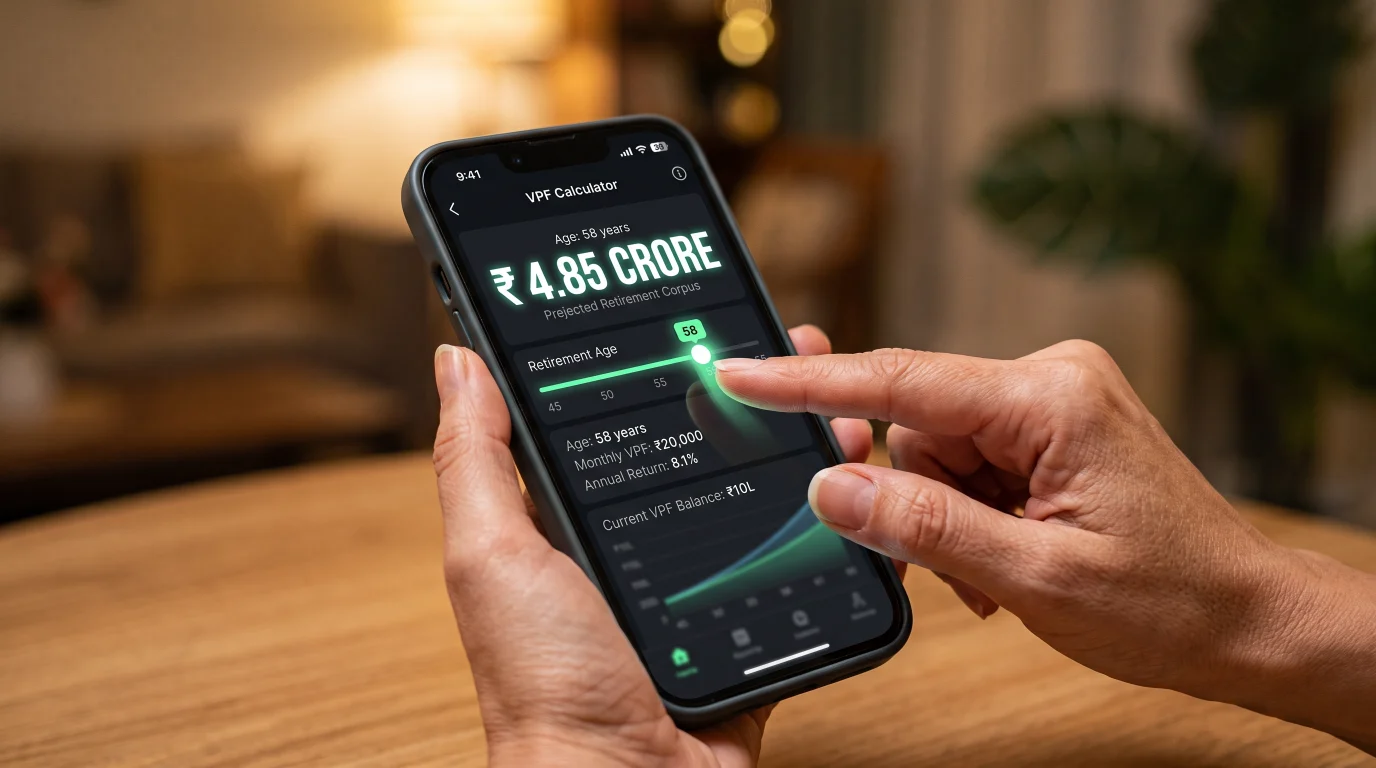
For the exact monthly working, tap “View Contribution Breakdown.” To see what extra VPF would build, tap “Compare 12% EPF vs Higher VPF.”
The PF Calculation Formula
If you’d rather know how to calculate PF by hand, this is all there is to it.
The Formula
PF wage               = Basic + DA          (or min(Basic + DA, ₹15,000) if capped)
Your contribution     = 12% × PF wage       (or your VPF % × Basic + DA)
Employer's total      = 12% × PF wage
   → to EPS            = 8.33% × min(PF wage, ₹15,000)    [max ₹1,250 a month]
   → to EPF            = Employer's total − EPS share

Monthly credit to your EPF account = Your contribution + Employer's EPF share
EPFO rounds each of these to the nearest rupee, and so does this calculator. That’s why the EPS limit reads ₹1,250 rather than ₹1,249.50.
Worked Example: ₹25,000 Basic + DA
| Component | PF on full salary | PF capped at ₹15,000 |
|---|---|---|
| Your contribution | ₹3,000 | ₹1,800 |
| Employer → EPS | ₹1,250 | ₹1,250 |
| Employer → EPF | ₹1,750 | ₹550 |
| Credited to your EPF each month | ₹4,750 | ₹2,350 |
Same salary, same company, and yet your EPF account gets more than double the money in the first column. Which brings us to the question everyone actually searches for.

PF on Full Salary or Capped at ₹1,800?
The wage ceiling is ₹15,000, and 12% of ₹15,000 is ₹1,800. That’s the amount both you and your employer are required to contribute if your salary is above the ceiling. Anything beyond that is voluntary, and needs your employer and you to agree to it.
In July 2026, this came back into the news because of how the new Code on Social Security rules describe contributions: they’re tied to the notified wage ceiling, with higher contributions allowed only by agreement. Many companies have historically paid PF on the full basic anyway. Some haven’t. Zerodha Varsity’s explainer on the ₹1,800 cap is a good plain-English summary of the rule change.
What the Difference Costs Over 30 Years
Here’s what it looks like for someone earning ₹50,000 Basic + DA, starting at 28 and retiring at 58, with 5% yearly raises:
| PF on full salary | PF capped at ₹15,000 | |
|---|---|---|
| Monthly credit to EPF | ₹10,750 | ₹2,350 |
| Take-home pay difference (your share) | Baseline | About ₹4,200 more per month |
| Projected corpus at 58 | ₹2.79 Cr | ₹0.35 Cr |
Assumes 8.25% interest throughout, which EPFO can change every year. It isn’t a promise.
That ₹4,200 extra in your hands each month comes at a cost of roughly ₹2.4 crore at retirement, since your employer’s matching money disappears along with it. Neither choice is “wrong”. A bigger paycheque today and a bigger corpus tomorrow are both legitimate goals. But you should make the choice knowing the numbers.
How to Find Out Which One Your Employer Uses
Look at your payslip. If your PF deduction is exactly ₹1,800, you’re on the cap. If it’s 12% of your Basic + DA, you’re on the full salary. Your UAN passbook confirms it too, since the monthly credits will match one of the two columns above.
PF Deduction by Salary: Quick Reference Table
PF calculation on salary is easiest to grasp with real numbers, so here’s a quick reference. Find your Basic + DA in the first column. “You pay” is what comes off your salary each month, and “Credited to EPF” is what actually lands in your PF account (your share plus your employer’s EPF share). Your employer’s ₹1,250 EPS share is on top of this at every salary above ₹15,000.
| Basic + DA | You pay (full salary) | Credited to EPF (full salary) | You pay (capped) | Credited to EPF (capped) |
|---|---|---|---|---|
| ₹10,000 | ₹1,200 | ₹1,567 | ₹1,200 | ₹1,567 |
| ₹15,000 | ₹1,800 | ₹2,350 | ₹1,800 | ₹2,350 |
| ₹18,000 | ₹2,160 | ₹3,070 | ₹1,800 | ₹2,350 |
| ₹21,000 | ₹2,520 | ₹3,790 | ₹1,800 | ₹2,350 |
| ₹25,000 | ₹3,000 | ₹4,750 | ₹1,800 | ₹2,350 |
| ₹35,000 | ₹4,200 | ₹7,150 | ₹1,800 | ₹2,350 |
| ₹40,000 | ₹4,800 | ₹8,350 | ₹1,800 | ₹2,350 |
| ₹50,000 | ₹6,000 | ₹10,750 | ₹1,800 | ₹2,350 |
| ₹60,000 | ₹7,200 | ₹13,150 | ₹1,800 | ₹2,350 |
| ₹75,000 | ₹9,000 | ₹16,750 | ₹1,800 | ₹2,350 |
Up to ₹15,000 the two versions are identical, because the ceiling doesn’t bite yet. Above it, the gap widens quickly. The figures are rounded to the nearest rupee, the way EPFO does it. Want your exact number? Put your own Basic + DA into the calculator above.

How EPFO Actually Calculates PF Interest
The interest rate box in the calculator makes it a PF interest rate calculator too: change the rate and watch the corpus move. Here’s what happens behind it. EPFO works out interest every month on your running balance, but only credits it once a year. Two details follow from that. This month’s contribution doesn’t earn interest until next month, and interest doesn’t compound within the year.
Why This Calculator's Numbers May Look Lower Than Others'
Many online calculators produce a bigger corpus. There are usually two reasons.
Monthly Compounding Overstates It
Some tools add interest to the balance every month and then earn interest on that interest. EPFO doesn’t do that mid-year. Over 30 years the gap is around 5%, which is real money on a crore-plus corpus. This calculator follows EPFO’s method: monthly accrual, yearly credit.
The 3.67% Shortcut
A few calculators apply the employer’s 3.67% to your entire salary. That only works when your salary is at or below ₹15,000. Above it, the employer’s EPS share stops growing at ₹1,250, so the rest of their 12% goes into your EPF. On ₹25,000 that’s ₹1,750 for the employer’s EPF share, not the ₹917.50 the shortcut gives you.
VPF: The Option Most People Don't Know They Have
Here’s why a VPF calculator is worth a few minutes. VPF lets you put up to 100% of your Basic + DA into your PF, at the same interest rate as your regular contribution. Your employer doesn’t need to match it, and the money stays locked in until retirement or eligible withdrawal.
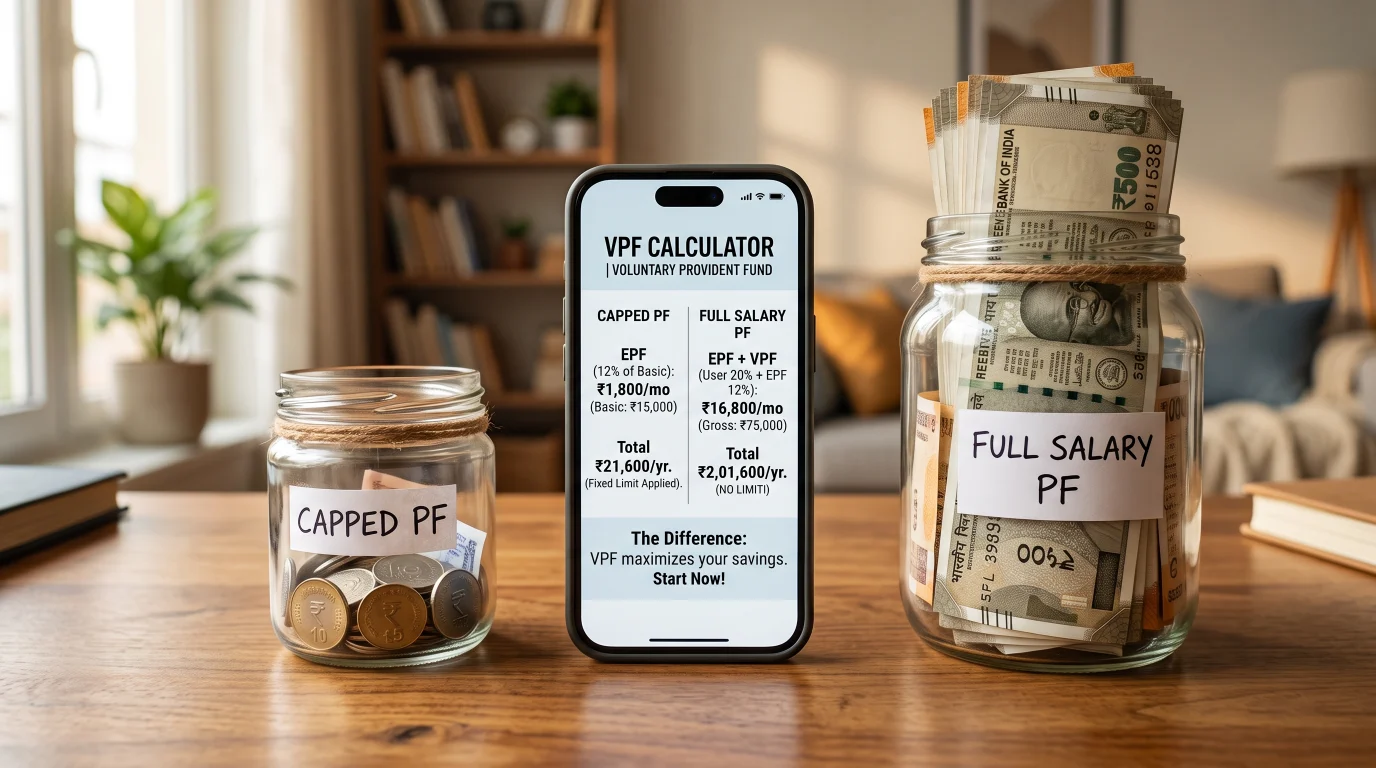
12% vs VPF: A Real Comparison
On ₹25,000 Basic + DA, starting at 28, retiring at 58, with 5% raises and 8.25% interest:
| Standard 12% | VPF at 20% | |
|---|---|---|
| Your monthly contribution | ₹3,000 | ₹5,000 |
| Projected corpus at 58 | ₹1.30 Cr | ₹1.80 Cr |
That’s about ₹50 lakh extra from contributing 8% more of your salary, mostly thanks to time. Use the “Compare” button above with your own numbers.
The ₹2.5 Lakh Tax Rule
There’s one catch worth knowing before you go big on VPF. Since FY 2021-22, interest earned on your own contributions (EPF and VPF added together) above ₹2.5 lakh a year is taxable at your slab rate. The limit is ₹5 lakh if your employer makes no contribution. Only the interest on the excess is taxed, not the contribution itself. The calculator flags this automatically when your yearly contribution crosses the limit.
Is EPF Interest Taxable?
For most employees, no. Interest on your contributions up to ₹2.5 lakh a year stays tax-free. Your own contribution also counts towards the ₹1.5 lakh Section 80C deduction, if you’re on the old tax regime. If you want to see how PF fits into your overall tax picture, try our Income Tax Calculator 2026.
PF Withdrawal in Brief
You can withdraw your full balance on retirement at 58. EPFO also allows partial withdrawals for specific needs such as medical emergencies, housing or other circumstances, and it simplified these into three broader categories under its 2026 reforms. The conditions – and a new rule requiring you to retain part of your balance – change from time to time, so see our full PF Withdrawal Rules 2026 guide or check the EPFO member portal before planning around any specific rule.
If you change jobs, your UAN stays with you for life, and your PF balance can be transferred to your new employer’s account rather than withdrawn.
What This Calculator Deliberately Doesn't Show
Your EPS contribution doesn’t behave like a savings account. It doesn’t earn compound interest, and it doesn’t pay out as a lump sum. Your eventual monthly pension is worked out from a separate formula, based on your pensionable salary and years of service.
Plenty of calculators show a made-up “EPS maturity value” as if it worked like EPF. It doesn’t, so this tool shows your total EPS contribution honestly and sends you to EPFO’s member portal for your actual pension estimate.
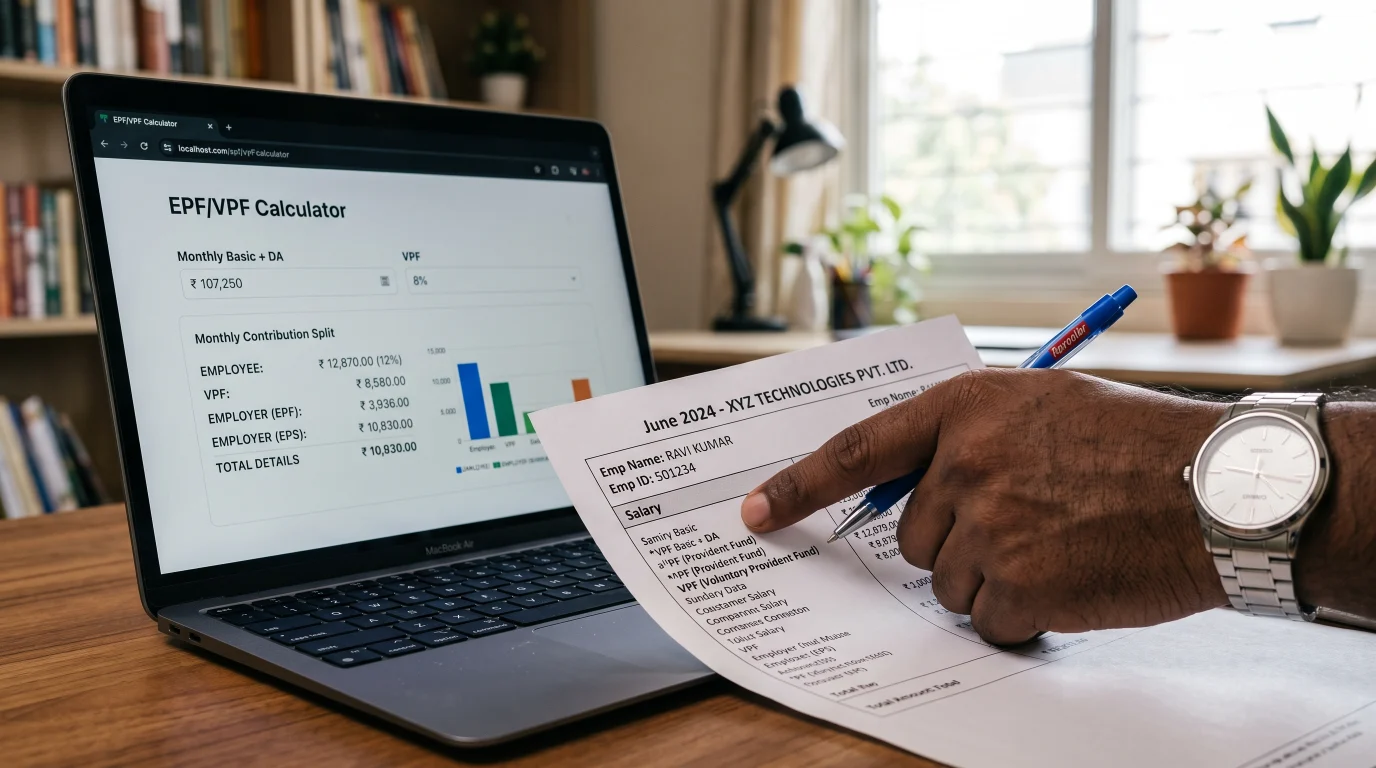
Common Mistakes People Make With PF Calculations
- Using gross salary or CTC. PF is worked out on Basic + DA only. Using the wrong base gives a wildly wrong answer.
- Assuming everyone is on the full-salary version. Check your payslip. A ₹1,800 deduction means you're on the cap.
- Applying 3.67% to the whole salary. Above ₹15,000, your employer's EPF share is much larger than 3.67%.
- Treating EPS like a second PF account. It pays a monthly pension, not a lump sum with interest.
- Not knowing VPF exists. Most people never ask HR whether they can contribute more than 12%.
- Forgetting the interest rate can change. 8.25% has held for three years running, but EPFO reviews it every year.
- Applying PF's Basic + DA logic to ESI too. They're separate deductions with different wage bases - our PF and ESI Calculation Explained guide covers exactly where they diverge.
PF Checklist: Before You Trust the Numbers
- You've entered Basic + DA, not gross salary or CTC
- You've picked the right setting: full salary or capped at the ceiling
- Your age and retirement age are realistic
- You've added your existing PF balance, if you have one
- You understand the EPS figure is a contribution total, not your future pension
- You've checked EPFO's site for the current year's interest rate

Keep Planning Beyond PF
PF is a solid base, but for most people it’s only one part of retirement planning. To see how regular investing could add to it, try our SIP Calculator with Inflation, which shows what your monthly investment could be worth after inflation. And if a pay rise or VPF top-up changes your tax bill, the Income Tax Calculator 2026 shows what you’d actually keep.
PF and VPF Calculator: Frequently Asked Questions
How is PF calculated from salary?
PF is worked out on your Basic Salary + DA, not your gross pay or CTC. You contribute 12% of that amount and your employer contributes another 12%. Of the employer’s share, 8.33% (a maximum of ₹1,250 a month) goes to the EPS pension fund and the rest goes into your EPF account. So your monthly PF credit is your 12% plus the employer’s EPF share. If your payslip also shows an ESI deduction, that’s calculated separately on your full gross wages – see our PF and ESI Calculation Explained guide for the difference.
How much PF is deducted from a ₹10,000 salary?
If your Basic + DA is ₹10,000, ₹1,200 (12%) is deducted from your pay. Your employer adds ₹1,200, of which ₹833 goes to EPS and ₹367 goes to your EPF, so ₹1,567 is credited to your PF account each month. Below ₹15,000 the ceiling doesn’t apply, so this is the same whichever way your employer calculates PF.
How much PF is deducted from a ₹25,000 or ₹35,000 salary?
With PF on the full salary, a ₹25,000 Basic + DA means ₹3,000 from you and ₹4,750 credited to your EPF. A ₹35,000 Basic + DA means ₹4,200 from you and ₹7,150 credited. If your employer caps PF at ₹15,000 instead, both salaries see ₹1,800 deducted and ₹2,350 credited to EPF.
How much PF is deducted from a ₹50,000, ₹60,000 or ₹75,000 salary?
With PF on the full salary, you pay ₹6,000 at ₹50,000, ₹7,200 at ₹60,000 and ₹9,000 at ₹75,000. The amounts credited to your EPF are ₹10,750, ₹13,150 and ₹16,750 respectively. If PF is capped at ₹15,000, all three salaries see just ₹1,800 deducted and ₹2,350 credited.
Is it better to have PF on 12% of full salary or capped at ₹1,800?
Neither is better for everyone, because it’s a trade-off. PF on the full salary puts more into your retirement corpus, since your employer’s contribution rises too. At ₹50,000 Basic + DA it means ₹10,750 a month into EPF versus ₹2,350 on the cap, which projects to about ₹2.79 crore versus ₹0.35 crore over 30 years (assuming 8.25% interest and 5% yearly raises). The cap leaves about ₹4,200 more in your monthly pay. Whether you get a choice depends on your employer’s payroll policy, so ask HR.
How much EPF will I get after retirement?
It depends on your salary, how long you contribute and the interest rate. As an example, someone with ₹25,000 Basic + DA who starts at 28, gets 5% yearly raises and earns 8.25% interest could have about ₹1.30 crore at 58 with PF on the full salary, or about ₹0.35 crore if PF is capped at ₹15,000. EPFO can change the interest rate every year, so treat any projection as an estimate.
Can I withdraw the EPS amount shown above too?
No. The EPS figure this calculator shows is money your employer has paid toward your future monthly pension, not a balance sitting in your EPF account – it’s held and paid out separately, and isn’t part of what you’d withdraw when you leave a job or retire. Only your EPF balance (your contributions plus your employer’s EPF share, with interest) is withdrawable in the usual sense. For exactly when and how much of that you can access, see our PF Withdrawal Rules 2026 guide.
What is the current PF interest rate?
The EPF interest rate is 8.25% a year for FY 2025-26, the third year in a row at that rate. EPFO works out interest every month on your running balance and credits it once a year. It reviews the rate every financial year, so the calculator lets you edit it if a new rate is announced.
Is VPF worth it?
It can be, if you can spare the money until retirement. VPF earns the same 8.25% as your regular PF. On ₹25,000 Basic + DA, raising your contribution from 12% to 20% adds roughly ₹50 lakh over 30 years in our projection (₹1.30 crore to ₹1.80 crore). Two things to weigh: the money stays locked in until retirement or an eligible withdrawal, and interest on your own contributions above ₹2.5 lakh a year is taxable. This is general information, not financial advice.
The Bottom Line on Your PF
A payslip line that just says “PF” hides three numbers and two accounts. This VPF calculator exists to show all of it: what’s yours, what’s your employer’s, where it goes, and what it could be worth when you retire. If a figure looks off, tap “View Contribution Breakdown” and check the working yourself.
Related Guides
Want to go deeper on the parts of PF this calculator only touches on? These guides cover them in full:
- PF Withdrawal Rules 2026: When Can You Take Your Money Out? The 3 new categories, the 25% retention rule, and what’s taxable.
- PF and ESI Calculation Explained: Rates, Ceilings and Examples How both deductions come off your payslip, side by side, on two different wage bases.
How We Keep This Calculator Accurate
We tested the formulas against several published worked examples for both the full-salary and capped versions. We use the notified wage ceiling and the EPFO-declared interest rate, and we update the page whenever either changes. The ceiling and the interest rate are also editable in the tool, so you can test “what if” scenarios such as a future ceiling change.
Sources: Contribution rates, the wage ceiling and interest rate come from the EPFO official portal and the Labour Ministry’s notification under the Code on Social Security, 2020. The ₹1,800 cap explainer is from Zerodha Varsity.
Last reviewed for accuracy: September 2026 (FY 2025-26 EPFO rates). This tool gives estimates for general guidance and planning only. It isn’t financial or tax advice, and it doesn’t cover reduced-rate establishments or EPS pension amounts. For exact figures, check your EPF passbook or EPFO’s member portal, or speak to a qualified adviser. See our full disclaimer.
What the Get Calculator Base Community Says
Average Rating: 4.9/5 based on our beta users