
Rent vs Buy Calculator: Buying a Condo vs Renting
Quick Answer
Whether buying a condo vs renting works out cheaper depends on how long you plan to stay, your down payment, and your local market. Our free calculator does the full math for you and shows the exact year buying starts to pay off. Enter your numbers below to see your personal result.
Rent vs Buy Calculator Inputs
Calculating your breakeven point…
Adjust the inputs on the left to see your personalized result.
Bottom line: Enter your numbers to see a plain-English summary here.
Full Cost Breakdown
| Buying | Renting | |
|---|---|---|
| Initial / upfront costs | $0 | $0 |
| Recurring costs (over term) | $0 | $0 |
| Tax savings (credit) | -$0 | — |
| Investment gains on unspent down payment (credit) | — | -$0 |
| Net sale proceeds / deposit return (credit) | -$0 | -$0 |
| Total Net Cost | $0 | $0 |
Year-by-Year Cost Comparison
| Year | Total Cost if Buying | Total Cost if Renting | Cheaper Option |
|---|
*The breakdown table above shows actual nominal cash flows; the headline, bottom-line summary, and year-by-year table can optionally be shown in today's dollars using the inflation-adjustment toggle. This calculator compares net worth impact, not just cash outflow: the Buy total subtracts net home-sale proceeds (after selling costs and any capital gains tax owed), and the Rent total subtracts investment growth on money not spent on a down payment. PMI is included when your down payment is below 20% and automatically removed once you reach 20% equity through paydown and appreciation. Capital gains tax is estimated at a flat 15% federal long-term rate on gains above the primary-residence exemption; your actual rate may differ based on income and state. This tool is for informational purposes only and is not financial or tax advice — consult a qualified professional for your specific situation.
Introduction
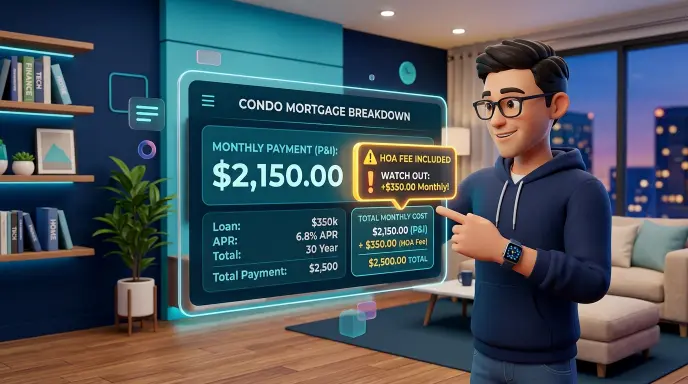
Condos come with a wrinkle that most rent vs buy advice skips: the HOA fee. Forget to include it, and your buying a condo vs renting estimate can be off by years.
I’ve watched people run rough numbers on a condo purchase, leave out the HOA fee entirely, and end up thinking buying was the better deal — only to find out later it wasn’t once the full picture came in. It’s an easy thing to miss if you’re used to comparing rent to just a mortgage payment.
This calculator accounts for that, along with property tax, PMI, and capital gains tax when you eventually sell. Whether you’re comparing citywide or specifically weighing buying vs renting in NYC, you’ll get a buying a condo vs renting comparison you can actually rely on. If your search is closer to a straightforward house purchase rather than a condo, our Mortgage Recast Calculator can help you model payment changes after a lump-sum payment too.
My Personal Experience
This is my personal experience. When we changed our home and moved to another city, we were thinking about whether it would be better to rent a house or buy one. At that time, I searched on Google to find a platform that could provide a real solution for this decision, but I could not find any suitable platform.
I then thought about how a finance manager or a marketer who understands the rent-and-buy market could help people make this decision. Based on that idea, I created this tool.
This tool can help you check whether it may be better for you to rent or buy a home. You can use the tool to compare the situation and understand which option may be more suitable for you.
You can also check the results again after a few years because the situation may change. If you want to check it, simply click on the tool and use it.
Pro Tips:
From my side, I have a tip for you: we have many different tools available on our site. If you scroll down, you will find a wide range of tools, and you may find a tool that can help solve one of your problems.
This is what I recommend: explore the available tools and use the one that is relevant to your needs.
All of these tools are for informational purposes only and do not provide professional advice.
How to Use This Buying a Condo vs Renting Calculator
- Enter your home purchase details — price, down payment percentage, interest rate, and loan term.
- Add ownership costs — property tax, insurance, HOA fee, and maintenance.
- Enter your rental details — monthly rent and the typical annual rent increase for your area.
- Add your investment assumptions — the return you’d expect if you invested your down payment instead. If you want to model that investment growth separately, our SIP Calculator with Inflation is built exactly for that.
- Read your instant result — a break-even year, full cost breakdown, and year-by-year table update as you type.
No sign-up, no email — everything runs in your browser.

How It Works (Privacy-Friendly by Design)
This calculator runs entirely client-side. Your numbers never touch our servers, and closing the tab clears everything. That also keeps it fast, since there’s no delay waiting on a server for every input change.
Core Benefits of Comparing Buying a Condo vs Renting This Way
- A personalized break-even year instead of a generic average
- Clear visibility into how much home equity you'd build versus renting
- A realistic cost of ownership figure — property tax, insurance, HOA, and maintenance included
- The opportunity cost of tying up your down payment instead of investing it
- A confident, numbers-backed answer to the buying a condo vs renting question instead of a guess


Why Choose This Rent vs Buy Calculator for Buying a Condo vs Renting
Most general calculators skip condo-specific costs, and most city-specific tools skip the deeper mechanics like PMI and capital gains. This tool handles both, whether you need a broad buying a condo vs renting comparison or a market-specific one like a buy vs rent calculator nyc search would need.
- HOA fees included by default, since they matter most for condo buyers
- Instant plain-English answer at the top, not buried in a spreadsheet
- PMI auto-calculated and removed once you hit 20% equity
- Capital gains tax handled, including the primary residence exemption most tools skip
Calculation Logic: How the Numbers Work
Here’s the simplified version of what’s happening behind the scenes when you compare buying a condo vs renting on this tool:
On the buying side, we calculate your monthly mortgage payment using standard amortization, add PMI if your down payment is under 20%, then layer in property tax, insurance, HOA, and maintenance, all rising yearly to reflect realistic inflation. At the end of your timeline, we estimate the sale value, subtract closing costs and any capital gains tax owed, and pay off whatever mortgage balance remains — what’s left becomes your net proceeds. If you’d rather run a pure loan comparison alongside this, our Loan Analytics Pro tool breaks down amortization schedules in more depth.
On the renting side, we total your rent payments plus insurance, then subtract the opportunity cost — what your down payment would have earned if invested instead.
Whichever total is lower is your more cost-effective option over your chosen timeline, not just today.
Pros and Cons of Buying a Condo vs Renting
Buying a Condo
- Builds equity with every payment instead of paying a landlord
- Often a lower down payment entry point than a single-family home in the same area
- Downside: the HOA fee adds a recurring cost renters don’t have, and building rules can limit renovations
- Note: mortgage interest may be deductible, though that benefit has shrunk for many households since the standard deduction increased — check with a tax professional, or start with our Income Tax Calculator 2026 to see where you land
Renting
- Lower upfront cost, more flexibility to relocate
- No maintenance or HOA responsibility
- Downside: rent increases yearly, and you build no equity
Real-Life Example: Buying vs Renting in NYC
Say you’re comparing a $600,000 condo (20% down, 6.25% rate, $800/month HOA) against renting a similar unit for $3,500 a month. Because the HOA fee is baked into the ownership cost here, the numbers tend to favor a longer break-even period than a comparable single-family home elsewhere — often somewhere in the 6-9 year range, depending on appreciation and rent growth in the specific building or neighborhood. That’s exactly why running your own numbers matters more for a buy vs rent calculator nyc search than relying on a national average when you’re comparing buying a condo vs renting there.

Comparison: Our Buying a Condo vs Renting Calculator vs Other Options
| Feature | Our Calculator | Other Online Tools | Manual Calculations |
|---|---|---|---|
| HOA fee included | Yes, by default | Sometimes | Only if you remember to add it |
| Break-even year shown | Yes, instantly | Sometimes | Requires spreadsheet work |
| PMI included | Yes, auto-calculated | Rarely | Only if you build it yourself |
| Capital gains tax factored | Yes, with exemption | Rarely | Usually skipped |
| Cost | Free | Free | Free, but takes hours |

Common Mistakes to Avoid When Comparing Buying a Condo vs Renting
- Forgetting the HOA fee when comparing a condo purchase to renting
- Ignoring PMI when your down payment is under 20%
- Using today’s rent without factoring in yearly increases
- Assuming you’ll benefit from the mortgage interest deduction — many households now take the standard deduction instead
- Comparing only monthly payments instead of full cost over time, and overlooking how much financial flexibility you’re giving up either way
Limitations & Accuracy Notice
This calculator uses standard, widely accepted formulas for amortization, PMI, and capital gains estimates, but it can’t account for every local variable — such as rent control rules, condo special assessments, or state-specific transfer taxes. Treat the result as a strong planning estimate for your buying a condo vs renting decision, not a substitute for a personalized quote from a lender or tax professional.
Checklist Before You Decide
- Know your down payment and current mortgage rate
- Check the HOA fee if you're buying a condo
- Estimate how long you realistically plan to stay
- Factor in PMI if your down payment is under 20%
- Compare your break-even year to your expected timeline
- Weigh non-financial factors too — commute, space, and lifestyle matter alongside the math

Frequently Asked Questions (FAQs)
Is it cheaper to rent or buy?
It depends on your local market and how long you plan to stay. Generally, buying a condo vs renting becomes cheaper the longer you stay, since upfront costs get spread out and you build equity over time.
What is the 5% rule for renting vs buying?
It’s a guideline suggesting that if your annual cost of owning is under 5% of the home’s value, buying may be the better deal. Our calculator gives a more precise, personalized answer.
How long should I rent before buying?
Most financial guidance suggests staying at least 4-5 years to offset the upfront costs of buying, though this varies by market and loan terms.
Is buying a condo worth it compared to renting?
It can be, especially if you plan to stay long enough to offset closing costs and the HOA fee through built-up equity. Run your specific numbers in the calculator above to check your own break-even year.
Is it cheaper to buy or rent in NYC specifically?
It depends heavily on the building’s HOA fee and how long you plan to stay. A buy vs rent calculator nyc search often turns up a longer break-even period than the national average because of higher purchase prices.
Do I need to include PMI if I'm putting down more than 20%?
No. The calculator automatically skips PMI once your down payment reaches 20%, since it typically isn’t required above that threshold.
Conclusion
Buying a condo vs renting isn’t just a national-average question — HOA fees, local price levels, and how long you plan to stay all shift the answer. Whether you’re comparing citywide or specifically weighing buying vs renting in NYC, the fastest way to know for sure is to run your own numbers through the calculator above.
Try adjusting the HOA fee or your expected stay length and watch how your break-even year shifts — it’s the clearest way to see what’s really driving your buying a condo vs renting decision. You can also browse our full range of finance tools if you want to model other parts of your financial picture.
About This Tool
This calculator was built and is maintained by our in-house development team, who also handle the underlying formulas and update them as tax rules or lending standards change.
Getcalcbase Disclaimer:
This calculator is for informational purposes only and does not constitute financial, tax, or legal advice. Results are estimates based on the inputs you provide and standard assumptions (such as a flat capital gains rate). Consult a licensed financial advisor, accountant, or real estate professional for guidance specific to your situation.
Related Reading
Want to dig deeper into buying a condo vs renting?
- 📖 Renting vs Buying a House: 7 Pros and Cons to Know Comming Soon— the full breakdown beyond just the numbers
- 📖 How Much House Can You Actually Afford in 2026? — set a realistic budget before you start comparing
- 📖 First-Time Homebuyer Mistakes That Cost Thousands — avoid the costliest rookie errors
- 📖 PMI Explained: When It Disappears and How to Avoid It — everything this calculator’s PMI number is based on
- 📖 Renting an Apartment vs a House: What Actually Costs More? Comming Soon— if you’re not sure buying is even the right category yet
- 📖 How a 1% Rate Change Flips the Rent vs Buy Math Comming Soon— see how today’s rates specifically affect your decision
What the Get Calculator Base Community Says
Average Rating: 4.9/5 based on our beta users