

Claude 4.7 vs. GPT-5.2: The 2026 Pricing Showdown
In 2026, the gap between Anthropic and OpenAI has widened, particularly in how they handle long-context and reasoning tokens. Choosing the right model isn’t just about performance — it’s about protecting your margins. At GetCalcBase, we track these pricing shifts as they happen so you always know your real cost per million tokens.
Then I found the tool linked below in this article, and it helped me understand everything clearly for free. After using the tool, I finally understood token usage, pricing, and how AI plans work.
Because of this guidance, I was able to purchase an AI tool with confidence, and I even received some free benefits during the process.
Thanks to GCB for helping me understand everything in such a simple way.
In 2026, the delta between Anthropic and OpenAI has widened, particularly in how they handle long-context and reasoning tokens. As a developer, choosing the right model isn’t just about performance—it’s about protecting your margins. At GetCalcBase, we track these shifts daily to ensure our community stays ahead of the curve.
The Raw Breakdown: 2026 Flagship Model Pricing
As of May 2026, here is how the top-tier models stack up in terms of API costs:
| Model Tier | Model Name | Input (per 1M tokens) | Output (per 1M tokens) | Context Window |
|---|---|---|---|---|
| The Flagship | Claude Opus 4.8 | $5.00 | $25.00 | 1,000,000 |
| The Balanced | Claude Sonnet 5 | $2.00 (intro) / $3.00 (standard) | $10.00 (intro) / $15.00 (standard) | 1,000,000 |
| The Reasoning Leader | GPT-5.6 Sol | $5.00 | $30.00 | 1,000,000 |
| The Budget | GPT-5.6 Luna | $1.00 | $6.00 | 1,000,000 |
Claude Sonnet 5’s introductory pricing runs through August 31, 2026, after which it reverts to standard rates. This makes it currently one of the most cost-effective frontier-tier models available for both coding and general reasoning tasks.

Critical Difference: Context vs. Cost
Both Claude Opus 4.8 and Claude Sonnet 5 ship a 1-million-token context window with no long-context surcharge — a real advantage over Google’s Gemini Pro line, which doubles pricing past 200K tokens. GPT-5.6’s Sol tier matches this context size but at a higher flagship price. For high-volume, cost-sensitive tasks, GPT-5.6 Luna or Claude Haiku 4.5 remain the cheaper picks without needing flagship-level reasoning.
Why You Need a Claude AI Token Calculator
If you’ve ever looked at your Anthropic dashboard and seen a $400 spike overnight, you know that “guesstimating” your token usage is a recipe for disaster. This is why we built the Claude AI Token Cost Calculator & Estimator.

How It Works (and Why It’s Human-First)
Tokens aren’t just words; they are the “atoms” of AI processing. Our tool helps you:
- Predict Prompt Bloat: Before you send a 50k-line codebase to Claude Sonnet 5 or Opus 4.8, paste a snippet into our tool to see the real-time cost.
- Compare Modalities: Switch between Opus and Sonnet pricing instantly to see where you can save.
- Optimize Storage: Large payloads often mean heavy data transit. Use our data storage converter alongside the calculator to manage your local vs. cloud overhead.
How to Set Up API Spending Limits in 2026 (Step-by-Step)
Managing “hallucinating” costs is just as important as managing hallucinating models. Here is how to lock down your budget:

1. For OpenAI (GPT-5.2 Users)
OpenAI has refined their Usage Limits to prevent “bill shock” from recursive agent loops.
- Navigate: Settings > Billing > Usage limits.
- Soft Limit: Set this to 50% of your budget to receive a “check the logs” email alert.
- Hard Limit: At your maximum budget, the API will return a 429 error. Ensure your app handles this gracefully, perhaps by falling back to a local model.
2. For Anthropic (Claude Sonnet 5 / Opus 4.8 Users)
- Navigate: Dashboard > Billing > Spending Limits.
- Monthly Budget: Enter your maximum spend.
- SMS Alerts: You can now set multiple tiers (50%, 75%, 90%) to receive instant notifications.
Building Topical Authority in AI Development
As a developer, your expertise shouldn’t just be in writing code; it’s in managing resources. At GetCalcBase, we believe in a digital marketing tools framework that prioritizes E-E-A-T (Experience, Expertise, Authoritativeness, and Trustworthiness).
When I’m building a tool like our best free password generator, I’m not just thinking about the JS logic—I’m thinking about the Image Load Time for the UI. If your site loads slowly, your users refresh the page, which can double your AI API requests and costs.
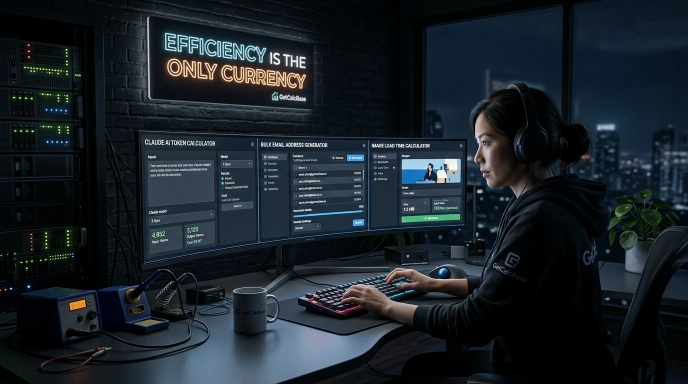
The Developer’s Ecosystem
Building in 2026 is about clustering your tools. If you’re working on an outreach project using a bulk email address generator, you’ll likely need an AI to draft those emails. Using the Claude AI Token Calculator ensures your outreach ROI doesn’t go negative before you even hit “send.”
FAQs: Frequently Asked Questions
Q: How accurate is the Claude AI Token Calculator?
A: It is 99% accurate for standard text using BPE encoding. However, always leave a 5% “buffer” for reasoning tokens.
Q: Is my data safe while calculating tokens?
A: Yes. Like our best free password generator, the calculator works locally in your browser. Your text never touches our server.
Q: Which model is best for heavy coding tasks?
A: Claude Opus 4.8 and GPT-5.6 Sol currently trade top spots on coding benchmarks depending on the task. For most day-to-day refactoring work, Claude Sonnet 5 offers nearly the same quality at a fraction of the cost.
Final Thoughts: The Waseem Aijaz Perspective
Efficiency is the only currency that lasts. Whether you choose Claude for its massive context or GPT for its aggressive pricing, remember that the most expensive token is the one you didn’t plan for.
Explore more in our education tools section if you’re a student or researcher looking to bridge the gap between math and AI implementation. Stay curious, stay within your API limits, and keep building.