

Quick answer: Adding as little as $100–$300 extra to your monthly mortgage payment, applied directly to principal, can cut 4–10 years off a standard 30-year loan and save tens of thousands in interest. The earlier in your loan term you start, and the more consistent you are, the bigger the effect.
Introduction
Paying off a 30-year mortgage in 10 or 15 years sounds like it requires a windfall, but for most homeowners it’s really about consistency, not a lump sum. A relatively modest extra payment, applied every month without fail, compounds into years shaved off your loan and a meaningful chunk of interest never paid at all.
This guide breaks down exactly how sending extra money each month works, how much difference realistic amounts make, and the mistakes that quietly cancel out the benefit.
How Extra Payments Actually Shorten Your Loan
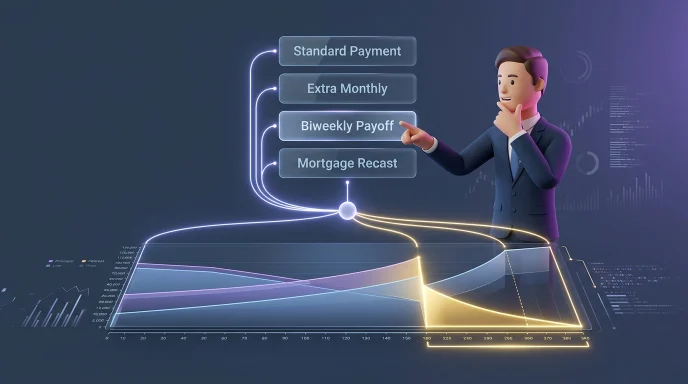
Every regular mortgage payment is split between interest (based on your current balance) and principal (what actually reduces your balance). Early in a loan, most of each payment goes to interest. Any amount you pay beyond your required payment goes entirely to principal, with no interest charged on it at all.
That’s the mechanism: every extra dollar reduces the balance that all future interest is calculated on, which means every payment after that is doing a little more principal-reduction work than it otherwise would have. The effect compounds — small additional amounts sent consistently for years add up to far more than the same total paid as one lump sum near the end of the loan.
How Much Difference Realistic Extra Payments Make
Take a $320,000 loan at 6.5%, 30-year term, standard payment around $2,022/month, standard total interest around $408,000, standard payoff in 30 years.
| Extra Monthly Payment | New Payoff Time | Years Saved | Interest Saved |
|---|---|---|---|
| +$100/month | ~26.2 years | ~3.8 years | ~$62,000 |
| +$250/month | ~22.5 years | ~7.5 years | ~$118,000 |
| +$500/month | ~18.3 years | ~11.7 years | ~$175,000 |
Notice that the jump from $100 to $250 extra saves nearly double the time, and $500 extra gets you well past the “10–15 years” mark most people are aiming for. The relationship isn’t perfectly linear — bigger amounts have an outsized effect because they compound against a shrinking balance faster.
Three Ways to Add Extra Payments

1. A fixed extra amount every month. The simplest approach — add a set amount, like $150 or $300, to every payment. Easiest to budget for and stick with long term.
2. One extra full payment per year. Some homeowners make 13 payments a year instead of 12 — for example, using a tax refund or year-end bonus. This has a similar effect to a biweekly payment plan.
3. Occasional lump sums. Applying windfalls (bonuses, tax refunds, side income) as one-time principal payments whenever they arrive, without committing to a fixed monthly amount.
All three work through the same mechanism — less principal means less future interest — so the “best” one is whichever you’ll actually stick with consistently.
Common Mistakes That Cancel Out the Benefit
- Not confirming the extra amount is applied to principal. Some servicers apply extra payments to your next month’s payment instead of your principal unless you specifically mark it. Always confirm with your servicer or check your statement after the first extra payment.
- Stopping and starting inconsistently. The compounding effect depends on consistency — sporadic extra payments still help, but far less than a steady monthly habit.
- Ignoring PMI removal eligibility. If your original down payment was under 20%, extra payments that bring your balance under 80% of your home’s value may let you request PMI removal separately, which is easy to miss if you’re not tracking your equity.
- Not comparing against a recast. If your real goal is a lower monthly bill rather than an early payoff, a recast might suit you better than ongoing extra payments — see our comparison of recast vs refinance vs extra payments to check.
Practical Ways to Find Extra Payment Money
Committing to an extra payment sounds simple until you have to find the money for it every single month. A few approaches that actually hold up over time:
- Round up, don’t guess. Instead of picking an arbitrary number, round your payment up to the nearest $100 or $200. It’s psychologically easier to commit to “round it up” than to “find $237 a month.”
- Redirect a paid-off debt. Once a car loan or credit card is paid off, redirect that exact monthly amount straight into your mortgage before it quietly gets absorbed into everyday spending.
- Automate it immediately. Set up the extra amount as a separate automatic payment tied to your mortgage account, on the same day as your regular payment, so it never becomes a decision you have to make each month.
- Use predictable windfalls deliberately. Tax refunds, annual bonuses, and side income are easier to commit to a mortgage than regular paycheck money, since you never budgeted around having them in the first place.
- Start smaller than you think you need to. An extra $50–$100 a month that you actually stick with for 10 years outperforms an ambitious $500 a month that only lasts six months before life gets in the way.
Does It Matter When You Start?
Yes, meaningfully. Money sent early in a loan has more time to compound against a larger remaining balance, so starting in year 2 of a 30-year loan produces noticeably more total savings than starting the same amount in year 15, even though the monthly figure is identical. That said, starting later is still worth doing — the math still favors paying extra at any point, it just favors starting sooner even more.
Extra Payments vs. Biweekly Payments
A related strategy is switching to a biweekly payment schedule — paying half your monthly payment every two weeks. Since there are 52 weeks in a year, this works out to 26 half-payments, the equivalent of 13 full monthly payments instead of 12. It has a similar effect to adding roughly one payment’s worth of extra principal per year, spread automatically across your payment schedule instead of requiring a manual top-up each month.
See Your Own Numbers
The table above uses a $320,000 loan as an example, but your own balance, rate, and remaining term will produce different numbers. Use our mortgage recast calculator, which includes an Extra Payments tab and a Biweekly Payoff tab, to enter your actual loan details and see exactly how much time and interest you’d save at different extra-payment amounts — and compare that directly against what a lump-sum recast would do instead.
For a deeper look at exactly how much a lump-sum recast specifically could save on your loan, see how much a mortgage recast actually saves you.
Frequently Asked Questions
How do I pay off my 30-year mortgage in 10 years? On most loans, this typically requires extra monthly payments in the range of $500–$1,000+, depending on your balance and rate. Run your specific numbers through a mortgage calculator to find the exact extra amount needed for a 10-year payoff.
What happens if I pay 3 extra mortgage payments a year on a 30-year mortgage? Three extra full payments a year (roughly equivalent to an extra 25% of your annual payment total) can cut several years off a standard 30-year mortgage, depending on your rate and remaining term.
What happens if I pay an extra $3,000 a month on my mortgage? On most loan balances, this represents a very large extra payment relative to the required amount and could pay off the loan in well under 10 years, though the exact time depends heavily on your starting balance.
What happens if I pay an extra $100 a month on my mortgage? On a typical 30-year loan, an extra $100 a month often saves 3–5 years off the term and tens of thousands of dollars in interest, though the exact figures depend on your loan size and rate.
Do extra payments reduce my monthly required payment? No. Extra payments reduce your principal balance and shorten your payoff timeline, but your required monthly payment amount stays the same unless you specifically request a recast.
Is it better to pay extra monthly or make one big annual payment? Both reduce your balance and save interest. Paying extra monthly compounds slightly faster since the balance is reduced sooner in the year, but a once-a-year lump sum is easier for people whose extra cash arrives in a single windfall, like a bonus or tax refund.
Conclusion
Paying off a 30-year mortgage in 10–15 years is realistic for a lot of homeowners, and it usually comes down to a manageable extra monthly amount rather than a large lump sum. The table above gives you a rough sense of what different amounts can do, but your own numbers depend on your balance, rate, and remaining term. Plug your details into our mortgage recast calculator to see your exact payoff timeline under a few different extra-payment amounts before you commit to one.
Disclaimer: The payoff timelines and interest-savings figures in this article are illustrative estimates based on sample loan scenarios, not a quote for any specific loan. This content is for informational and educational purposes only and does not constitute financial, legal, or lending advice. GetCalcBase is not a lender or financial advisor. Confirm how your specific lender applies extra payments before relying on these figures. See our full Disclaimer for details.
Reviewed by Zainab Sarfraz, Financial Expert and Waseem Aijaz, WordPress Developer & SEO Expert.
Financial freedom isn’t about how much you make; it’s about how much you keep. Whether you need a car finance calculator tool or a 2026 tax breakdown, GetCalcBase is here for your journey. Bookmark this page, take control of your wallet, and let’s build your wealth together!