

Quick answer: In the mortgage recast vs refinance vs extra payments decision, a recast lowers your monthly payment while keeping your rate and payoff date. A refinance changes your rate but costs thousands upfront. Extra payments cost nothing and shorten your payoff date instead. The right choice depends on whether you want a lower bill, a better rate, or a faster payoff.
Introduction : Mortgage Recast vs Refinance vs Extra Payments
Say you have $30,000 sitting in a savings account and a mortgage you’d like to deal with more aggressively. You’ve got three real options: recast, refinance, or just start sending extra money with every payment. Each one does something different with your money, and picking the wrong one for your actual goal is an easy way to leave money on the table.
This guide breaks down what each option actually does to your loan, what it costs, and which one fits which situation — using real numbers, not just theory.
What Each Option Actually Does
Mortgage Recast

You make a lump-sum payment toward your principal, and your lender re-amortizes your remaining balance over your remaining term at your same interest rate. Your monthly payment drops. Your payoff date doesn’t change. There’s no credit check and no new appraisal — just a small processing fee, usually $150–$500.
Refinance
You replace your entire loan with a new one — a new interest rate, a new term (or the same term reset), and a new set of closing costs, typically 2–5% of your loan amount. If rates have dropped since you got your original loan, this can meaningfully lower your payment or let you switch from a 30-year to a 15-year term. If rates haven’t dropped, refinancing usually doesn’t make sense.
Extra Payments
You keep your existing loan exactly as it is and simply pay more than the required amount each month, or make occasional lump sums, with that extra money applied directly to principal. Your required payment stays the same. Your loan just finishes early. No fees, no application, no approval needed — you can start or stop anytime.
Side-by-Side Comparison
| Factor | Recast | Refinance | Extra Payments |
|---|---|---|---|
| Changes your interest rate | No | Yes (new rate) | No |
| Lowers required monthly payment | Yes | Depends on new rate/term | No |
| Shortens payoff date | No (unless you also pay extra) | Can, with a shorter term | Yes |
| Typical cost | $150–$500 | 2–5% of loan amount | $0 |
| Credit check required | Usually no | Yes | No |
| Processing time | 1–2 weeks | 30–45 days | Immediate |
| Minimum amount needed | Often $5,000+ lump sum | N/A | Any amount, anytime |
| Reversible / flexible | One-time change | One-time change | Fully flexible |
Real Numbers: The Same $30,000, Three Different Outcomes
Take a homeowner with a $350,000 balance at 6.5%, 28 years remaining, standard payment around $2,213/month.
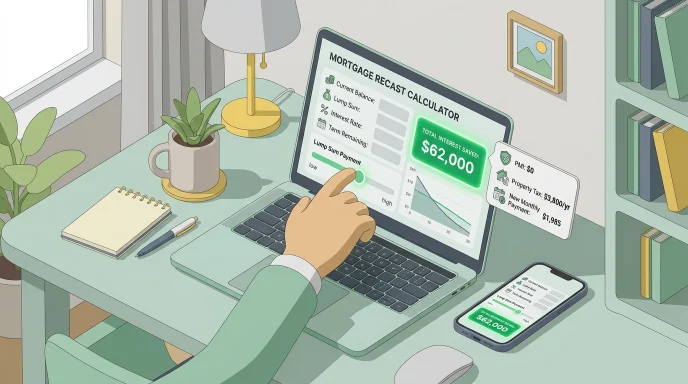
If they recast with the $30,000: their balance drops to $320,000, re-amortized over the same 28 years. New payment lands around $1,988/month — roughly $225 lower every month, for the rest of the loan, at the same 6.5% rate.
If they refinance and current rates happen to be lower, say 5.75% on a new 28-year term over the original $350,000 balance (they didn’t use the $30,000 to pay down principal, they used it toward closing costs and fees instead): payment drops to around $2,079/month — a smaller monthly drop than the recast, and it cost them thousands in closing costs to get there. If rates hadn’t dropped, refinancing wouldn’t have helped at all.
If they keep the same loan and add the $30,000 as a lump-sum extra payment without recasting: their required payment stays $2,213/month, but their payoff date moves up by roughly 4–5 years and they save tens of thousands in interest over the life of the loan.
Three totally different results from the same amount of money, depending on what you’re actually trying to achieve.
Does Any Option Affect Your Taxes or Credit?

Credit score: Refinancing involves a hard credit check and shows up on your credit report as a new inquiry and a new account. Recasting and extra payments generally don’t touch your credit at all, since you’re keeping the same loan with the same servicer.
Mortgage interest deduction: All three options can affect the mortgage interest deduction if you itemize, simply because you’re paying less interest over time (with a recast or extra payments) or paying interest at a different rate (with a refinance). The effect is usually small relative to the savings, but if you rely heavily on that deduction, it’s worth a quick conversation with a tax professional before making a large lump-sum decision.
Home equity: All three options can also change how much equity you have, but only extra payments and recasting do it without resetting your loan. A refinance technically restarts your equity-building clock in terms of the amortization curve, even if your balance itself doesn’t change.
Common Scenarios: Which Option People Actually Pick
“I want more breathing room in my budget this year.” Most homeowners in this position choose a recast, since it directly lowers the required payment starting the very next billing cycle, without touching their rate or restarting their loan term.
“Rates dropped since I bought my house.” This is the clearest case for refinancing. If your new rate is at least three-quarters of a point to a full point lower than your current one, the math often works out in your favor even after closing costs, especially if you plan to stay in the home for several more years.
“I just want to be debt-free faster.” Extra payments usually win here, since they’re the only option of the three that actually shortens your payoff date without also changing your rate or costing you anything upfront.
“I got a windfall but I’m not sure yet.” In this case, it often makes sense to hold off on a hard commitment and start with extra payments, since they’re fully reversible. You can always request a recast later once you’ve decided your balance reduction is permanent, but you can’t undo a recast fee or refinance closing costs once they’re paid.
Which One Fits Your Situation
Choose a recast if: you like your current rate, you want a lower monthly bill starting immediately, and you don’t mind keeping your original payoff date.
Choose a refinance if: current rates are meaningfully lower than your existing rate, or you want to change your loan term entirely (like going from a 30-year to a 15-year), and you’re fine with the upfront closing costs.
Choose extra payments if: your priority is finishing the loan early and reducing total interest, you want to stay flexible in case your financial situation changes, and you don’t want to pay any fees to get there.
It’s also worth running your specific numbers through a mortgage recast calculator before deciding — the calculator lets you test a recast, extra payments, and a biweekly plan on your exact loan balance and rate side by side, so you’re comparing your real numbers instead of these general examples.
Questions People Ask
Is a mortgage recast better than refinancing? It depends on your goal. A recast is usually better if you like your current rate and just want a lower payment. A refinance is usually better if rates have dropped significantly since you got your loan.
Can you recast and refinance at the same time? No. Once you refinance, you have an entirely new loan, so any prior recast no longer applies. You’d need to consider a fresh recast only after the new loan has been in place for a while.
Do extra payments save more than a recast? Usually yes, in terms of total interest saved, because extra payments shorten your payoff date rather than just lowering your monthly bill. But a recast gives you an immediate lower required payment, which extra payments don’t.
Which option has the lowest upfront cost? Extra payments cost nothing to set up. A recast typically costs $150–$500. A refinance costs the most, often 2–5% of your loan balance in closing costs.
Can I combine a recast with extra payments afterward? Yes. Many homeowners recast to lower their required payment, then continue paying extra on top of the new lower amount to shorten their payoff date further.
Does my credit score affect which option I can choose? It affects refinancing, since lenders check your credit and current financial profile for a new loan. Recasting and extra payments generally don’t require a credit check since you’re keeping your existing loan.
Final Thoughts
There’s no single “best” option here — only the one that matches what you’re actually trying to do with your money. If you want breathing room in your monthly budget, a recast usually wins. If you want to be debt-free sooner, extra payments usually win. If your current rate is genuinely bad, refinancing might be worth the upfront cost. Run your specific numbers through our mortgage recast calculator to see exactly where you land before you call your lender.
For a deeper look at how much a recast specifically could save you, see our guide on how much a mortgage recast actually saves you, or if extra payments sound like your path, check out how to pay off a 30-year mortgage in 10–15 years.
Disclaimer: This article compares mortgage recast, refinance, and extra payment strategies for general informational and educational purposes only. It does not constitute financial, legal, or lending advice, and GetCalcBase is not a lender or financial advisor. Loan terms, fees, and eligibility vary by lender — confirm your specific numbers with your loan servicer before making a decision. See our full Disclaimer for details.
Reviewed by Zainab Sarfraz, Financial Expert and Waseem Aijaz, WordPress Developer & SEO Expert.
Financial freedom isn’t about how much you make; it’s about how much you keep. Whether you need a car finance calculator tool or a 2026 tax breakdown, GetCalcBase is here for your journey. Bookmark this page, take control of your wallet, and let’s build your wealth together!