

Quick answer: A mortgage recast typically lowers your monthly payment by 5–15%, depending on your lump-sum amount relative to your remaining balance. On a $300,000–$400,000 loan, a $20,000–$50,000 recast commonly saves $100–$400 a month. The exact number depends on your remaining balance, interest rate, and remaining term.
Introduction
“How much will this actually save me” is the first question most people ask before they bother calling their lender about a recast — and it’s a fair question, because the fee and paperwork are only worth it if the savings are real.
The honest answer is: it depends entirely on three numbers — your remaining loan balance, your interest rate, and how much you’re putting down as a lump sum. This guide walks through several real scenarios so you can see roughly where your own numbers might land.
The Three Numbers That Determine Your Savings

1. Your remaining balance. A larger balance means your lump sum makes a smaller percentage dent, so the monthly savings are typically smaller in percentage terms (though similar in dollar terms) compared to recasting a smaller balance.
2. Your interest rate. Higher rates mean more of your payment goes to interest, so reducing your principal has a bigger effect on your monthly payment at higher rates than at lower ones.
3. Your lump-sum amount relative to your balance. A $20,000 lump sum on a $100,000 balance (20%) will move your payment far more than the same $20,000 on a $400,000 balance (5%).
Example Scenarios With Real Numbers
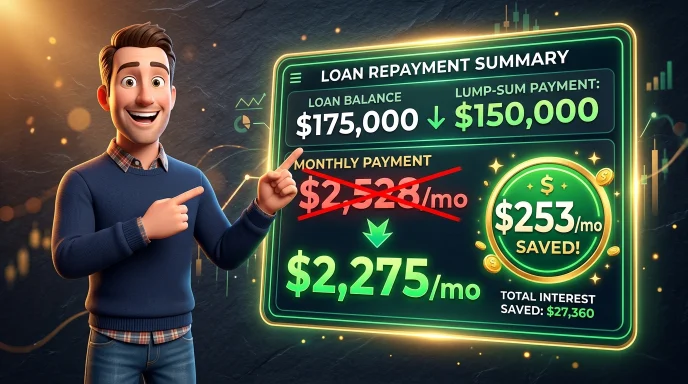
Scenario 1: Early-Loan Recast on a Larger Balance Loan: $400,000 at 6.5%, 30 years remaining, standard payment ~$2,528/month. Recast with $40,000 in month 12: new balance $360,000, re-amortized over the remaining ~29 years. Result: New payment drops to roughly $2,275/month — about $253/month saved, and total interest saved over the life of the loan comes in around $85,000–$90,000 depending on exactly when the recast happens.
Scenario 2: Mid-Loan Recast on a Medium Balance Loan: $320,000 at 6.5%, 30 years remaining, standard payment ~$2,022/month. Recast with $20,000 in month 24. Result: New payment drops to roughly $1,893/month — about $129/month saved, since the lump sum is a smaller share of the balance than in Scenario 1.
Scenario 3: Smaller Balance, Larger Relative Lump Sum Loan: $150,000 at 4.0%, 15 years remaining, standard payment ~$1,109/month. Recast with $30,000 (20% of the balance). Result: New payment drops to roughly $887/month — about $222/month saved, a bigger percentage drop because the lump sum represents a larger share of the remaining balance.
Scenario 4: Late-Loan Recast Loan: $80,000 at 5.5%, 8 years remaining, standard payment ~$1,053/month. Recast with $20,000. Result: New payment drops to roughly $842/month — about $211/month saved, but since so little of the loan term remains, total interest saved is smaller in absolute dollars than in the earlier examples, even though the monthly percentage drop looks similar.
What This Tells You
The pattern across all four scenarios: the size of your lump sum relative to your remaining balance matters more than the raw dollar amount. A $20,000 recast on a $150,000 balance moves the needle more than a $20,000 recast on a $400,000 balance, even though the dollar amount is identical.
It’s also worth noting that recasting earlier in your loan term tends to produce larger total interest savings over the life of the loan, since more of your future payments are still going toward interest at that point — recasting late in the term saves less overall, even if the monthly payment drop looks comparable.
Factors That Can Increase or Decrease Your Savings
What increases your savings:
- A lump sum that represents a larger percentage of your remaining balance
- Recasting earlier in your loan term, while more of your future payments would have gone to interest
- A higher interest rate on your existing loan (since reducing principal has a bigger effect when more of each payment is interest)
- Recasting instead of letting the same money sit uninvested, if you don’t have a specific higher-return use for it
What decreases your savings:
- A small lump sum relative to your balance — recasting $5,000 on a $400,000 loan will barely move your payment
- Recasting very late in your loan term, when most of your balance is already principal rather than interest
- Recast fees eating into your net benefit, particularly on smaller lump sums where the fee is a bigger percentage of what you’re putting down
- Not accounting for the fact that your escrow (taxes and insurance) doesn’t change with a recast — only your principal and interest portion does, so your total bill may drop less than your principal and interest alone would suggest
When a Recast Might Not Save You Much (And What To Do Instead)
If you’re recasting with a relatively small lump sum on a large remaining balance, the monthly savings might be modest enough that the fee and paperwork aren’t clearly worth it compared to simpler alternatives. In that case, two options are usually worth comparing:

Just make an extra payment instead. If your lump sum wouldn’t move your recast savings much, applying it as a one-time extra principal payment (without formally recasting) still reduces your total interest and shortens your payoff date — you just don’t get the immediate lower required payment that a recast provides.
Wait and combine it with future extra amounts. If you’re not in a rush, holding onto a smaller amount and combining it with future savings before recasting can make the eventual recast fee a smaller percentage of your overall benefit.
Our guide on mortgage recast vs refinance vs extra payments walks through this decision in more detail, and if extra payments sound like the better fit for your situation, see how to pay off a 30-year mortgage in 10–15 years for a full breakdown of how much difference different monthly amounts make.
A Quick Way to Sanity-Check Your Own Numbers
Before you plug your exact figures into the calculator, you can get a rough sense of where you’ll land with a simple gut check: divide your planned lump sum by your remaining balance. If that comes out around 5%, expect a modest monthly drop, similar to Scenario 2 above. Around 10–15%, expect something closer to Scenario 1 or Scenario 3. Above 20%, you’re in territory similar to Scenario 3’s outcome, where the payment drop is proportionally larger.
This is only a rough gut check, not a substitute for running your actual numbers, since your interest rate and remaining term both shift the result too. But it’s a useful way to set expectations before you spend time gathering your exact loan statement details.
How to Estimate Your Own Savings
Rather than trying to eyeball where your numbers fall among these examples, plug your actual loan balance, rate, remaining term, and planned lump sum into our mortgage recast calculator. It runs the exact same amortization math used in the examples above, but on your real numbers, and shows you the new payment, total interest saved, and a full year-by-year amortization schedule.
Common Questions, Answered
How much does a typical mortgage recast lower your payment? Most homeowners see a 5–15% reduction in their monthly payment, though this varies significantly based on your lump-sum amount relative to your remaining balance.
Is a bigger lump sum always better for recasting? Generally yes for lowering your payment, but check your lender’s fee structure and your own cash reserves — putting every available dollar into a recast isn’t always the best use of that money compared to keeping an emergency fund.
Does recasting save more early or late in a loan? Recasting earlier in your loan term typically produces larger total interest savings, since more of your remaining payments were still going toward interest at that point.
How much does a mortgage recast cost to set up? Most lenders charge a one-time processing fee between $150 and $500, which is small compared to the ongoing monthly savings in most cases.
Will recasting show up as savings immediately? Yes — once your lender processes the recast, your new, lower payment typically takes effect starting with your very next billing cycle.
Can I run the numbers before committing to a recast? Yes, that’s exactly what a mortgage recast calculator is for — you can test different lump-sum amounts and timing before contacting your lender to confirm.
The Bottom Line
The exact dollar amount a recast saves you depends on your specific balance, rate, and lump sum, but the examples above show the range most homeowners can expect — typically $100 to $400 a month, with tens of thousands in total interest savings over the life of the loan. The fastest way to know your real number is to run your own loan details through our mortgage recast calculator rather than relying on someone else’s example.
Disclaimer: The savings examples in this article are illustrative estimates based on sample loan scenarios, not a quote for any specific loan. This content is for informational and educational purposes only and does not constitute financial, legal, or lending advice. GetCalcBase is not a lender or financial advisor. Actual recast terms and savings are determined solely by your loan servicer. See our full Disclaimer for details.
Reviewed by Zainab Sarfraz, Financial Expert and Waseem Aijaz, WordPress Developer & SEO Expert.
Financial freedom isn’t about how much you make; it’s about how much you keep. Whether you need a car finance calculator tool or a 2026 tax breakdown, GetCalcBase is here for your journey. Bookmark this page, take control of your wallet, and let’s build your wealth together!