
Car Insurance Calculator Without Personal Information: Get Your Price Range in 30 Seconds
Built by Waseem Aijaz, WordPress developer and SEO specialist. Last updated: October 9, 2026.
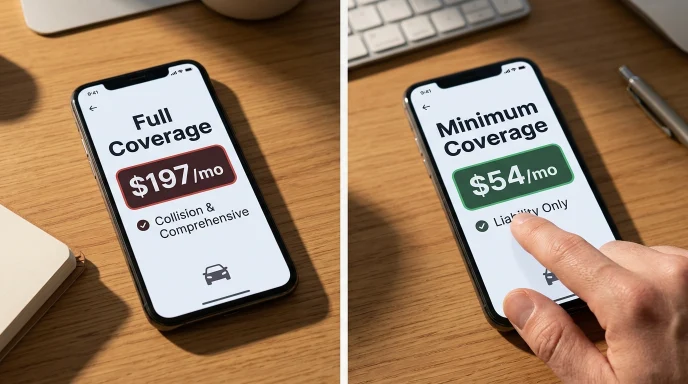
Quick answer: A car insurance calculator without personal information estimates your premium from four general choices: your city or state, age group, driving record and coverage level. You never enter your name, birthdate, license number or VIN. For a 35-year-old with a clean record and good credit, the national median is about $197 a month ($2,361 a year) for full coverage and about $54 a month ($648 a year) for minimum coverage.
No name, birthdate, license number or VIN - just four general details, and you'll never be asked for more.
Key numbers at a glance (October 2026 data):
- National median, full coverage: $2,361 a year (about $197 a month)
- National median, minimum coverage: $648 a year (about $54 a month)
- Most expensive of 50 big cities: New York, $5,103 a year. Cheapest: Raleigh, $1,328
- Every result is a plus or minus 20% range, because real insurers vary that much
I’m not a licensed insurance agent. This calculator turns published rate data into a ballpark range, and it shows its math so you can check it.
My Personal Experience Car Insurance Calculator
Look, it is very important to understand this because not everyone understands things in the same way. Some people provide their details and understand the matter, while others do not.
I faced this problem with one of my clients who lived in the USA. Whenever he used a car insurance tool, it asked him to provide his personal information first. He did not want to share those details. He complained to me about this problem and asked me to build a tool that could calculate the result without requiring his personal information.
I discussed this with some finance experts and other team members. After researching and testing, I created this tool, which I named Car Insurance Calculator Without Personal Information.
I made this tool for people who face the same problem. You can use it to check the result without sharing all your personal details. My client tested the tool and gave me his review, which you can see below.
You already know that I am a developer, and I work with experts as well. I include client reviews and testimonials after testing so that you can feel confident about the tool. I also explain the information, formulas, and other details so you can understand how the tool works, how the result is calculated, and what makes this tool different from others.
Short Pro Tips:
My tip is short, but it is important. Whenever you use any tool, you should first read the information provided on its page. Read the details about the tool and understand how it works. Many tools also have a blog or guide linked to them, so take a little time to read that as well.
This will help you understand the tool properly and increase your knowledge. If you use it without understanding what it does, you may not know how to use it correctly.
For example, on this page, you can see a full and a minimal sidebar. Click on it to explore the details and learn more about how the tool works.
How This Car Insurance Calculator Without Personal Information Works
You want one thing: a rough number. So you open a quote site, and before it shows you anything it asks for your name, address, date of birth and driver’s license number. That’s a lot to hand over just to find out if $200 a month is normal.
This car insurance calculator without personal information skips all of that. It has four dropdowns, no sign-up and no phone number. I built it for people who want a ballpark first and real quotes later. It won’t replace a real quote, and I’ll be upfront below about where it’s accurate and where it isn’t.

What your results mean
You’ll see a monthly range, an annual range and a base rate. The base rate is the published median for your city or state before your age and driving record are applied.
How to use this car insurance estimator
- Pick your city or state. Fifty major cities have their own rates. If yours isn’t listed, choose your state’s average. A green City-specific badge or an orange State average badge tells you which one you’re getting.
- Choose your age bracket: 16-19, 20-29, 30-59, 60-69 or 70+.
- Choose your driving record and credit: clean with good credit, clean with poor credit, one speeding ticket, one at-fault accident or one DUI.
- Choose your coverage level: full coverage or minimum (liability-only).
- Read your range. It updates the moment you change anything.
- Go deeper if you like. The calculation link walks you through the math, and the compare link helps if you’re thinking about moving to another city or state.
Real Examples From the Calculator
Here’s what the car insurance calculator without personal information returns for a few common profiles. It’s full coverage and a clean record unless noted.
Scenario | Monthly range | Annual range |
|---|---|---|
Chicago, age 30-59, clean record | $202–$303 | $2,424–$3,636 |
Raleigh, same profile | $89–$133 | $1,062–$1,594 |
New York, same profile | $340–$510 | $4,082–$6,124 |
New Orleans, same profile | $337–$505 | $4,040–$6,060 |
Houston, age 20-29, one speeding ticket | $359–$538 | $4,304–$6,455 |
National, age 16-19 | $277–$416 | $3,324–$4,986 |
Detroit, age 30-59, clean record, minimum coverage | $133–$200 | $1,598–$2,398 |
Location alone moves the number a lot. For the same driver, record and coverage, New Orleans’ base rate is $3,722 a year higher than Raleigh’s. New York now sits at the top of The Zebra’s October 2026 list of 50 big cities, just ahead of New Orleans.

Can an Instant Car Insurance Estimate Really Be Accurate?
It can be accurate about the things that move your price most, and honest about what it can’t see. A car insurance calculator without personal information has to work from averages, so it will never match a real quote to the dollar.
Where the numbers come from
- City rates: The Zebra’s city rate table, updated October 6, 2026, for the 50 biggest US cities. The Zebra says its figures use a default driver profile that can change as it refreshes the page, so treat city numbers as a guide.
- State rates and driving-record adjustments: NerdWallet’s October 2026 rates analysis for a 35-year-old with good credit and a clean record. Its full coverage sample has $100,000/$300,000 bodily injury, $50,000 property damage, uninsured motorist cover, and collision and comprehensive with $1,000 deductibles. Minimum coverage means the state minimum.
- Age pattern: Insurify’s age table, updated October 7, 2026, turned into a ratio against the 35-year-old rate. Ages 16-19 come out at about 1.76 times, 20-29 at 1.34, 30-59 at 1.00, 60-69 at 0.84 and 70+ at 0.85.
The formula
Estimate = base rate (city or state) x age factor x driving-record factor
Range    = estimate - 20%  to  estimate + 20%
Example: Houston, age 20-29, one speeding ticket, full coverage. $3,130 x 1.34 x 1.2826 is about $5,380 a year, or $448 a month. The tool then shows the range around that figure.
What it deliberately leaves out
Your car’s make, model and age, your exact ZIP code, your mileage and your discounts. When I built this car insurance calculator without personal information, I chose to leave them out rather than invent a multiplier. I couldn’t find a public, verified one I’d trust. That’s why a real quote can land outside the range.
What happens to your information
The calculation runs in your browser. Nothing is sent anywhere when you change a dropdown, and the only thing saved on your device is your dark-mode choice. As on most websites, ad and analytics cookies can still apply to your visit, so see our privacy policy.
What Changes Your Price Most
Four things do most of the work: where you live, your age, your driving record and your coverage level.

Age and driving experience
Teen drivers pay the most. In Insurify’s data, full coverage for a teen runs about $350 a month, close to 1.8 times what a 35-year-old pays. Rates keep falling through your 30s, 40s and 50s, hit their lowest in your 60s at roughly $163 a month, then start to creep up again around age 70.
If you’re retired and living on a fixed income, it’s worth knowing how much room your budget has. The Social Security COLA 2027 Calculator shows how next year’s cost-of-living adjustment may change your monthly benefit.
Full coverage vs minimum coverage
Minimum coverage meets your state’s legal requirement and pays for damage you cause to other people. It does not pay to repair your own car after an at-fault accident. Nationally, full coverage costs about $1,713 a year more than minimum. The side-by-side button in the tool shows that gap for your own city or state.
Average car insurance cost by state
Your state can matter more than anything else you choose. These are the five highest and five lowest full-coverage medians from NerdWallet’s October 2026 analysis:
Where it falls | State | Full coverage a year | About a month |
|---|---|---|---|
Highest | Louisiana | $4,296 | $358 |
Highest | New Jersey | $3,687 | $307 |
Highest | Texas | $3,652 | $304 |
Highest | Nevada | $3,497 | $291 |
Highest | Kentucky | $3,298 | $275 |
Lowest | North Carolina | $1,789 | $149 |
Lowest | Maine | $1,713 | $143 |
Lowest | New Hampshire | $1,578 | $132 |
Lowest | Vermont | $1,556 | $130 |
Lowest | Wyoming | $1,148 | $96 |
Why your state matters
Your state matters before almost anything else you choose. Louisiana’s full-coverage median is $4,296 a year, while Wyoming’s is $1,148, a gap of $3,148. The calculator covers all 50 states and Washington, D.C. See the average car insurance cost by state to compare every state side by side.
Car insurance rate by driving record
NerdWallet priced the same 35-year-old with different histories. Here are the national medians:
Driver profile | Full coverage | Minimum coverage | Full coverage vs clean |
|---|---|---|---|
Clean record, good credit | $2,361 | $648 | Baseline |
One speeding ticket | $3,028 | $840 | +28% |
One at-fault accident | $3,524 | $952 | +49% |
One DUI | $4,437 | $1,231 | +88% |
Clean record, poor credit | $3,954 | $1,030 | +67% |
Your driving record and credit
Nationally, one speeding ticket adds about 28%, an at-fault accident about 49% and a DUI about 88% to a full-coverage premium, and poor credit adds about 67%. See how much car insurance goes up after a speeding ticket, accident or DUI for the dollar breakdown.
How This Estimator Compares With a Real Quote
| This estimator | Typical online quote form | Calling an agent |
|---|---|---|---|
Personal details needed | None | Usually name, address, birthdate, license number | Usually the same, by phone |
What you get | A price range | Specific quotes | A specific quote |
Follow-up calls or emails | None, we never ask for contact details | Possible | Likely |
Shows how the number was built | Yes | Rarely | Usually not |
Exact price | No, an estimate | Yes, once verified | Yes, once verified |
A car insurance calculator without personal information and a real quote do different jobs. Use the estimate to plan, then get real quotes before you buy.
Why start with an estimate
- No personal details, ever. No name, birthdate, license number, VIN, email or phone number.
- City and state rates. Fifty major cities, all 50 states and Washington, D.C.
- It shows its working. Every step of the calculation is one click away.
- Side-by-side views for full vs minimum coverage and for two locations.
- An honest range instead of one made-up number, on a fast, mobile-friendly page with dark mode.
How to Get the Lowest Price on a Real Policy
Six tips that actually move the price
- Get three quotes for the same coverage. Prices for the same driver can differ by more than double. In NerdWallet's October 2026 comparison, the eight insurers shown for a sample ZIP code ranged from $75 to $171 a month for the same 35-year-old clean driver.
- Know what your record costs. A ticket, a crash and a DUI add roughly 28%, 49% and 88% to a full-coverage premium nationally.
- Don't choose minimum coverage on price alone. It won't repair your own car.
- Ask about discounts, such as bundling, safe-driver programs and low mileage.
- Consider a higher deductible, but only one you could pay tomorrow.
- Re-shop every year, and again after a move or a new job.

Use your estimate from the car insurance calculator without personal information as a yardstick. If a quote lands far above the range, shop around. If one lands far below it, check what it leaves out.
If you’re financing the car, the loan payment sits on top of your insurance. Run it through Loan Analytics Pro first. Then check what you actually take home with the Income Tax Calculator 2026, so your monthly budget is built on net pay, not gross.

Common mistakes when estimating car insurance
- Treating an estimate as a quote. Only a licensed insurer can give you a binding price.
- Comparing quotes with different limits or deductibles. A cheaper quote may simply cover less.
- Ignoring where you park the car. Moving between cities can change your price by more than a ticket would. Moving? The Rent vs Buy Calculator helps you see the full housing cost in the new place too.
Quick checklist before you rely on the numbers
Before you act on a result from any car insurance calculator without personal information, run through this list:
- You picked your own city, or your state if yours isn't listed
- You chose the age bracket and driving record that actually fit you
- You looked at both full and minimum coverage
- You know the result is a range, not a quote
- You plan to get three real quotes before buying
From estimate to real quote
- Set a budget range with the estimator, so you can spot a quote that’s too high or suspiciously low.
- Decide your coverage first, then ask every insurer for the same limits and deductibles.
- Share your details only when you’re ready for real quotes.
- Compare three quotes side by side, checking coverage as well as price.
- Check the company too: how it handles claims and complaints.
Frequently Asked Questions (FAQs)
How can I check car insurance rates without personal information?
Use a car insurance calculator without personal information, like this one. It asks only for a city or state, an age bracket, a driving record and a coverage level, then returns a price range built from published rate data. A binding quote is different, because insurers have to verify your driving record, vehicle and address.
How do I figure out how much my car insurance will be?
Start with a range, then confirm it with real quotes. Your price is driven mainly by where you live, your age, your driving record, your credit in most states, and your coverage. Run the estimator for a ballpark, then get quotes from at least three insurers for the same coverage.
Is $400 a month normal for car insurance?
It depends on who’s driving and where. $400 a month is $4,800 a year, about double the national full-coverage median of $2,361 for a 35-year-old with a clean record. In the priciest cities it’s normal: the same profile comes out around $425 a month in New York, $421 in New Orleans and $403 in Detroit. A teen driver can reach it easily, since the estimator puts a 16-19 driver in Chicago at about $444 a month. For a clean-record adult in Raleigh (about $111 a month), it’s a sign to shop around.
Why do car insurance quotes differ so much between companies?
Every insurer weighs the same factors differently, so one company may like your age or ZIP code more than another does. In NerdWallet’s October 2026 comparison, full coverage for one identical profile ran from $75 to $171 a month across the eight insurers shown. Comparing quotes for the same coverage is the most reliable way to save.
Can I get a car insurance estimate without email or phone calls?
Yes. This car insurance calculator without personal information never asks for an email address or phone number, so there’s nothing to follow up on. Quote forms usually need contact details to deliver and follow up on quotes.
Does the calculator cover my city?
It has city rates for 50 major US cities, including New York, Los Angeles, Chicago, Houston and Phoenix. For any other location, choose your state’s average, which covers all 50 states and Washington, D.C.
Why does the calculator show a range instead of one price?
No public data can predict what one insurer will charge you. Even for the same driver, insurers can differ by more than 2x, and details this calculator doesn’t ask for, like your car’s make and model, also move the number. The range is the estimate plus or minus 20%.
Conclusion
A car insurance calculator without personal information can’t tell you the exact price an insurer will charge, and it shouldn’t pretend to. What it can do is give you a realistic range from current rate data, and show how the number was built, before you share a single personal detail.
Pick your city, set your profile and see your range above. Then get three real quotes with your number in hand. If you want more free money tools, browse the full set of Finance Tools.
Data sources (checked October 2026): The Zebra, NerdWallet and Insurify. This page and calculator give estimates for general information only. They are not an insurance quote or financial advice, and actual prices vary by insurer. Get a quote from a licensed insurer for an exact figure. See our full disclaimer.
Related Guides
More detail on the parts of car insurance pricing this calculator only touches on:
- How Much Does Car Insurance Go Up After a Speeding Ticket, Accident or DUI? (coming soon)
- Average Car Insurance Cost by State (2026) (coming soon)
What the Get Calculator Base Community Says
Average Rating: 4.9/5 based on our beta users