

Quick Answer
A common starting point for how much house can I afford is the 28/36 rule: keep housing costs under 28% of your gross monthly income, and total debt under 36%. Your real number also depends on your down payment, credit score, and local property tax rates — this guide breaks down how to calculate a figure that actually fits your budget, not just what a lender approves.
This is a very important point to understand: if you want to use any of our tools, you do not need a lot of information or prior knowledge. Our tools are designed to be easy to use, and when you use a tool, you can get an idea of what you need to do and which option may be right for you.
My tip from my side is that if you do not know much about the topic, first read this blog. If you do not want to read the blog, you can scroll down and click the button below to use our tool directly.
You can use the tool and see if it is helpful for you.
Introduction
Every lender will approve you for more than you should actually spend. That’s not a conspiracy — it’s just how the math works on their end. Their job is assessing risk. Your job is figuring out how much house you can afford comfortably, not just what you technically qualify for.

I’ve seen people get approved for a mortgage that left them “house poor” — able to make the payment every month, but with nothing left over for savings, travel, or emergencies. This guide walks through the real framework for setting your number in 2026, not just the bank’s number.
The 28/36 Rule, Explained
This is the classic starting point most financial planners still recommend. Take your gross monthly income (before taxes) and apply two caps:
- Front-end ratio (28%): Your total housing payment — mortgage principal and interest, property tax, insurance, and HOA — shouldn’t exceed 28% of gross monthly income.
- Back-end ratio (36%): All your monthly debt combined (housing plus car loans, student loans, credit cards) shouldn’t exceed 36%.
If you earn $6,000/month gross, that’s roughly $1,680 for housing and $2,160 for total debt, including that housing figure.
Quick Reference Table
| Gross Monthly Income | Max Housing Payment (28%) | Max Total Debt (36%) |
|---|---|---|
| $4,000 | $1,120 | $1,440 |
| $6,000 | $1,680 | $2,160 |
| $8,000 | $2,240 | $2,880 |
| $10,000 | $2,800 | $3,600 |
Beyond the Ratio: What Actually Changes How Much House You Can Afford
- Your down payment size. A bigger down payment lowers your monthly payment and can help you avoid PMI entirely, which changes your effective front-end ratio.
- Your credit score. Higher scores unlock lower interest rates, which meaningfully changes your affordable price range — sometimes by tens of thousands of dollars on the total loan you can comfortably carry.
- Where you live. Property tax rates and insurance costs vary a lot by state and can shift your real budget by hundreds of dollars a month, even for the same home price.
- Other debt you’re carrying. Student loans or a car payment eat into your 36% ceiling fast, sometimes more than people expect until they actually run the numbers.
- Job stability and income type. Lenders (and your own comfort level) should weigh whether your income is steady salary or variable, since variable income deserves a more conservative ceiling.
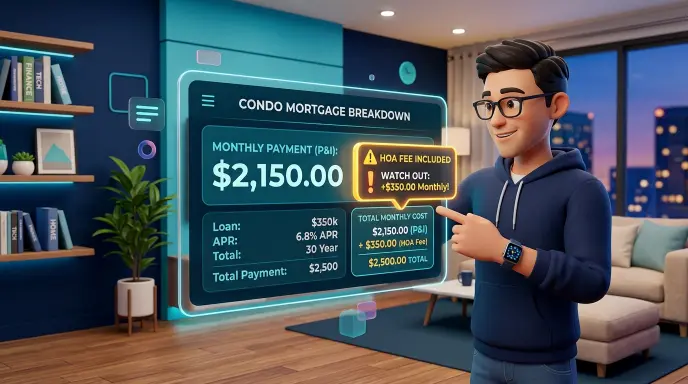
How Lenders Calculate How Much House You Can Afford Differently Than You Might
It’s worth knowing that lenders often approve buyers above the 36% back-end ratio, sometimes up to 43-50% depending on the loan program. That doesn’t mean it’s the right number for you — it just means the ceiling a lender offers and the ceiling that keeps you financially comfortable aren’t always the same number. Treat your pre-approval letter as a maximum, not a target.
Common Mistakes People Make When Estimating How Much House They Can Afford
- Using pre-approval as a spending target. Pre-approval shows your maximum, not your recommended budget — and it’s easy to creep toward that ceiling once you start house hunting.
- Forgetting maintenance and closing costs when calculating what they can “afford.” A home that fits the monthly mortgage payment can still strain your budget once repairs start.
- Ignoring how property tax and insurance change the actual monthly number beyond the loan payment itself — these can add several hundred dollars depending on your state.
- Not leaving room for an emergency fund after the down payment. Buyers who drain their entire savings on the down payment have no cushion if something breaks in year one.
- Comparing their budget to friends’ or family’s home prices without accounting for differences in income, debt, or local cost of living.
How Much House Can You Afford: A Realistic Budget Checklist
- Calculate your gross monthly income
- Apply the 28/36 rule as a starting ceiling
- Subtract your existing monthly debt obligations
- Research property tax and insurance rates in your target area
- Add a buffer for maintenance and future cost increases
- Confirm you’ll still have 3-6 months of expenses saved after the down payment
- Get pre-approved to confirm your number against a real lender quote

Expert Insight: How Much House Can You Afford Isn’t Just About the Mortgage
A mortgage payment is only part of the real cost of owning a home. Maintenance alone is often estimated at 1-2% of the home’s value annually — on a $350,000 home, that’s $3,500-$7,000 a year that doesn’t show up in a simple affordability calculator. Building this into your budget upfront avoids the surprise later.
See Your Full Financial Picture
Once you know your target budget, the next step is comparing what buying actually costs against renting over time — not just today’s payment, but the full multi-year picture. Our rent vs buy calculator factors in your down payment, PMI, closing costs, and even what that money could earn if invested instead, which is genuinely useful once you have a price range in mind.
Frequently Asked Questions
How much house can I afford on a $70,000 salary? Using the 28/36 rule, that’s roughly $1,630/month for housing. Depending on your down payment and interest rate, that could translate to a home price in the $250,000-$300,000 range, though local taxes and insurance will shift this figure.
Is the 28/36 rule outdated in 2026? It’s still a useful starting point, though some lenders now approve buyers above a 36% back-end ratio. That doesn’t mean it’s the right choice for your comfort level — treat it as a guideline, not a hard rule.
Does my down payment change how much house I can afford? Yes — a larger down payment lowers your loan amount and monthly payment, and can help you avoid PMI if you reach 20%, which further lowers your effective monthly cost.
Should I max out my pre-approval amount? Generally, no. Pre-approval reflects the maximum a lender will offer, not necessarily a comfortable monthly payment for your lifestyle and other financial goals.
How does credit score affect how much house I can afford? A higher credit score typically qualifies you for a lower interest rate, which can meaningfully increase the home price you can afford at the same monthly payment.
Should I include future income growth when calculating affordability? It’s safer to budget based on your current, confirmed income. If a raise or bonus materializes, you can always increase your down payment or pay down the loan faster instead.
Conclusion
How much house you can afford isn’t just a lender’s calculation — it’s a personal budget decision that depends on your full financial picture, not just your income. Start with the 28/36 rule, adjust for your real expenses and local costs, and leave room to breathe financially. Once you’ve got a target price range, run it through our rent vs buy calculator to see whether buying at that price actually beats renting for your timeline.
Once you know your budget range, the next question is renting vs buying. Run the numbers with our Rent vs Buy Calculator to see which option actually saves you more over time.
This article is for informational purposes only and does not constitute financial advice. Consult a licensed financial advisor or mortgage professional for guidance specific to your situation.