

Written and fact-checked by Waseem Aijaz, WordPress Developer & SEO Expert. Last reviewed: September 2026.
Quick answer: PF is 12% of your Basic + DA, matched by your employer. ESI is 4% of your full gross wages (0.75% you, 3.25% employer), and only applies if your gross wages are ₹21,000 a month or less. They’re calculated on different salary components, run by different organisations, and fund completely different things – which is exactly why payroll teams mix them up.
Why I Added This Tool
This tool was already available, but we also added it to our website because, as I told you, this was a client-related requirement.
When this tool was added, the response was very good. Many people were searching for this information because they needed it.
However, our main focus is not only on the tool. We also provide detailed information so users can understand the topic before using the tool. This helps them learn the information they need and then use the tool properly.
Why PF and ESI Get Confused

Both show up as deductions on the same payslip. Both are percentage-based. Both have an employer top-up. It’s easy to assume they’re two flavours of the same thing. They aren’t.
PF (run by EPFO) builds a retirement fund. ESI (run by ESIC) funds medical, sickness and maternity benefits while you’re working. One is about your future, the other is about your health cover right now – and mixing up their rules is the single most common payroll mistake we see people ask about.
PF vs ESI at a Glance
| PF (EPFO) | ESI (ESIC) | |
|---|---|---|
| What it’s for | Retirement savings | Medical & sickness insurance |
| Calculated on | Basic + DA only | Full gross wages |
| Employee rate | 12% | 0.75% |
| Employer rate | 12% (split: EPF + EPS) | 3.25% |
| Combined rate | 24% | 4% |
| Wage ceiling | ₹15,000 (for the EPS split; your own 12% keeps going on your full Basic + DA unless your employer caps it) | ₹21,000 (₹25,000 for persons with disabilities) – above this, ESI stops applying entirely |
| Who’s covered | Establishments with 20+ employees | Establishments with 10+ employees (20+ in some states) |
| Governing law | EPF & MP Act, 1952 | ESI Act, 1948 |
The wage ceiling is where people get tripped up worst. PF’s ₹15,000 figure only limits the EPS portion of your employer’s contribution. ESI’s ₹21,000 figure is different in kind: cross it, and ESI stops applying to you altogether for the rest of that contribution period.
How PF Is Calculated (Quick Recap)
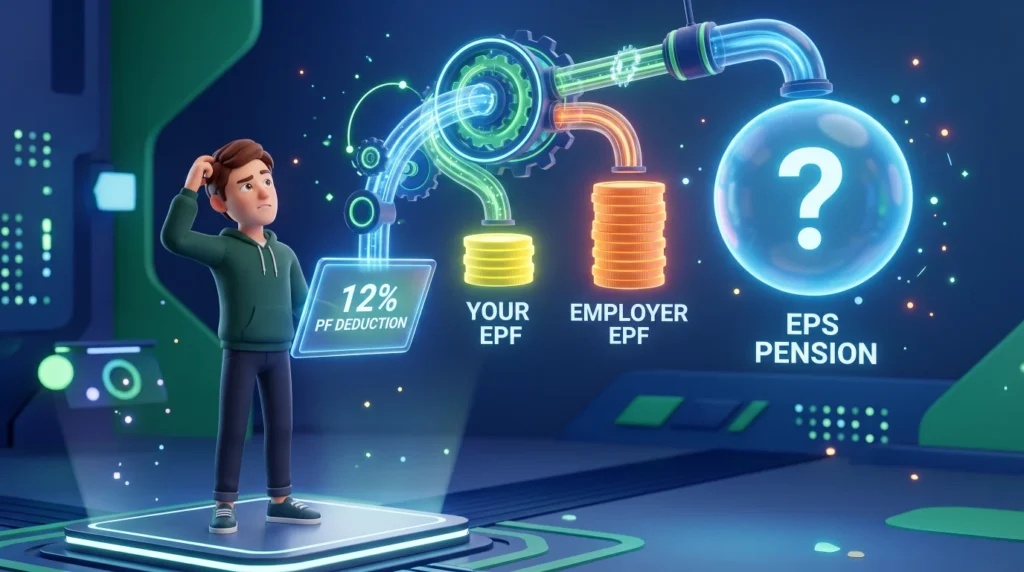
PF is 12% of your Basic + DA from you, matched by 12% from your employer – of which 8.33% (capped at ₹15,000 of wage) goes to the EPS pension fund and the rest to your EPF account. We’ve covered this in full, with a working calculator, in our VPF / EPF / PF Calculator.
How ESI Is Calculated
This is where the real difference from PF shows up.
The Formula
Employee's ESI share   = 0.75% x Gross wages
Employer's ESI share   = 3.25% x Gross wages
Total ESI contribution = 4% x Gross wages

Applies only if Gross wages <= Rs 21,000/month
What Counts as “Gross Wages” for ESI
This is the part most PF-trained instincts get wrong. ESI is worked out on your full gross wages, not just Basic + DA. That typically includes Basic, DA, HRA, city compensatory allowance, overtime pay, and regular production incentives – the actual mix depends on how your company structures its salary. It excludes annual bonuses, retrenchment compensation, leave encashment and gratuity.
So the same person can have very different PF and ESI wage bases, on the exact same payslip.
Worked Examples
| Gross wages | Employee (0.75%) | Employer (3.25%) | Total ESI |
|---|---|---|---|
| ₹10,000 | ₹75 | ₹325 | ₹400 |
| ₹15,000 | ₹113 | ₹488 | ₹600 |
| ₹18,000 | ₹135 | ₹585 | ₹720 |
| ₹20,000 | ₹150 | ₹650 | ₹800 |
| ₹21,000 | ₹158 | ₹683 | ₹840 |
Above ₹21,000 gross wages, none of this applies – ESI simply stops, for that contribution period.
The Low-Wage Exemption
If your average daily wage is ₹176 or less, you’re exempt from your own 0.75% share entirely. Your employer still pays their full 3.25% on your behalf. This is a genuine, if narrow, protection for the lowest-paid workers in a covered establishment – they get full ESI medical coverage without losing a rupee of take-home pay for it.

Contribution Periods: Why Your ESI Deduction Doesn’t Change Mid-Year
ESI runs on two fixed six-month contribution periods each year: April to September, and October to March. If your salary rises above ₹21,000 partway through one of these periods, your employer keeps deducting ESI – on your new, higher wages – until that period ends. The change only takes effect at the start of the next period. This trips people up when a mid-year raise doesn’t immediately stop the ESI line on their payslip.
A Real Scenario: One Payslip, Two Different Wage Bases
Say someone has a monthly salary structured as ₹12,000 Basic + DA, ₹5,000 HRA and ₹1,000 conveyance allowance – ₹18,000 gross in total.
For PF, only the ₹12,000 Basic + DA counts. That’s ₹1,440 from the employee (12%) and ₹1,440 from the employer (12%, split between EPS and EPF as usual).
For ESI, the full ₹18,000 gross counts, since it’s under the ₹21,000 ceiling. That’s ₹135 from the employee (0.75%) and ₹585 from the employer (3.25%).
Add the employee’s two shares together and ₹1,575 comes off this person’s pay every month for PF and ESI combined – but they were calculated on two completely different numbers (₹12,000 and ₹18,000), from the same payslip. This is exactly the kind of split that a calculator built only around PF’s Basic + DA logic gets wrong the moment ESI enters the picture.
Common Mistakes People Make With PF and ESI
- Applying PF’s Basic + DA logic to ESI. ESI uses gross wages – HRA and regular allowances included – not just Basic and DA.
- Assuming ESI stops the moment a raise crosses ₹21,000. It continues to the end of the current contribution period on the actual wages.
- Missing the daily-wage exemption. Very low-paid employees don’t lose ESI coverage by being exempt from their own share – only their 0.75% is waived, not the benefit.
- Registering late. A covered establishment must register within 15 days of the ESI Act becoming applicable to it, and stays covered even if headcount later drops.
- Forgetting these are two separate compliance regimes. Meeting your PF obligations doesn’t automatically mean you’re compliant on ESI, and vice versa – the eligibility thresholds, wage bases and payment deadlines are all independent of each other.
Quick Checklist for PF and ESI Payroll
- You’re using Basic + DA for PF and full gross wages for ESI – not the same figure for both
- You’ve confirmed your establishment’s headcount meets both thresholds (20+ for PF, 10+ or 20+ for ESI depending on state)
- You know which contribution period you’re in for ESI, and haven’t stopped deductions early after a mid-period raise
- You’ve checked whether any employee qualifies for the ₹176/day ESI exemption
- Both PF and ESI payments are made by their respective deadlines each month
Frequently Asked Questions
How do I calculate PF and ESI together?
Calculate them separately, since they use different wage bases. PF is 12% (you) plus 12% (employer) of Basic + DA. ESI is 0.75% (you) plus 3.25% (employer) of full gross wages, only if gross wages are ₹21,000 or below. Add the two employee-side deductions together to see your total payslip impact.
What is the ESI contribution rate for 2026?
4% of gross wages in total – 0.75% from the employee and 3.25% from the employer. These rates have been unchanged since 1 July 2019.
Is ESI calculated on the same salary as PF?
No, and this is the detail that trips up the most calculators. PF uses Basic + DA. ESI uses full gross wages, including HRA and most regular allowances.
What is the wage ceiling for ESI in 2026?
₹21,000 a month (₹25,000 for persons with disabilities). Above this, ESI doesn’t apply, though PF can still apply regardless of salary.
Do all employees get PF and ESI together?
Not necessarily. An employee can be covered by PF but not ESI (common once gross wages pass ₹21,000, since PF has no such ceiling), or covered by ESI in an establishment too small for mandatory PF. Check both thresholds independently.
What would PF and ESI together look like on an ₹18,000 salary?
It depends on the split between Basic + DA and other allowances, since PF uses only Basic + DA while ESI uses the full ₹18,000 gross. As a simplified example, if the full ₹18,000 counts as gross wages for ESI, that’s ₹135 (employee) + ₹585 (employer) = ₹720 total ESI. For the exact PF figure, use our PF Calculator with your actual Basic + DA.
Does ESI stop automatically once I cross ₹21,000?
Not immediately – your employer continues ESI deductions on your actual wages until the end of the current six-month contribution period, then stops at the start of the next one.
This article explains the general PF and ESI framework as of September 2026. Contribution rates, ceilings and covered establishments can change, and specific payroll situations vary – always confirm current figures on the EPFO and ESIC portals. This is general information, not financial, tax or compliance advice. See our full disclaimer.