

Etsy Fees Explained 2026 — Every Charge You Pay as a Seller (And How to Calculate Each One)
“You have finally arrived at the exact place where you will find a solution for everything. If you don’t take my word for it, just scroll down and explore our categories for yourself. Speaking from my personal experience, I used to constantly search for an all-in-one platform—a single hub where I could access every single tool I needed right when I needed it.
This massive problem was completely solved for me by Get Calculator Base (GCB). I tested their Etsy Calculator tool, and honestly, it feels like it was engineered for the year 2050, yet we are getting to use it today! Click the button below to try it out right now.”
You made a sale. Congratulations. Now comes the part nobody warns you about properly: figuring out what you actually keep.
Etsy has multiple fee types, each calculated differently, some applied to different portions of the transaction, and at least one that becomes mandatory without any action on your part once you cross a sales threshold. Reading Etsy’s help documentation gives you the rates. It doesn’t give you the full picture of how they compound.
This guide does. By the time you finish, you’ll understand every single charge Etsy applies to your sales, exactly how each one is calculated, which ones you can control and which ones you can’t, and how they stack up against each other on a real transaction.
Bookmark it. You’ll want to come back when Etsy updates its rates — which it does, and often with less fanfare than sellers deserve.

The Complete List of Etsy Fees in 2026
Etsy charges sellers through six distinct fee mechanisms. Most sellers know about two or three. The ones they don’t know about are usually the ones that erode their margins most quietly.
1. Listing Fee — $0.20 Per Item
Every time you publish a listing on Etsy, you pay $0.20. This fee is charged:
- When you first publish the listing
- Every four months if the item hasn’t sold and the listing auto-renews
- Every time a unit sells (the listing renews automatically for the next unit at $0.20)

For a single item that sells within its first four months, you pay $0.20 total. For a multi-quantity listing where you sell 10 units, you pay $2.00 in listing fees across those 10 sales.
The detail most sellers miss: If you list an item with a quantity of 5 and all 5 sell in the same month, you pay 5 × $0.20 = $1.00 in listing fees. It’s not a one-time charge — it’s per unit sold.
For digital products: Your digital listing doesn’t expire the same way a physical listing does when stock runs out, because there’s no physical stock. Each download sale triggers a $0.20 renewal, just like a physical product sale would. High-volume digital sellers pay this fee repeatedly throughout the month.
2. Transaction Fee — 6.5% of Everything the Buyer Pays
This is Etsy’s primary commission on your sales. The rate is 6.5% of the total amount the buyer pays, which includes:
- Your item price
- Your shipping charge
- Gift wrapping fees
- Any personalisation fees
The critical detail: The transaction fee is NOT calculated only on your item price. It’s calculated on the entire order total. If you charge $20 for the item and $8 for shipping, Etsy takes 6.5% of $28 — not $20.
The calculation: $28 × 0.065 = $1.82 transaction fee
Etsy raised this fee from 5% to 6.5% in April 2022. For a seller averaging $2,000 in monthly sales, that 1.5% increase cost an extra $30 per month — $360 per year — in additional fees. Many sellers never updated their prices to account for this.
For digital products: The transaction fee is the same 6.5%, but it’s calculated only on your item price since there’s no shipping charge. A $12 digital print generates a $0.78 transaction fee.
3. Payment Processing Fee — Varies by Country
If your buyers pay through Etsy Payments (the standard payment processor for most countries), you pay a payment processing fee on every transaction. This fee has two components: a percentage and a flat amount.
2026 payment processing rates by country:
| Country | Rate |
|---|---|
| United States | 3% + $0.25 USD |
| United Kingdom | 4% + £0.20 |
| Canada (domestic) | 3% + C$0.25 |
| Canada (international) | 4% + C$0.25 |
| Australia (domestic) | 3% + A$0.25 |
| Australia (international) | 4% + A$0.25 |
| Most EU countries | 4% + €0.30 |
| Japan | 6.5% + ¥40 |
The percentage portion is calculated on the total order amount (same base as the transaction fee). The flat amount is fixed per transaction regardless of order size.
Why the flat fee matters more on small sales: On a $5 item, the $0.25 flat fee represents 5% of your revenue on its own — before the percentage portion. This is why very low-priced items are structurally harder to profit from on Etsy than higher-priced ones. The $0.25 flat fee is the same whether you sell a $5 item or a $500 item.

4. Offsite Ads Fee — 12% or 15%
This is the fee that catches the most sellers off guard — particularly because it can become mandatory without any decision on your part.
Etsy promotes sellers’ listings on external platforms: Google Shopping, Facebook, Instagram, and Pinterest. When a buyer clicks one of these ads and makes a purchase within 30 days, Etsy charges a fee:
- 15% of the total order amount — for shops that earned less than $10,000 USD in the previous 12 months
- 12% of the total order amount — for shops that earned $10,000 USD or more in the previous 12 months
The mandatory enrollment rule: Sellers below the $10,000 threshold can opt out of the offsite ads program. Sellers who have earned $10,000 or more in the past 12 months cannot opt out. Enrollment becomes permanent.
Why this changes the math significantly:
Take a $30 item with $5 shipping — a $35 order total — for a US seller.
Without offsite ads:
- Listing: $0.20
- Transaction (6.5%): $2.28
- Processing (3% + $0.25): $1.30
- Total fees: $3.78
- Profit on $35 order before costs: $31.22
With offsite ads (15%):
- Listing: $0.20
- Transaction (6.5%): $2.28
- Processing (3% + $0.25): $1.30
- Offsite ads (15%): $5.25
- Total fees: $9.03
- Profit on $35 order before costs: $25.97
One fee — $5.25 — on a $35 order. That’s 15% of your revenue gone before you’ve accounted for a dollar of production cost.
Not every sale comes through offsite ads, so you won’t pay this fee on every order. But for shops where a significant portion of traffic comes from Google Shopping (which is most well-optimized Etsy shops), a meaningful percentage of sales will incur this fee.
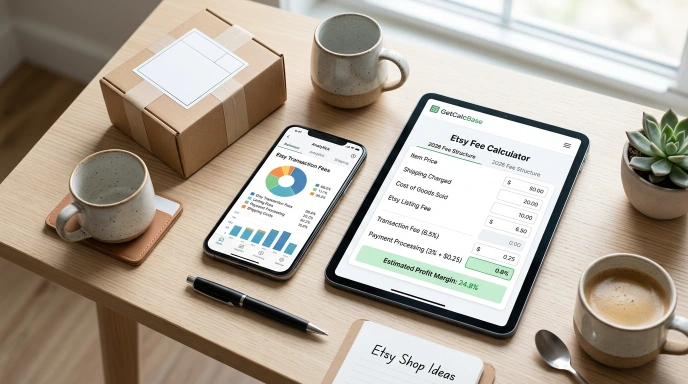
Use the Etsy fee calculator at GetCalcBase to model your margin both with and without offsite ads — so you understand the range your profit actually sits in.
5. Regulatory Operating Fee — Country-Specific Percentage
Etsy charges an additional regulatory operating fee in some countries to cover the cost of complying with local digital services regulations. This fee is calculated as a percentage of the total order amount.
Countries where this fee applies (2026):
| Country | Rate |
|---|---|
| Turkey | 2.27% |
| Vietnam | 1.24% |
| Canada | 1.15% |
| Spain | 0.72% |
| France | 0.47% |
| United Kingdom | 0.32% |
| Italy | 0.32% |
| India | 0.29% |
For most UK sellers, this is an additional 0.32% on every order — small per transaction but worth knowing. For Canadian sellers, 1.15% adds up quickly at any meaningful sales volume.

6. VAT on Etsy Fees — UK and EU Sellers
This one trips up UK and EU sellers regularly.
If you are not VAT registered, Etsy adds 20% VAT to all the fees it charges you. The £0.20 listing fee becomes £0.24. The transaction fee becomes 7.8% in effective terms. This applies across all fee types.
If you are VAT registered and have entered your VAT number in your Etsy settings, Etsy does not charge VAT on its fees. However, you then need to charge VAT on your own sales (20% in the UK) and remit it to HMRC.
The VAT question is one of the more complex aspects of selling on Etsy from the UK or EU. Use the VAT calculation calculator at GetCalcBase to understand how VAT registration affects your net income from Etsy before making that decision.
How Fees Stack on a Real Transaction — Four Examples
Example 1: US Seller, Handmade Physical Item, No Offsite Ads
Item price: $28 | Shipping charged: $7 | COGS: $10
| Fee | Amount |
|---|---|
| Listing | $0.20 |
| Transaction (6.5% × $35) | $2.28 |
| Processing (3% × $35 + $0.25) | $1.30 |
| Total Fees | $3.78 |
| COGS | $10.00 |
| Net Profit | $21.22 |
| Margin | 60.6% |
Example 2: US Seller, Same Item, With 15% Offsite Ads
| Fee | Amount |
|---|---|
| Listing | $0.20 |
| Transaction (6.5% × $35) | $2.28 |
| Processing (3% × $35 + $0.25) | $1.30 |
| Offsite Ads (15% × $35) | $5.25 |
| Total Fees | $9.03 |
| COGS | $10.00 |
| Net Profit | $15.97 |
| Margin | 45.6% |
Example 3: UK Seller, Digital Product
Item price: £12 | Shipping: £0 | COGS: £0 (time only, $3 equivalent)
| Fee | Amount |
|---|---|
| Listing | £0.15 |
| Transaction (6.5% × £12) | £0.78 |
| Processing (4% × £12 + £0.20) | £0.68 |
| Regulatory (0.32% × £12) | £0.04 |
| Total Etsy Fees | £1.65 |
| Time cost | £3.00 |
| Net Profit | £7.35 |
| Margin | 61.3% |
Example 4: EU Seller, Physical Item With Discount
Item price: €35 | Shipping: €8 | 10% coupon | COGS: €12
After 10% discount, item becomes €31.50 + €8 = €39.50 total order.
| Fee | Amount |
|---|---|
| Listing | €0.20 |
| Transaction (6.5% × €39.50) | €2.57 |
| Processing (4% × €39.50 + €0.30) | €1.88 |
| Total Fees | €4.65 |
| COGS | €12.00 |
| Net Profit | €22.85 |
| Margin | 57.8% |
Running these calculations manually for every product and every scenario is time-consuming and error-prone. The Etsy calculator at GetCalcBase handles all four of these examples in seconds — including discount modeling and reverse profit calculation.
How Etsy Fees Work for Digital Products Specifically
Selling digital products on Etsy is increasingly popular — printables, patterns, templates, SVG files, digital art, planners. The fee structure is the same as physical products, but the economics are fundamentally different.
No shipping fee: No shipping charge means no shipping component in the transaction fee base. Your 6.5% applies only to the item price.
No material cost: Your COGS is essentially zero for subsequent sales of the same file. You pay for your time and tools once — every sale after that is profit minus fees.
High margin potential: A $10 digital download with no material cost after the initial creation pays out roughly $7.50 to $8.00 after Etsy’s fees for a US seller without offsite ads. That’s a 75 to 80% margin. Even with offsite ads at 15%, the margin stays above 60%.
How much does Etsy charge to sell digital products (exact math for a $10 item, US):
| Fee | Amount |
|---|---|
| Listing | $0.20 |
| Transaction (6.5% × $10) | $0.65 |
| Processing (3% × $10 + $0.25) | $0.55 |
| Total Etsy Fees | $1.40 |
| Net Payout | $8.60 |
If offsite ads apply at 15%, add $1.50, bringing net payout down to $7.10. Still a 71% margin — genuinely strong for an e-commerce product.
The challenge with digital products on Etsy isn’t the fee structure. It’s discoverability and pricing confidence. Many digital sellers significantly underprice because the marginal cost of each sale feels like zero. But your time has value. The original creation cost should be amortized over expected sales volume and included in your pricing.
Fee Minimization — What Actually Works
There are legitimate ways to reduce your effective fee rate on Etsy. There are also strategies that sound good but don’t actually change the math.
What works:
Increasing average order value. The $0.20 listing fee and $0.25 processing flat fee are fixed. On a $50 order, these fixed costs represent 0.9% of revenue. On a $10 order, they represent 4.5%. Higher order values make fixed fees proportionally smaller.
Bundling products. Selling three items as one bundle listing means one $0.20 listing fee instead of three, and one $0.25 processing flat fee instead of three. The transaction percentage still applies to the full amount, but fixed fees are minimized.
Strategic free shipping. Baking your shipping cost into your item price and offering free shipping doesn’t change the total fees (Etsy taxes the same total either way) — but it can improve search ranking and conversion rate, increasing revenue without increasing per-unit fee load.
Opting out of offsite ads before crossing $10,000. If you’re below the $10,000 threshold and your margins can’t comfortably absorb a 15% offsite ads fee, opt out while you still can. Once you cross the threshold, the option disappears permanently.
What doesn’t work:
Trying to avoid the transaction fee by directing buyers off Etsy is a violation of Etsy’s terms of service. Don’t do it.
Reducing listing count to save on listing fees rarely makes sense. A $0.20 fee that generates a $15 profit is a 1,333% return on that fee. The listing fee is rarely the cost worth optimizing.
Using the GetCalcBase Finance Tools for Etsy Sellers
The GetCalcBase Finance Tools suite includes tools beyond the Etsy calculator that are relevant to running a profitable Etsy shop.
Etsy Fee Calculator — Your primary tool for per-sale fee calculation, margin modeling, reverse profit engineering, and break-even analysis. Use it here.
VAT Calculator — For UK and EU sellers navigating VAT registration and its impact on Etsy fees. The VAT calculation calculator helps you understand the net effect of being VAT registered vs. unregistered.
Income Tax Calculator 2026 — Etsy income is taxable income. Use the income tax calculator to estimate your annual tax liability on Etsy earnings and set aside the right amount throughout the year.
USA Currency Converter — For international sellers receiving USD payouts that need converting. The currency converter gives you real-time conversion rates.
SIP Calculator with Inflation — Thinking about reinvesting your Etsy profits? The SIP calculator models investment growth over time, accounting for inflation — useful for sellers planning long-term financial strategy.
Zakat Calculator — For Muslim sellers, the Zakat calculator helps calculate obligatory charitable giving on business wealth and inventory.
Frequently Asked Questions — Etsy Fees 2026
What percentage does Etsy take from sellers? Etsy takes 6.5% as a transaction fee on every sale, plus a payment processing fee of 3–4% (plus a flat amount) depending on your country. Combined with the $0.20 listing fee and potential offsite ads fee, total Etsy charges typically range from 11% to 26% of your gross revenue depending on your region and advertising enrollment.
How much does Etsy take from a $100 sale? For a US seller with free shipping (all $100 going to the item): listing $0.20 + transaction $6.50 + processing $3.25 = $9.95 in Etsy fees. Without offsite ads you keep $90.05. With 15% offsite ads, add $15.00 — you keep $75.05 before production costs.
How much does Etsy charge to sell digital products? The same fee structure as physical products: $0.20 listing, 6.5% transaction on the sale price, and payment processing (3% + $0.25 for US). No shipping fees apply to digital products. On a $10 digital product for a US seller, total Etsy fees are approximately $1.40 — leaving $8.60 before any time costs.
What is Etsy’s payment processing fee? In the US: 3% + $0.25 per transaction. UK: 4% + £0.20. Most EU countries: 4% + €0.30. Canada domestic: 3% + C$0.25. These rates are applied to the total order amount including shipping.
Why are so many sellers leaving Etsy? The April 2022 transaction fee increase from 5% to 6.5%, combined with mandatory offsite ads enrollment above $10,000 in annual sales, significantly compressed margins for established sellers. Many concluded that selling through their own website (where they control fees) became more profitable at scale. For newer and smaller sellers, Etsy’s 90 million active buyers still represents significant value that’s difficult to replicate independently.
How much does Etsy take from a $10 sale? From a $10 item with no shipping, a US seller pays: $0.20 listing + $0.65 transaction + $0.55 processing = $1.40 in total Etsy fees. You keep $8.60. The flat $0.25 in the processing fee makes small transactions proportionally more expensive than large ones.
Conclusion — Know Every Fee Before You List
The sellers who thrive on Etsy aren’t the ones who ignore fees and hope margins work out. They’re the ones who calculate every deduction before the listing goes live and price accordingly.
Etsy’s fee structure has six components. Most calculators only model two or three. This guide has walked you through all six — with real examples, real math, and the context that makes each fee meaningful rather than just a number on a rate card.
Use the free Etsy fee calculator 2026 at GetCalcBase to check your numbers for any listing, any region, any advertising scenario. It’s free, it requires no login, and it’s updated for current 2026 rates.
Know what you keep. Price what you’re worth.
Prepared by Waseem Aijaz — WordPress Developer & SEO Expert | Reviewed by Zainab Sarfraz
More Tools at GetCalcBase:
- Finance Tools
- VAT Calculator
- Income Tax Calculator 2026
- Loan Analytics Pro
- SIP Calculator with Inflation
- Zakat Calculator 2026
- Digital Marketing Tools
- Education Tools
- GetCalcBase Home