
Christmas Light Calculator for House: How Many Feet Do You Need?
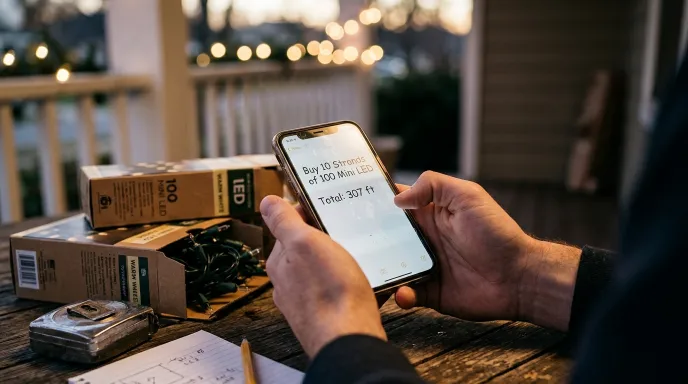
To find how many feet of Christmas lights a house needs, add up every edge you’ll light, then add 10% for corners. Our family-home example (two gables, six windows, one door and 120 ft of straight runs) comes to about 307 ft, or 10 strands of 100 mini LED bulbs. This Christmas light calculator for house does the sums.
You’re on the driveway with a tape measure, a notepad and a vague feeling that the roofline is longer than it looks. Sound familiar? Most people guess how many lights a house needs, and most people guess wrong.
There’s a simple way to avoid it. Add up the length of every edge you want to light, allow a little extra, then divide by the length of one strand. That’s how to calculate how many Christmas lights you need for a house, and it works for most houses. The hard parts are the gable edges, the windows and the circuit, so this free outdoor Christmas light calculator for house handles them.
Below you’ll find how to use it, what each result means, the formulas behind it, three worked examples and a safety checklist.
My Personal Experience Building the Christmas Light Calculator for House
As you may know, we have already launched the Christmas Tree Light Calculator. However, many people also asked about lighting up their houses, so we decided to create a separate tool for that purpose.
When I launched the Christmas Tree Light Calculator, many people asked if there was a tool that could help them plan their house Christmas lights. After hearing their requests, one of my clients suggested that I create a tool specifically for house lighting. He wanted people to be able to plan their decorations according to their own needs.
That is how I started working on the Christmas Light Calculator for House. I also collected feedback from clients, which you can read in the testimonials at the end of this page.
If you need help planning your house Christmas lights, you can try this tool. If you face any problems while using it, you can contact us. We are here to help you.
Our goal is to understand the problems people face and create tools that help solve them. If you have a problem that you think a tool could help with, you can also contact us. We want to keep creating useful tools that meet people’s needs and help our clients and users.
Pro Tips:
My tip is that when you open this tool, you may need to fill in some details to get your results. If you want to enter more information, look for the dropdown options. Click them to see the available choices and select the ones that suit your needs. Once you have entered the required details, the tool will calculate your results.
How to Use the Christmas Light Calculator for House
Work down the page. Leave out anything you aren’t lighting.
- Pick your units and light type. Choose feet or metres, then the strand you plan to buy. Mini LED with 100 bulbs is the default.
- Enter the straight runs. Add your eaves and gutters, any ridge lines, and railings or fences. No eave length? Type your house length and width, and tap the button that uses 2 x (length + width).
- Enter the gables. Give the number of gables, the width of one and its rise (from the bottom edge to the peak). Know the roof pitch instead, such as 6 for a 6/12 roof? Leave the rise empty and type the pitch.
- Enter windows and doors. Use the most common size for each. Garage doors and a second window size are under More things to light.
- Add extras if you need them. Columns, outdoor evergreen trees and icicle lights have their own boxes.
- Check the settings. The extra length is 10% by default. Strand length, price, electricity cost and your circuit rating are in the two settings boxes.
- Read the results. They update as you type. Tap Try an example house if you’d like to see it filled in.
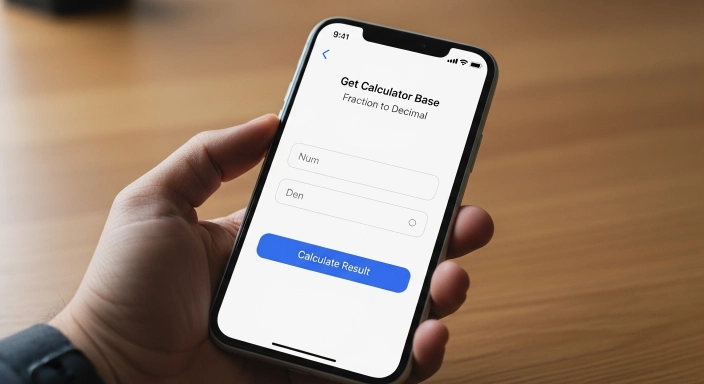
A tip on tape measures: they speak in feet and inches, but the boxes want decimal feet. If a window is 3 ft 4 1/2 in wide, work out 4.5 / 12 = 0.375, so type 3.375. Fraction to Decimal Pro can turn the 1/2 into 0.5 if you want a hand with the fraction.
What the Calculator Counts: Eaves, Gables, Windows, Doors and More
Area | What to measure | How the calculator counts it |
|---|---|---|
Eaves and gutters | Total length of the runs you’ll light | As typed |
Ridge lines and other runs | Straight edges along the roof peak | As typed |
Gables | Width and rise of one gable, and how many | Two sloped edges per gable, from the Pythagorean theorem |
Windows | Width and height of the usual size | All four sides: 2 x (width + height) |
Doors | Width and height | Three sides, not the threshold: 2 x height + width |
Railings and fences | Total run | As typed |
Columns and posts | Height, diameter and gap between wraps | A spiral round the column |
Evergreen trees outside | Height, width at the base and wrap gap | A spiral round a cone |
Icicle lights | Length one strand covers (from the box) | Strands = eaves with extra, divided by that length |
Gables are the part people get wrong. The sloped edge is longer than half the width. With the Pythagorean theorem, each edge is the square root of (half the width squared plus the rise squared). A 24 ft wide gable with an 8 ft rise has two edges of about 14.4 ft, so one gable needs about 28.8 ft. If you only know the roof pitch, the rise is half the width times the pitch, divided by 12.
Want help with the measuring itself? Our guide on how to measure house for christmas lights covers tape, measuring wheels and map tools.
Key terms in plain English
- Eaves: the lower edge of a roof, where it overhangs the wall and gutters usually hang.
- Gable: the triangle-shaped part of the wall at the end of a pitched roof.
- Rise: the vertical height from the bottom of a gable to its peak.
- Ridge: the horizontal line at the top of the roof, where two slopes meet.
- Roof pitch: how steep the roof is, written as rise per 12 units of run, such as 6/12.
- GFCI: a ground fault circuit interrupter, an outlet or breaker that cuts the power quickly if it senses a fault.
Understanding Your Results: Strands, Bulbs, Power and Circuit Check
Result | What it means |
|---|---|
Strands to buy | Whole strands of your light type, rounded up. If you already own some, only the extra ones are shown |
Light length needed | Everything you measured, plus the extra length |
Bulbs needed | Length divided by the space between bulbs |
Power when all lit | Watts of every bulb on the strands you’ll run, and the amps at your voltage |
Circuit check | Whether that load stays within 80% of your breaker rating |
Estimated electricity cost | Based on your hours, days and price per kWh |
Where the lights go | A table with the length for each area |
The circuit check in plain words. A common guideline is to keep a continuous load to 80% of a circuit’s rating. On a 15 A circuit at 120 V that’s 1,440 W. The tool compares your lights with that limit, subtracts anything else on the circuit, and tells you how many separate circuits you’d need. It’s a guideline, not electrical advice. Ask a qualified electrician if you’re unsure.
Two more things. The connection limit on the box (how many strands can join end to end) is separate from the circuit check, so enter it to see how many plugs you need. And the circuit check counts watts only, so your extension cords must be rated for the load as well.
How the Calculator Works: Formulas and Technology
Everything is plain geometry and arithmetic.
- Gable edge = square root of ((width / 2)^2 + rise^2). Two edges per gable.
- Window = 2 x (width + height). Door = 2 x height + width.
- Column spiral = height x square root of (1 + (pi x diameter / gap)^2). Unroll the column and each turn is the long side of a triangle.
- Evergreen tree = the same cone-spiral formula as our Christmas tree calculator.
- Total = measured length x (1 + extra %).
- Strands = total / strand length, rounded up. Strand length is bulbs per strand x bulb spacing, unless you type the length from the box.
- Power = bulbs on the strands you run x watts per bulb. Cost = kilowatts x hours x days x price per kWh.
Typical bulb power used as defaults (check your box, because brands vary): mini LED 0.05 W, mini incandescent 0.4 W, C7 incandescent 5 W and C9 incandescent 7 W per bulb. LED C7 and C9 aren’t preset, because their watts vary a lot. Choose Custom and type the figures from the box.
How we checked it. Before publishing, we compared the calculator with independent methods (for example, adding up tiny straight pieces along each spiral) on hundreds of random test houses. The answers matched to within the rounding on screen.
Technology and privacy. The calculator uses plain HTML, CSS and JavaScript and runs in your browser. Nothing you type is sent to a server or stored by the tool, and there’s no sign-up.
Why Choose Our Tool? Comparison with Guides and Manual Math
Feature | Our tool | Other online guides and tables | Manual measuring |
|---|---|---|---|
Interactive calculation | Yes | Usually static tables, or a running-cost tool only | By hand |
Gable edges from width and rise or pitch | Yes | Usually measured with a tape | You work it out |
Windows, doors, columns and trees | Yes | Explained in words, not calculated | Separate sums |
Circuit check against the 80% guideline | Yes | A sentence of advice | Extra research |
Feet and metres | One tap | Varies | You convert |
Sells a product | No | Often | No |
Sign-up | None | Varies | None |
Benefits
- One shopping trip, not two.
- You see the load and the cost before you buy.
- It works on a phone, so you can use it while you walk round the house.
- It’s free.
Pros and cons, honestly
- Pros: every area has its own formula, results are shown by area, and you can check the maths.
- Cons: houses aren’t perfect shapes, so it’s an estimate. It doesn’t cover hip roofs, net lights for bushes, pathway lights or the lead wires on each strand. The extra length is there to absorb those.
Worked Examples: Small, Family and Large Homes
These are example scenarios, not customer stories. Each uses a 10% extra length and the default 15 A, 120 V circuit. Mini LED is 100 bulbs per strand. C9 is 25 bulbs per strand, incandescent.
Example | Total to buy | Mini LED | C9 incandescent |
|---|---|---|---|
Small single-storey home, 36 ft x 24 ft (eaves 2 x (36 + 24) = 120 ft), 5 windows, 1 door | 227.7 ft | 7 strands, 35 W, about $1.07 | 10 strands, 1,750 W, about $53.55, over the guideline |
Family home: two gables (24 ft wide, 8 ft rise), 70 ft of eaves, 30 ft of ridge, 20 ft of railings, 6 windows, 1 door | 306.6 ft | 10 strands, 50 W, about $1.53 | 13 strands, 2,275 W, about $69.62, over the guideline |
Large home: 180 ft of eaves, four gables (20 ft wide, 7 ft rise), 12 windows, 2 doors, a garage door, 2 columns and 40 ft of railings | 716.3 ft | 22 strands, 110 W, about $3.37 | 29 strands, 5,075 W, about $155.30, over the guideline |
Sizes used: windows 3 ft x 4 ft (3 ft x 5 ft in the large home), doors 3 ft x 7 ft, garage door 16 ft x 7 ft, columns 9 ft tall and 8 in across, wrapped every 6 in. Cost uses 6 hours a day for 30 days at $0.17 per kWh. Use your own price.
The pattern is clear. The same house needs a similar number of strands either way, but incandescent C9 bulbs draw so much more power that they can overload a single circuit. In these examples they need at least 2, 2 and 4 circuits. Mini LED stays far inside the limit. For the full running-cost picture, read our guide on how much electricity Christmas tree lights use, which uses the same formula.
How many feet of Christmas lights do I need for my house?
It depends on the house. In our three examples it ranged from about 228 ft for a small single-storey home, to 307 ft for a family home with two gables, to 716 ft for a large home with a garage and columns. However big the house, how many Christmas lights for a house you need comes down to the total length of the edges you light, plus 10%, divided by your strand length.
How much will 100 feet of lights cover?
About 90 ft of measured edge, once you allow 10% extra. That’s roughly six standard windows (3 ft x 4 ft, 14 ft each, 84 ft in all) with a little to spare. Six windows plus 10% is 92.4 ft, which takes three strands of 100 mini bulbs (about 100 ft).
Common Mistakes, Safety Tips and a Checklist
Common mistakes
- Skipping the extra length. Corners, drops and routing always use more string than you measured.
- Counting bulbs when you mean feet. A rule like 100 lights per foot of tree height counts bulbs, not feet of string. Feet and bulbs are different things.
- Ignoring the circuit. Lots of incandescent strands on one circuit can exceed a safe load.
- Treating typical watts as exact. Check the box.
Safety tips. The Electrical Safety Foundation International (ESFI) has outdoor decoration safety tips. The main ones: use lights and extension cords marked for outdoor use, plug outdoor decorations into GFCI-protected circuits, match the amperage of cords to your lights, inspect everything for damage, fasten lights securely without damaging the cord, and keep cords out of snow and standing water. Use a wooden or fiberglass ladder, because metal ladders conduct electricity, and stay at least 10 feet from power lines. Don’t overload outlets, and switch the lights off before you leave or go to sleep.
Checklist before you buy:
- Every area measured and entered.
- Gable width and rise (or pitch) checked.
- Strand length and bulb spacing checked on the box.
- Connection limit on the box noted.
- Circuit rating and other loads checked.
- Outdoor-rated cords and a GFCI planned.
- One spare strand added.
Christmas Light Calculator for House FAQs
How do I figure out how many Christmas lights I need for my house?
Measure every edge you’ll light, add 10% for corners and routing, then divide by the length of one strand. The Christmas light calculator for house does the gable, window and door sums, and rounds the strands up.
How much will 100 feet of lights cover?
About 90 ft of measured edge once you allow 10% extra. That’s roughly six standard windows, which need three strands of 100 mini bulbs.
How much extra length should I add?
The calculator uses 10% by default for corners, drops and routing. Raise it if your roofline has many corners.
What if my house has a hip roof?
The calculator is built for gables, so it doesn’t work out hip roofs directly. Measure the eaves and the ridge as straight runs, and measure any other sloped edge you want to light with a tape and enter it under ridge lines and other runs.
hristmas lights add to the electric bill?
It depends on the bulb type. In our family-home example, mini LED costs about $1.53 over 30 days at 6 hours a day and $0.17 per kWh, while incandescent C9 costs about $69.62. Use your own electricity price.
for icicle lights, columns and trees?
Yes. Open More things to light for second sizes, columns, evergreen trees and icicle lights.
Conclusion and Disclaimer
Getting the right amount of lights for a house comes down to measuring each edge, allowing a little extra and dividing by the strand length. The Christmas light calculator for house takes care of the awkward parts, such as sloped gables, windows and doors, and the circuit check shows if a plan is realistic before you buy.
What’s the longest run on your house? Start with that, type it in, and see where the total lands.
Disclaimer: this calculator gives planning estimates for information only. Houses aren’t perfect shapes, strands and bulb wattage vary by brand, and the circuit check uses a general guideline, not electrical advice. Always follow the information printed on your light packaging and ask a qualified electrician if you are unsure.
Related Tools and Guides
More free tools
- Christmas Tree Light Calculator: work out the lights for an indoor tree.
- Fraction to Decimal Pro: turn tape-measure fractions into decimals.
- Time Difference Calculator: find the exact hours your lights run each evening.
- Browse more Education Tools and Finance Tools.
Guides that go deeper
- How to measure house for Christmas lights
- How to hang Christmas lights on a house
- C9 vs mini lights for rooflines
About the author: Waseem Aijaz builds and checks every tool on Get Calc Base. He’s a WordPress developer and SEO specialist with an M.Sc in Mathematics, a part-time teacher, and has 10 years in web work. Connect on LinkedIn. Last updated: October 2026.