
Christmas Tree Light Calculator: How Many Lights Do You Need?
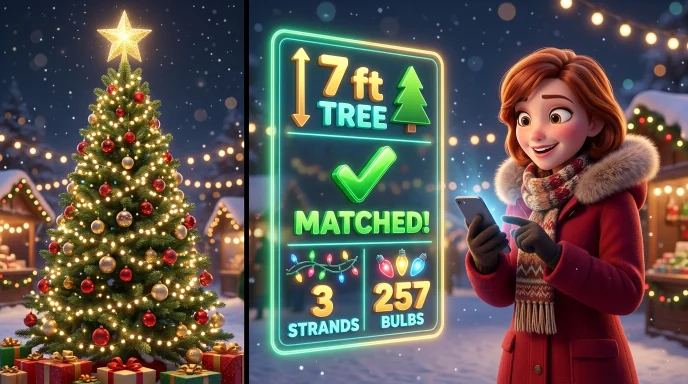
Quick Answer: A standard 7 ft Christmas tree needs about 85 ft of lights. That’s roughly 257 mini bulbs, or 3 strands of 100 lights, with a 6-inch wrap gap. Enter your height and tree type in this Christmas tree light calculator to see your own strands, length, wattage and cost.
Nothing kills the holiday mood like running out of lights halfway up the tree. Or the opposite: a closet full of spare strands and a tree that still looks half-dressed.
Most of us shop for tree lights by guessing, and guessing usually means a second trip to the store. This free Christmas tree light calculator takes the guesswork out. You give it your tree’s height and shape, and it works out how much light string you need, how many strands to buy, what they’ll draw in watts and what they’ll cost to run.
Below you’ll find how to use it, what each result means, the math behind it, and some worked examples. We’ll also cover the mistakes that waste money.
My Personal Experience Building the Christmas Tree Light Calculator
I think it is important to share a little background about every tool I launch because there is a reason behind creating each one. Sometimes the idea comes from a problem I have personally faced, and sometimes it comes from the experiences of people I know. I build tools to help solve these problems.
This time, I want to tell you why I built the Christmas Tree Light Calculator.
As Christmas is approaching on December 25, I want to wish everyone a Merry Christmas!
The idea for this tool came from one of my clients. As I mentioned in the testimonials at the end of this page, I work as a web developer and SEO expert, and I have clients in different cities and countries, including the USA and the UK. One of my clients suggested that I build this tool after explaining the problems he faced when decorating a Christmas tree.
He wanted a tool that could help people estimate how many lights and bulbs they would need for their tree and how much it might cost. People often find it difficult to calculate these things manually, so he asked me to create something that could make the process easier.
That is how I started working on the Christmas Tree Light Calculator. I also worked with people who had relevant knowledge and experience to help develop the tool.
The tool includes different features. You can enter your tree’s height in feet, inches, centimetres, or metres and estimate how many lights and bulbs you may need, along with the expected cost. It is an advanced tool with several features, and you can explore them yourself.
Once the tool was ready, I shared it with clients in different cities and asked them to test it. I have included their testimonials and feedback below so you can read their experiences.
After receiving their feedback, I continued working on the tool to improve it. One of my clients was very happy when he saw the result. I felt happy too because he was satisfied with the tool and now uses it whenever he needs it.
I hope this tool can help you plan your Christmas tree decorations, estimate the number of lights you need, and understand the potential cost. Give it a try and see if it helps solve your problem.
Pro Tips:
My tip is to look at the top of this tool, where you will find the Quick Pick option. From there, you can select a decoration style that suits your preferences and get started quickly. If you don’t want to use any of the provided options, you can also customize the settings according to your own preferences.
How to Use the Christmas Tree Light Calculator
It takes about half a minute. This order works best:
- Enter your tree height. Type it in, or tap a quick pick (4.5, 6, 7, 7.5 or 9 ft). Prefer metres? Switch the units first.
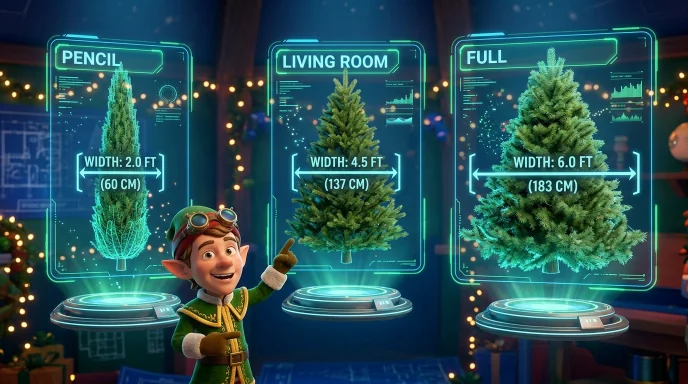
- Pick your tree type. Pencil, slim, standard and full each use a typical width for that shape, and every card shows the width it will use for your height. If you’ve measured your tree, choose My own width and type it in.
- Choose how full you want it. Light leaves 8 inches between wraps, standard 6 inches, full 4 inches and extra full 3 inches. You can also set your own gap.
- Select your light strand. Most people buy 100-bulb mini LED strands, so that’s the default. Switch to 50 or 200 bulbs, or to incandescent, if that’s what’s on your shelf.
- Read your results. They update as you type. Open the optional settings to change bulb spacing, electricity price, garland or ornament size.
A quick tip on measuring: measure the tree itself and leave the topper out. For width, measure across the lowest branches, not the stand. A couple of inches won’t change the answer much, but being a foot off on a tall tree can add a whole strand to your shopping list.
Tree types at a glance
Tree type | Width used | Width at 7 ft | Good for |
|---|---|---|---|
Pencil | 35% of height | 2.4 ft | Corners, hallways and small flats |
Slim | 45% | 3.2 ft | Smaller rooms |
Standard | 55% | 3.9 ft | A typical living-room tree |
Full | 65% | 4.6 ft | Bushy trees with wide lower branches |
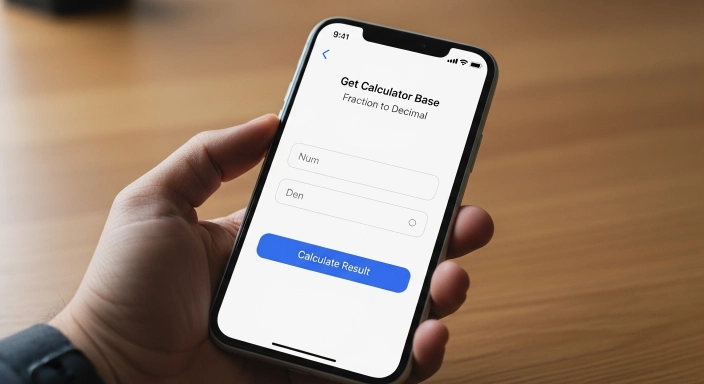
Measuring in fractions? A tape measure speaks in fractions, but the boxes want decimals. A tree that’s 6 ft 6 in tall is 6.5 in the height box. For something like a 4 3/8 inch bulb spacing, Fraction to Decimal Pro turns it into 4.375.
Not sure how many hours to enter? Say the lights go on at 5:30 pm and off at 11:15 pm. A time difference calculator gives you 5 hours 45 minutes, so you’d type 5.75 in the hours box.
Understanding Your Results: Strands, Bulbs, Length and Wattage
Each result card in the Christmas tree light calculator answers a different shopping question.
Result | What it means | How to use it |
|---|---|---|
Strands to buy | Whole strands of the size you chose, rounded up | Your shopping number |
Light length needed | Total length of lit string wrapped around the tree | Compare with the length printed on the box |
Bulbs needed | Length divided by the space between bulbs | Handy if you shop by bulb count |
Power when all lit | Watts used by every bulb on the strands you buy | Check it against your outlet or power strip |
Estimated electricity cost | Based on your hours, days and price per kWh | Compare LED with incandescent |
Power runs needed | How many plugs you need if the box says how many strands connect end to end | Plan where the cords go |
Why strands matter more than feet. You can’t buy 85 ft of light. You buy strands, and a 100-bulb strand with 4-inch spacing is about 33 ft long. So 85 ft means three strands, with some slack left over. When that slack is under about 10%, the calculator suggests buying one more, because burnt-out sections and awkward corners eat more string than you’d expect.
Key terms in plain English
- Wrap gap: the distance from one turn of lights to the next, measured up the tree.
- Bulb spacing: the distance between neighbouring bulbs on a strand. It’s printed on the box.
- Strand: one string of lights with a plug, usually 50, 100 or 200 bulbs.
- Mini lights: the small bulbs on most tree strands, usually a few inches apart.
- C9 bulbs: larger bulbs, normally spaced much wider than mini lights. For these, choose Custom for the strand and enter the bulbs per strand and the spacing from the box in the advanced settings.
Before you buy, check:
- The box says how many bulbs are on each strand and how far apart they sit.
- The maximum number of strands you can connect end to end.
- Whether the strand is LED or incandescent, so the wattage matches.
- That you’ve allowed a spare strand for the tree, not the whole house.
- That an outlet sits close enough to the tree.
How the Calculator Works: Conical Helix Formula and Technology
Here’s the idea behind the Christmas tree light calculator: picture your tree as a cone. A string wound from the bottom branches to the tip, with an even gap between turns, traces a spiral on that cone. Mathematicians call it a conical helix, and its length has an exact formula:
L = 1/2 x sqrt(a + b^2) + (a / 2b) x asinh(b / sqrt(a))
where a = R^2 + H^2, b = 2 x pi x N x R and N = H / gap.
H is the tree height, R is the radius at the bottom (half the width), the gap is the distance between wraps and N is the number of turns. The asinh function is the inverse hyperbolic sine, which any scientific calculator has. If you enjoy the geometry, the Wikipedia article on the helix covers the basics.
From that length, everything else follows:
- Bulbs = length divided by the space between bulbs, rounded up.
- Strands = length divided by one strand’s length (bulbs per strand times spacing), rounded up.
- Power = bulbs on the strands you buy times watts per bulb.
- Cost = kilowatts times hours per day times days times your price per kWh.
- Garland or ribbon uses the same spiral with a wider gap.
- Ornaments = the share of the tree’s surface you want covered (5%, 10% or 18%) divided by the area of one ornament. The surface area of a cone is pi x R x sqrt(R^2 + H^2).
Defaults you can change.
Tree width is a share of height: pencil 35%, slim 45%, standard 55% and full 65%. Typical bulb power is 0.05 W for a mini LED and 0.4 W for a mini incandescent. These are typical figures, so your box always wins.
One thing that surprised us while building it:
tree shape matters as much as height. A pencil tree and a full tree of the same height can need almost twice the string. That’s why the tool asks for the shape, not just the height.
How we checked it.
Before publishing, we compared the calculator’s output with an independent method that adds up tens of thousands of tiny straight pieces along the spiral. Across 300 random tree sizes, gaps and strand types, the answers matched to within the rounding you see on screen.
Technology and privacy.
The calculator is built with plain HTML, CSS and JavaScript and runs entirely in your browser. What you type isn’t sent to a server or stored by the tool, and there’s no sign-up. The tree pictures are original illustrations, kept tiny so the page loads fast on a phone.
Why Choose Our Tool? Comparison with Manual Math and Other Tools
The usual alternatives are a rule of thumb scribbled on the back of an envelope, or a calculator that stops at a length in feet. Our Christmas tree light calculator goes one step further and tells you what to put in the basket.
Feature | Our tool | Other online tools | Manual math |
|---|---|---|---|
Strands to buy, rounded up | Yes | Varies | You round it yourself |
Wattage and running cost | Yes | Usually not included | Extra calculation |
Tree type pictures | Pencil, slim, standard, full | Rare | Not applicable |
Feet and metres | Yes, one tap | Varies | You convert |
Spare strand advice | Yes | Rare | Easy to forget |
Garland and ornaments | Yes | Sometimes | Separate math |
Sign-up or install | None | Varies | None |
Benefits
- Fewer return trips and fewer leftover strands.
- You see the cost of LED against incandescent before you buy.
- Works on phones, tablets and desktops.
- Free, with no account.
Pros and cons, honestly
- Pros: fast, transparent formula, results for several tree shapes, optional extras.
- Cons: real trees aren't perfect cones, so results are estimates. It's built for indoor trees, not rooflines or whole houses.
Worked Examples: Metric Trees, Bigger Strands and a Shopping Plan
These are example scenarios for the Christmas tree light calculator, not customer stories. They show settings you might not try at first. Each uses a standard tree and a standard wrap gap.
Scenario 1: a tree measured in metres. Switch the units to metric, type 2.1 and keep Standard. You’ll get about 25.2 m of lights (82.7 ft), 249 bulbs and 3 strands of 100, with about 21% spare.
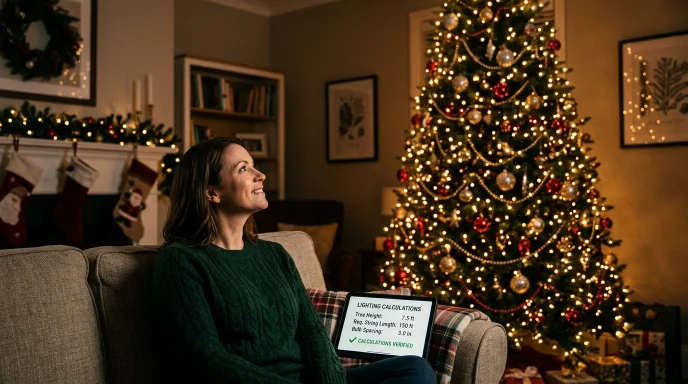
Scenario 2: bigger strands for a bigger tree. For a 7.5 ft tree, pick 200 mini LED lights. The calculator says 2 strands, with about 36% spare, which leaves room for a few dark corners.
Scenario 3: planning the shopping and the plugs. For a 7 ft tree, type a strand price of 6.99 and set 2 strands joined per plug. You’ll see 3 strands costing $20.97 and 2 power runs, so you know where the cords go before you buy.
Scenario 4: using up last year’s strands. Pick 50 mini LED lights for a standard 7 ft tree and the calculator says 6 strands. That’s the same 100 ft of string as three 100-bulb strands, so six strands from last year’s box will do the job.
Common Mistakes, Accuracy Limits and Safety Tips
Common mistakes
- Using the stand’s width. The widest branches set the radius.
- Leaving the units on the wrong setting. Switch to metric before you type metres.
- Leaving the electricity price at the default. Enter your own, or the cost won’t be yours.
- Treating the result as exact. Check the bulb spacing and strand length on the box.
Limitations and accuracy notice. The calculator treats your tree as a smooth cone with an even wrap gap. Real branches are uneven, wattage varies by brand and electricity prices differ everywhere, so enter your own price. Results are planning estimates, not an electrical design.
Safety tips. Follow the maximum connection limit printed on the packaging, and don’t overload an outlet or power strip. Turn the lights off when you leave or go to bed. Our guide on how to put lights on a Christmas tree covers joining strands safely.
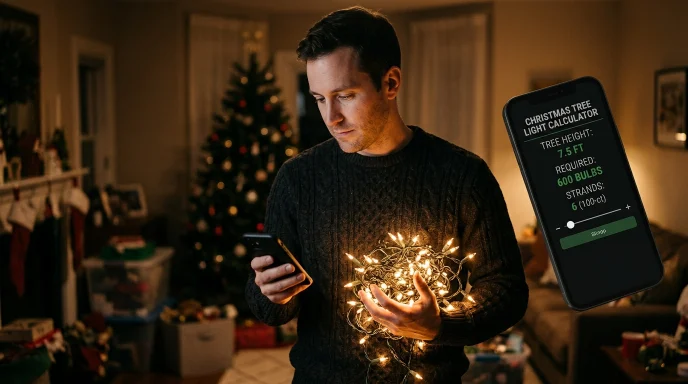
Final checklist: measured height and width, chose a fullness, checked spacing and connection limit on the box, allowed a spare strand, tested every strand.

Beyond Lights: Garland, Ornaments and Electricity Cost
The Christmas tree light calculator gives you more than a light count. For a standard 7 ft tree, garland wrapped every 12 inches comes to about 43.5 ft, and a medium covering of 3-inch ornaments is around 89.
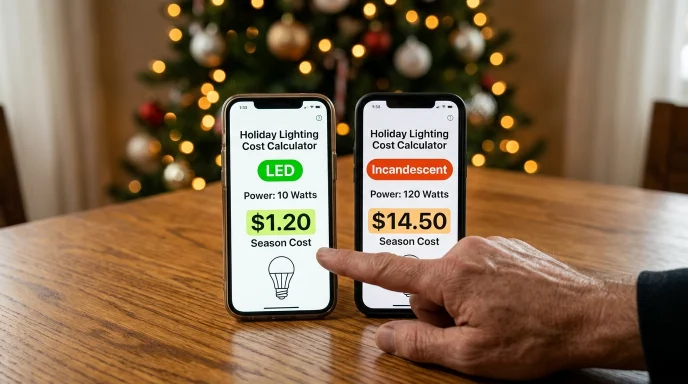
The cost card compares your strands on LED and on incandescent, using the typical wattage figures above. Use your own box and your own electricity price. The full cost breakdown is in our guide on how much electricity Christmas tree lights use.
Curious how big the LED saving is? Work it out as a percentage with our percentage decrease calculator.
Want to go deeper? Our guides cover how many lights for a Christmas tree, how to put lights on a Christmas tree and how much electricity Christmas tree lights use. More free tools are on the Get Calc Base homepage.
Christmas Tree Light Calculator FAQs
How do I calculate how many lights I need for a Christmas tree?
Measure the height and the width of the bottom branches, choose how full you want it, and enter them into the Christmas tree light calculator above. The calculator wraps the string around your tree like a spiral and gives you the length, bulbs and strands.
How accurate is the Christmas tree light calculator?
It’s a planning estimate. It treats your tree as a smooth cone with an even wrap gap, so real trees with uneven branches can differ a little. That’s why it suggests a spare strand when your total lands close to a whole one.
Can I use metres and centimetres?
Yes. Switch the units to metric and every box, result and quick pick changes to metres and centimetres.
Does the calculator save what I type?
No. It runs in your browser, and nothing you enter is sent to a server or stored by the tool.
Can I use it for C9 or other bulb types?
Yes. Choose Custom for the strand, then enter the bulbs per strand and the bulb spacing from the box in the advanced settings.
Does the calculator work for pencil and slim trees?
Yes, the Christmas tree light calculator handles pencil and slim trees. Choose Pencil or Slim, or type your own width.
Conclusion and Disclaimer
Getting the right number of lights comes down to three things: your tree’s height, its shape and the gap you like between wraps. Once you’ve entered those into the Christmas tree light calculator, the strand count, wattage and cost follow. Add a spare strand, check the box for spacing and connection limits, and you’re done.
What height is your tree this year? Pop it into the Christmas tree light calculator above and see how close your usual guess was.
Disclaimer: this calculator gives planning estimates for information only. Real trees aren’t perfect cones and strands vary by brand. Always follow the information printed on your light packaging, including the maximum number of strands that can be connected.
Related Tools and Guides
Free tools you might need next
- Percentage Decrease Calculator: see how much less power LED lights use than incandescent.
- Time Difference Calculator: find the exact hours your lights run each evening.
- Fraction to Decimal Pro: turn tape-measure fractions into decimals.
- Brick Wall Cost Calculator: another how-much-to-buy planner for home projects.
- Browse more Education Tools and Finance Tools.
Guides that go deeper
- How many lights for a Christmas tree? A height chart from 3 ft to 12 ft.
- How to put lights on a Christmas tree Wrap methods and spacing.
- How much electricity do Christmas tree lights use? LED against incandescent running costs.
About the author: Waseem Aijaz builds and checks every tool on Get Calc Base. He’s a WordPress developer and SEO specialist with an M.Sc in Mathematics, a part-time teacher, and has 10 years in web work. Connect on LinkedIn. Last updated: October 16, 2026.