
Quick Answer: Every year around the Social Security COLA announcement, scammers ramp up calls, texts, and emails claiming you need to “confirm” your information to receive your increase. The SSA never asks for payment, gift cards, or your full Social Security number over the phone or by text — any message that does is fraud.
Big COLA news is exactly the kind of moment scammers wait for. Every year, right around the announcement window, reports of Social Security-related fraud spike — and the run-up to the Social Security COLA 2027 announcement on October 14, 2026 is already producing the same pattern. If you’ve searched “social security cola fraud,” you’re doing exactly the right thing before you engage with anything unexpected.
Why COLA Season Attracts So Many Scams
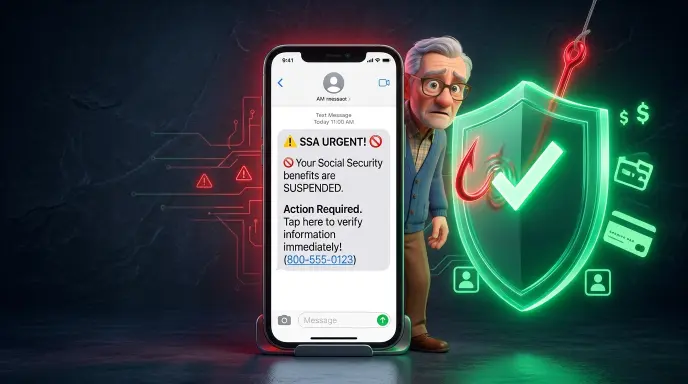
Scammers rely on urgency and confusion, and a big, widely reported number like a COLA increase gives them both. People are actively expecting some kind of communication about their benefits changing, which makes a fake one easier to slip past normal skepticism.
The Basic Pattern Behind Most COLA Scams
- You receive an unexpected call, text, or email referencing the COLA increase
- It claims something urgent — your payment is “on hold,” your information needs “verification,” or you’re eligible for an extra bonus
- It asks you to act immediately, often by phone, before you have time to think it through
- It requests personal information, payment, or remote access to your device or accounts
Common Social Security COLA 2027 Scam Tactics
The “Confirm Your Increase” Call
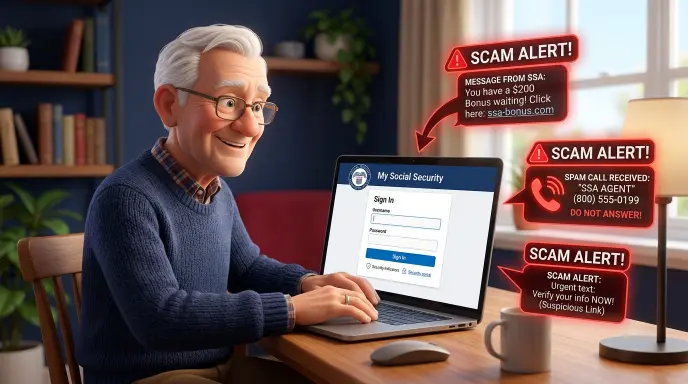
A caller claims to be from the SSA and says you need to confirm your bank details or Social Security number to receive your new COLA amount. The real SSA already has this information on file and will never call to ask for it.
The Fake Bonus Text
A text message claims seniors are receiving a special one-time bonus on top of the regular COLA — sometimes citing a specific, attention-grabbing figure. There is no such bonus tied to the Social Security COLA 2027 adjustment; the increase is a percentage applied to your existing benefit, nothing more.
The Threatening Voicemail
A recorded message states your benefits will be suspended unless you call back and “verify” your identity immediately. The SSA does not suspend benefits through unsolicited voicemail threats.
The Fake Calculator or Portal Link
Some scam messages include a link to a fake “COLA calculator” or “benefit portal” designed to harvest your Social Security number, date of birth, or banking details. Always type a known, trusted URL directly into your browser rather than clicking a link from an unexpected text or email.
How to Verify Anything COLA-Related Is Real
| Signal | Real SSA Communication | Likely Scam |
|---|---|---|
| Asks for full SSN or bank login | No | Yes |
| Demands payment or gift cards | No | Yes |
| Creates urgency to act immediately | Rare | Common |
| Contacts you by unsolicited text/email link | Rare | Common |
| Can be verified by calling SSA’s official number yourself | Yes | N/A |
If you’re ever unsure, hang up or don’t click, and contact the SSA directly using the number on their official website — never a number provided in the suspicious message itself.
Real Scam Scripts Reported to Watch For
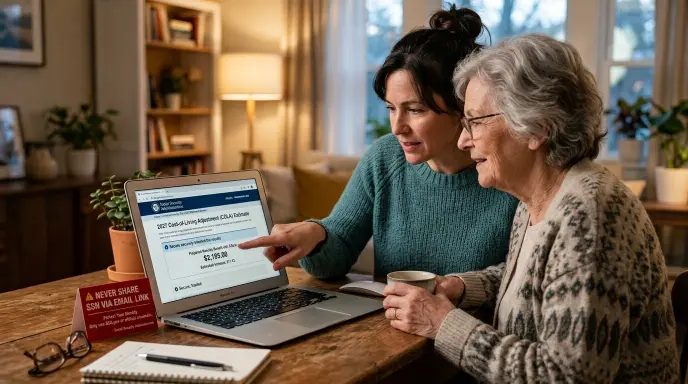
Fraud reports collected around past COLA announcements share some recurring patterns worth recognizing in your own inbox or voicemail.
Pattern 1 — The “Recalculation” Email
An email claims your benefit needs to be “recalculated” for the new COLA year and provides a link to enter your Social Security number to avoid a delay in payment. The real SSA never requires you to re-enter your Social Security number through an emailed link to receive a scheduled COLA increase — it applies automatically to your existing benefit.
Pattern 2 — The Local Field Office Impersonation
A caller claims to be from your local Social Security field office, references a real city or office name to sound credible, and asks you to “verify” your identity by reading back personal details. Real field office staff do not cold-call beneficiaries asking for identity verification over the phone.
Pattern 3 — The Family Emergency Combined With COLA Confusion
Some scammers combine a fake family-emergency story with COLA confusion, claiming a relative needs money urgently and that your “new COLA payment” can cover it if you act immediately through a specific payment method. The urgency and the unrelated COLA reference together are both red flags.
Protecting Your Identity Beyond the Initial Scam
Set Up Your Official My Social Security Account
Creating your own account directly on the SSA’s official site (not a link from a text or email) gives you a reliable, verified place to check your actual benefit and COLA information, and it also makes it harder for someone else to create a fraudulent account in your name.
Freeze Requests You Didn’t Initiate
If you notice any changes to your benefit information, direct deposit account, or address that you didn’t request, contact the SSA immediately using their official phone number, not any number provided in a suspicious message.
Talk to Older Family Members Before October
COLA scam volume tends to spike specifically around the announcement window each year. A quick conversation with parents or older relatives before the October 14, 2026 announcement, covering the basic red flags above, is one of the most effective prevention steps available.
Part of what makes COLA scams effective is that most people don’t have an easy, trustworthy place to check the real numbers themselves, so a scammer’s version feels like the only source available. Our Social Security COLA 2027 calculator pulls live inflation data directly from the Bureau of Labor Statistics and shows three independently sourced forecasts (AARP, The Senior Citizens League, and Mary Johnson) — all without ever asking for your Social Security number, bank details, or any personal information at all. You enter your benefit amount, and the calculation happens entirely in your own browser.
Who Scammers Target Most
New COLA News Cycles
Any time a COLA-related story trends — including coverage of factors like tariffs potentially pushing the 2027 estimate higher — scam volume tends to rise alongside genuine news coverage, because scammers piggyback on real headlines to make fake messages feel timely and credible.
Veterans and VA Disability Recipients
Because VA disability compensation also follows the Social Security COLA percentage, veterans are frequently targeted with similar scam scripts, sometimes referencing the VA specifically instead of the SSA.
What to Do If You’ve Already Responded to a Scam
- Stop all contact with the sender or caller immediately
- Do not send any further information, money, or gift cards
- Contact your bank if you shared any financial details
- Report it to the SSA Office of the Inspector General and the FTC
- Change passwords on any accounts you may have exposed
A Quick Pre-October Checklist
- I know the SSA will never call, text, or email asking for my full SSN or bank login
- I know there is no special “bonus” attached to the Social Security COLA 2027 increase
- I check my benefit estimates using a trusted, no-signup source
- I verify any unexpected SSA communication by calling their official number myself
- I’ve shared this information with any older family members who might be targeted
Frequently Asked Questions
Is there a real bonus with the 2027 Social Security COLA? No. The COLA is a percentage increase applied to your existing benefit — there is no separate bonus payment, regardless of what a scam message might claim.
Will the SSA ever call me about my COLA increase? The SSA generally does not initiate unsolicited calls asking you to verify personal information. Legitimate communication typically comes through mail or your online My Social Security account.
Why did I get a $6,000 check from Social Security? Large, unexpected deposits are usually retroactive payments or backdated claim adjustments, not related to the annual COLA. If you’re unsure about a payment, verify it through your official My Social Security account rather than any message referencing it.
Are seniors getting an extra $200 a month? No. Current 2027 COLA forecasts point to roughly $70–$77 a month for the average benefit. Any message claiming a flat $200 bonus is not supported by SSA or independent analyst projections.
How do I report a Social Security scam? You can report suspected fraud to the SSA Office of the Inspector General and the Federal Trade Commission, both of which have dedicated online reporting tools.
Conclusion
The Social Security COLA 2027 announcement is a genuine, useful piece of financial news — and exactly the kind of moment scammers try to exploit. Knowing the real signs of fraud, and having a trustworthy place to check your actual numbers, is the simplest way to stay ahead of it this October.
Disclaimer
This article is for informational and educational purposes only and does not constitute legal or law enforcement advice. If you believe you’ve been targeted by fraud, contact the appropriate authorities directly. For our full terms, see our Disclaimer page.
Reviewed for accuracy against public SSA fraud-prevention guidance. Connect with Waseem Aijaz on LinkedIn for more on how these tools are built.