
Quick Answer:
To measure a house for Christmas lights, walk round it and sketch every edge you’ll light. Measure the roof edge, not the wall, then add the gables, windows and doors, and 10% for corners. Our sample house comes to about 435 ft, which is 14 strands of 100 mini LED bulbs.
You’re standing on the drive with a tape measure that’s too short, a roofline that keeps changing length and a box of lights you aren’t sure about. It’s a very common spot to be in. Most of the trouble comes from measuring the wrong thing, such as the wall instead of the roof edge, or a flat map view instead of a sloped gable.
This guide shows how to measure your house for Christmas lights in six steps. You’ll see which tools to use, how to find a gable’s rise without climbing up, how to handle columns and curves, and how to turn your notes into numbers. When your notes are ready, our Christmas light calculator for house does the maths.
The information above is a summary of this blog, so you can get an idea of what it covers. If you want to learn more or explore the details, you can use the tool by clicking the button below. It will take you to the tool, where you can try it yourself and learn more about how it works.
How to Measure Your House for Christmas Lights: The Short Version
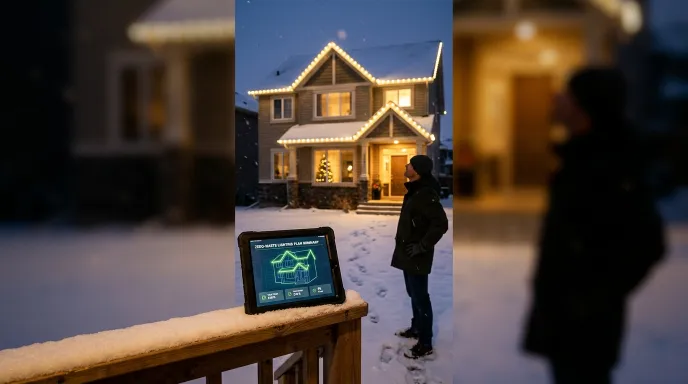
- Decide what you’ll light. Roofline, gables, windows, doors, railings, columns? Leave out anything you’re not lighting.
- Walk round and sketch. One quick drawing of each side of the house saves a lot of confusion later.
- Measure the straight runs. Eaves, gutters, ridge lines and railings. Measure the roof edge, not the wall.
- Measure gables, windows and doors. For a gable you need its width and its rise (or its roof pitch).
- Measure columns, trees and curves. Use the string method for anything that isn’t a straight line.
- Write it up and add 10%. Put all the numbers on one sheet, in feet, and allow a little extra for corners.
Tools and Methods: Tape, Measuring Wheel, Map App or String?
You don’t need much. Pick the method that matches the edge you’re measuring.
| Method | Good for | Watch out for |
|---|---|---|
| Tape measure (25 ft or longer) | Windows, doors, gable widths on the ground, railings | Hard to use alone on long runs. A second person helps |
| Measuring wheel | Long straight runs along the ground, such as the wall base | It measures the ground, not the roof edge. The overhang and any slope aren’t included |
| Laser distance meter | Heights and widths with a clear line of sight | Needs a clear target, and can be tricky in bright sun |
| Map app with a distance tool | Eaves on a simple house | Top-down views show horizontal distance only, so sloped edges come out short |
| String and tape | Curves, uneven edges, anything round | Mark the start and end carefully, then measure the string flat |
A word on map views. They’re handy for the ridge and eaves of a simple house. But a satellite view looks straight down, so it can’t see a slope. Take a gable 20 ft wide with a 6/12 pitch. Its two sloped edges are about 22.4 ft in total, yet from above they look like 20 ft. That’s about 10% short, and it adds up across several gables. Use the map for the flat runs and the tape for the sloped ones.
Plan First: Walk the House and Make a Sketch
Before you measure anything, walk all the way round. Look at what you want to light, where the power outlets are and what’s in the way, such as trees, bushes or a porch roof.
Then draw a rough sketch of each side. It doesn’t have to be neat. Mark every edge you’ll light and give each a letter, so you can measure in a loop and not miss anything. Start at the front door and go clockwise.
This is the measurement sheet we’ll fill in. The sample house has 40 ft x 28 ft walls, a 1 ft roof overhang, a front gable, eight windows, a front door, a garage door and a short porch railing.
| Area | Write down | Sample house |
|---|---|---|
| Eaves and gutters | Length of each roof edge, then the total | 42 + 30 + 42 + 30 = 144 ft |
| Ridge lines and other runs | Each straight edge along the peak | 42 ft |
| Gables | How many, the width of one, its rise or pitch | 1 gable, 20 ft wide, 6/12 pitch |
| Windows | How many, width x height (the usual size) | 8 windows, 3 ft x 5 ft |
| Doors | How many, width x height | 1 door, 3 ft x 7 ft |
| Garage or large doors | How many, width x height | 1 door, 16 ft x 7 ft |
| Railings and fences | Total run | 12 ft |
| Columns, trees, odd shapes | Height, distance round, or length of string | None |
Measuring Straight Runs and Gables
Eaves, gutters and ridge lines
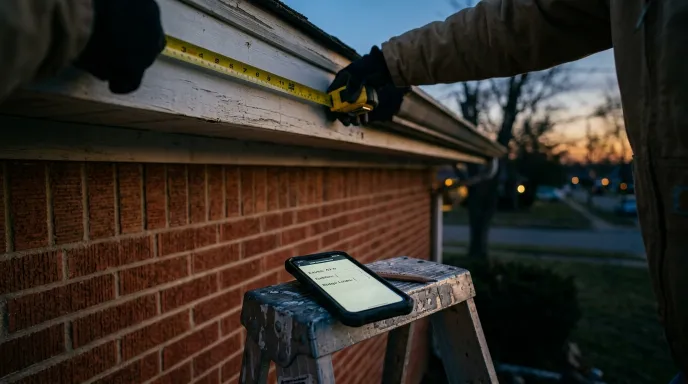
Measure the roof edge, not the wall. Most roofs overhang the wall a little, so the roof edge is longer than the wall below it. In our sample the walls are 40 ft x 28 ft, but with a 1 ft overhang the roof edge is 42 ft x 30 ft. That’s 144 ft of eaves, not 136 ft.
Does 8 ft matter? In this sample it does. With 136 ft the calculator says 13 strands of 100 mini LED bulbs. With the correct 144 ft it says 14. Measure the overhang where you can safely reach it, such as over a porch or carport, and add it to each end of the wall.
For long runs, measure in sections and add them up. Do the same for gutters and any ridge lines. Railings are easy, since you can measure along the top rail.
Gables
A gable is the triangle at the end of a pitched roof. You need two numbers: its width along the bottom, and its rise, which is the height from the bottom to the peak. Width is easy to measure on the ground. Rise is the tricky one, but you have three ways to find it.
- Measure it. If you can safely reach the roof’s underside in an attic, hold a level horizontal against a rafter, measure 12 inches along the level, then measure the vertical distance up to the rafter. That distance in inches is the pitch (for example 6 for a 6/12 roof).
- Use a phone level. Hold the phone’s built-in level or inclinometer along a straight board resting on the roof edge, or along a rafter. It gives an angle, which you can convert with the table below.
- Ask the paperwork. Plans, a survey or a roofer’s quote often state the pitch.
Once you know the pitch, you can read the rise straight from a table. Here are the common values for a gable 20 ft wide:
| Roof pitch | Angle | Rise for a 20 ft wide gable |
|---|---|---|
| 3/12 | 14.0 degrees | 2.5 ft |
| 4/12 | 18.4 degrees | 3.3 ft |
| 6/12 | 26.6 degrees | 5.0 ft |
| 8/12 | 33.7 degrees | 6.7 ft |
| 10/12 | 39.8 degrees | 8.3 ft |
| 12/12 | 45.0 degrees | 10.0 ft |
Wondering what pitch means? The roof pitch article on Wikipedia explains it. You don’t have to work out the sloped edge yourself. Type the width and the rise (or the pitch) into the calculator, and it does it.
If you do use a ladder, choose a sturdy one and follow the Electrical Safety Foundation International’s outdoor safety tips, including keeping well clear of power lines.
Windows and doors
Measure the outside of the frame, since that’s where the lights will sit. Windows get lights on all four sides. Doors usually get three, which means the top and both sides, but not the threshold.
Most houses have two or three window sizes. Measure one of each, count how many there are of each size, and note it on your sheet. Write the sizes in feet. A tape often shows fractions, so for a width such as 7 ft 9 3/8 in, Fraction to Decimal Pro turns the 3/8 into 0.375, and you divide the inches by 12.
Columns, Trees and Odd Shapes
Columns and posts. The width isn’t always easy to find on a round column. Wrap a tape or a piece of string round it, measure the distance, then divide by 3.14. A column that measures 25.1 inches round is 8 inches across. Note the height you want to wrap, too.
Curves and uneven edges. Lay a piece of string along the edge, press it into the corners, then mark where it ends. Lay the string flat and measure it with the tape. It’s quick and surprisingly accurate.
Trees outside. For a cone-shaped evergreen, write down its height and its width at the base. For anything with a very irregular shape, the string method is better than guessing.
Icicle lights. If you plan to hang icicle strands along the eaves, you only need the eave length, plus the length one strand covers and its watts from the box.
From Notes to Numbers: Add Extra Length and Use the Calculator
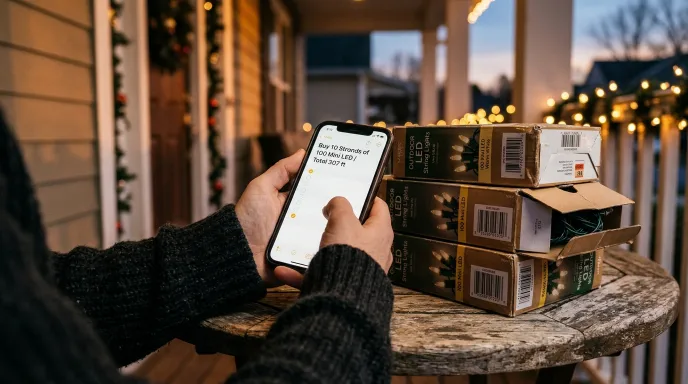
Now put everything on the sheet, in feet, and read it over once. Then add about 10% for corners, drops and routing. Lights always take more string than the bare measurement.
Here’s the sample house worked through with our calculator:
| Area | Length |
|---|---|
| Eaves and gutters | 144.0 ft |
| 1 gable (2 sloped edges) | 22.4 ft |
| Ridge lines and other runs | 42.0 ft |
| 8 windows (16.0 ft each) | 128.0 ft |
| 1 door (17.0 ft, three sides) | 17.0 ft |
| 1 garage door (30.0 ft, three sides) | 30.0 ft |
| Railings | 12.0 ft |
| Measured total | 395.4 ft |
| Extra 10% | 39.5 ft |
| Total to buy | 434.9 ft |
That’s about 13.05 strands of 100 mini LED bulbs, so 14 strands. You can enter your own numbers into the Christmas light calculator for house to see your strands, power and a circuit check.
After measuring, the next job is putting the lights up. Our guide on how to hang Christmas lights on a house covers that, and C9 vs mini lights for rooflines helps you choose the bulb type.
Common Measuring Mistakes (and a Checklist)
- Measuring the wall, not the roof edge. The overhang adds length. In our sample it was worth a whole strand.
- Trusting a map view for sloped edges. It can’t see the slope, so gables come out short.
- Using half the width for a gable. The sloped edge is longer than half the width.
- Measuring one window and assuming all are the same. Count each size separately.
- Counting doors on four sides. The threshold usually stays dark.
- Mixing units. Feet in one place and metres in another make a mess.
- Forgetting small extras. A dormer, bay window or porch roof adds edges that are easy to miss.
Checklist before you calculate:
- A sketch of every side of the house.
- Every run measured in sections, and the sections added up.
- Roof edge measured, with the overhang included.
- Gable width and rise (or pitch) for each gable size.
- Window and door sizes, and how many of each.
- Columns, trees and curves measured with a tape or string.
- All numbers on one sheet, in feet.
How to Measure Your House for Christmas Lights: FAQs
What app can I use to measure my house for Christmas lights? Any map app with a satellite view and a distance tool works for straight roof edges. It only shows flat distances, so add sloped edges such as gables with the pitch. Phone apps that measure with the camera exist, but their accuracy varies, so check one against a tape first.
How do I measure the roofline without a ladder? Measure the walls from the ground, then add the roof overhang, which you can often reach over a porch or carport. For a gable, measure its width on the ground and use the pitch to find the rise.
Should I measure the wall or the roof edge? The roof edge, because that’s where the lights go. Roofs usually overhang the wall, so the edge is longer.
How accurate do my measurements need to be? The nearest foot is fine for most runs, and the extra 10% covers the corners. Take more care with gables and very long runs, where small errors add up.
How do I measure a curved or uneven edge? Lay a piece of string along it, mark the end, then straighten the string and measure it with a tape.
How do I find the diameter of a round column? Wrap a tape or string round it, measure the distance, and divide by 3.14.
Conclusion and Disclaimer
Measuring a house for Christmas lights is mostly about being organised. Plan with a sketch, measure the roof edge, treat gables properly and add a little extra, and the numbers will be close. Once your sheet is ready, the calculator turns it into strands in a minute.
Which part of your house is the hardest to measure? Start there, and the rest will feel easy.
Disclaimer: this guide is for information only. Measurements are estimates, houses aren’t perfect shapes, and you should work safely when using ladders or working near roofs and power lines.
Related Tools and Guides
More free tools
- Christmas Light Calculator for House: turn your measurements into strands, power and a circuit check.
- Fraction to Decimal Pro: turn tape-measure fractions into decimals.
- Browse more Education Tools.
More guides
- How to hang Christmas lights on a house
- C9 vs mini lights for rooflines
About the author: Waseem Aijaz builds and checks every tool on Get Calc Base. He’s a WordPress developer and SEO specialist with an M.Sc in Mathematics, a part-time teacher, and has 10 years in web work. Connect on LinkedIn.