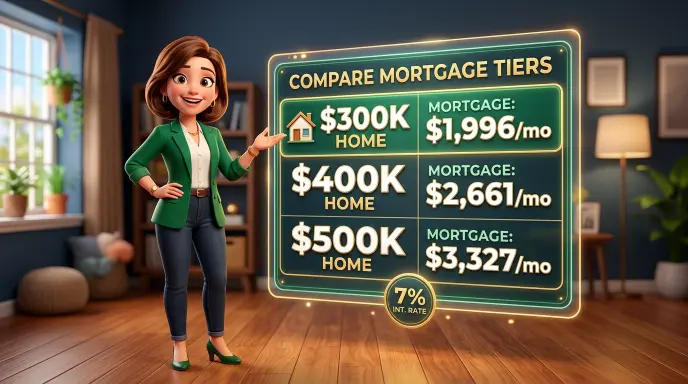
Quick answer: On a 30-year loan at 7%, a $300,000 mortgage runs about $1,996/month, a $400,000 mortgage about $2,661/month, and a $500,000 mortgage about $3,327/month in principal and interest alone. Property tax, insurance, and PMI (if applicable) add to these figures, and even small rate changes shift the numbers meaningfully.
Introduction
“What’s my payment going to be” is usually the first real question anyone asks when they start house hunting, long before they’re deep into a specific listing. The honest answer depends on your loan amount and your rate, but most people are working with a loan somewhere between $300,000 and $500,000, so it helps to see exactly what that range looks like in dollars and cents.
This breakdown walks through monthly payments at three common loan amounts and three realistic rate scenarios, plus what income you’d typically need to comfortably qualify.
Monthly Payment by Loan Amount and Rate (30-Year Fixed)
These figures are principal and interest only — property tax, homeowners insurance, and PMI (if your down payment is under 20%) are added separately below.
Loan Amount
Rate
Monthly P&I
Total Interest (30yr)
$300,000
6.0%
$1,798.65
$347,515
$300,000
6.5%
$1,896.20
$382,633
$300,000
7.0%
$1,995.91
$418,527
$400,000
6.0%
$2,398.20
$463,353
$400,000
6.5%
$2,528.27
$510,178
$400,000
7.0%
$2,661.21
$558,036
$500,000
6.0%
$2,997.75
$579,191
$500,000
6.5%
$3,160.34
$637,722
$500,000
7.0%
$3,326.51
$697,544
A few patterns worth noticing: going from 6% to 7% on a $400,000 loan adds about $263 to your monthly payment and roughly $95,000 in total interest over the life of the loan — a full percentage point matters more than most people expect. And at every rate, doubling your loan amount (from $250K-ish to $500K) doesn’t just double your payment — the relationship is close to linear for principal and interest, but your total interest paid scales up even faster.
What Gets Added on Top of Principal & Interest
The numbers above are just the loan itself. Your actual monthly mortgage bill (often called PITI: Principal, Interest, Taxes, Insurance) typically includes:
Property tax — varies significantly by state and county, often $150–$500+/month depending on your area and home value
Homeowners insurance — commonly $100–$300/month depending on your location and coverage
PMI — if your down payment is under 20%, expect roughly 0.3%–1.5% of your loan amount annually, split across 12 months
HOA fees — not part of your mortgage payment technically, but often bundled into what people consider their “total housing cost” if you’re in a community with an association
On a $400,000 loan, a realistic all-in monthly payment (P&I + tax + insurance) often lands $300–$600 higher than the principal-and-interest figure alone.
How Much Income Do You Need?
Lenders commonly use a guideline where your total housing payment (PITI) shouldn’t exceed about 28% of your gross monthly income — sometimes called the front-end ratio. Here’s a worked example:
Scenario: $300,000 home, 20% down payment, 7% rate, 30-year term
Loan amount after down payment: $240,000
Monthly P&I: about $1,597
Estimated tax + insurance: about $300/month
Total PITI: about $1,897/month
Required annual income under the 28% guideline: roughly $81,000
This is a useful reason why the common question “can I afford a $300k house on a $50k salary” usually gets a cautious answer — under the standard 28% guideline, $50,000 a year typically isn’t enough to comfortably support a $300,000 home purchase with a conventional down payment, unless you have a larger down payment, minimal other debt, or a lender using more flexible qualification criteria. Every lender and loan program is different, so this is a general guideline, not a hard rule.
It’s also worth knowing that lenders typically look at a second number alongside the 28% front-end ratio: the back-end ratio, usually capped around 36-43%, which includes your total monthly debt payments — car loans, student loans, credit cards — not just housing. Two buyers with identical salaries and identical target home prices can qualify very differently depending on what other debt they’re carrying, which is part of why two people earning the same income sometimes get very different answers from a lender.
How a 15-Year Term Changes These Numbers
Everything above assumes a 30-year term, which is what most buyers choose, but a 15-year term is worth understanding even if you don’t pick it — it shows just how much total interest a longer term actually costs you.
Loan Amount
30-Year Payment
30-Year Total Interest
15-Year Payment
15-Year Total Interest
$300,000
$1,996/month
$418,527
$2,696/month
$185,367
$400,000
$2,661/month
$558,036
$3,595/month
$247,156
$500,000
$3,327/month
$697,544
$4,494/month
$308,945
The 15-year payment is roughly 35% higher every month, but total interest paid over the life of the loan drops by well over half. This is the same trade-off a recast or extra payments can partially recreate — a 30-year loan with consistent extra payments can land you somewhere between these two rows without formally committing to the higher required 15-year payment.
Why the Same Loan Amount Can Have Very Different Payments
Two people can both have a “$400,000 mortgage” and pay noticeably different amounts each month, because of a few variables that don’t show up in a simple headline number:
Interest rate — as shown above, even a 0.5% difference changes the payment by roughly $65–$85/month on a $400,000 loan
Loan term — a 15-year term has a higher monthly payment but dramatically less total interest than a 30-year term at the same rate
Down payment size — a larger down payment reduces the loan amount itself, which lowers both the payment and whether PMI applies at all
Location — property tax rates vary enormously by state and even by county, which is often the single biggest swing factor in your total monthly bill beyond principal and interest
See Your Exact Numbers
The table above uses round loan amounts and common rates, but your actual payment depends on your specific numbers. Use our mortgage recast calculator to enter your exact property price, down payment, rate, and term, and see your real monthly payment, complete with tax, insurance, and PMI factored in — plus how a future recast or extra payments would change it.
If you’re weighing your rate and loan amount decisions against how much you could save through a recast or extra payments, our comparison of mortgage recast vs refinance vs extra payments is a useful next read. And since property tax varies so much by location, our guide on mortgage calculator by state breaks down average tax and insurance costs across the states where we see the most searches.
Frequently Asked Questions
What is the monthly payment on a $300,000 mortgage at 7% for 30 years? Approximately $1,996 per month in principal and interest alone. Adding typical property tax and insurance usually brings the total to around $2,200–$2,400/month, depending on your location.
What is the monthly payment on a $400,000 house for 30 years? At 7%, principal and interest alone runs about $2,661/month. The exact figure depends on your down payment, since PMI and your actual loan amount both affect the total.
How much is a $500,000 mortgage per month? At 7% over 30 years, expect about $3,327/month in principal and interest, plus property tax, insurance, and PMI if applicable, which commonly adds another $400–$700/month depending on your location and down payment.
Can I afford a $300k house on a $50k salary? Under the common 28% front-end debt-to-income guideline, a $50,000 annual salary typically supports a lower purchase price than $300,000 with a standard down payment, though this varies by lender, your down payment size, and your other monthly debts.
What is the most accurate mortgage calculator? The most accurate calculator is one that includes your actual property tax, insurance, and PMI rather than principal and interest alone, since those extra costs commonly add several hundred dollars to your real monthly bill.
How much do property taxes and insurance add to my monthly payment? It varies significantly by state, but a reasonable planning estimate is an additional $300–$600 per month on top of principal and interest for a typical $300,000–$500,000 home, depending on your location’s tax rate and your insurance coverage.
Conclusion
Loan amount and interest rate are the two biggest levers on your monthly mortgage payment, but property tax, insurance, and PMI can add several hundred dollars on top of the principal-and-interest figure most headline numbers quote. Use our mortgage recast calculator to plug in your exact numbers, including your state, and see a complete, realistic monthly total rather than a rough estimate.
Disclaimer: The figures in this article are illustrative estimates based on standard amortization math and general guidelines, not a quote for any specific loan. This content is for informational and educational purposes only and does not constitute financial, legal, or lending advice. GetCalcBase is not a lender or financial advisor. Confirm your specific qualification and payment figures with a licensed lender. See our full Disclaimer for details.
Financial freedom isn’t about how much you make; it’s about how much you keep. Whether you need a car finance calculator tool or a 2026 tax breakdown, GetCalcBase is here for your journey. Bookmark this page, take control of your wallet, and let’s build your wealth together!