
“I have a crucial tip for you: always follow this order. Before using any tool, first read the instructional article to gain a clear understanding of the concept. Then, read the documentation written right below the tool. This will give you full transparency on how the tool functions, what formulas are being used, and the logic behind the results. Once you have that knowledge, go ahead and test the tool yourself!”
Speed, distance, and time are three of the most practically useful quantities in everyday life. Every time you calculate whether you’ll arrive on time, estimate how much fuel a journey will use, check whether a car is speeding, or solve a physics problem, you’re working with the same three connected variables.
The relationship between them is captured in one formula — one of the simplest and most powerful in all of mathematics. Once you understand it properly, you can solve any speed, distance, or time problem with confidence.
This guide covers the formula, all three variations, worked examples from driving to running to physics, a complete solution table for common problems, and how to handle unit conversions when the units in a problem don’t match. Use the free speed converter at GetCalcBase alongside this guide to handle any unit conversion in seconds.
The Speed Distance Time Formula — The Foundation
All speed, distance, and time calculations use one core relationship:
Distance = Speed × Time
Written in shorthand: d = s × t (or d = v × t in physics notation, where v is velocity)
From this single equation, you can derive two more formulas by rearranging:
Speed = Distance ÷ Time (s = d ÷ t) Time = Distance ÷ Speed (t = d ÷ s)
A helpful memory device: the “DST triangle” or “magic triangle.”
Draw a triangle. Put D at the top, S at the bottom left, and T at the bottom right. To find any value:
- Cover D: S × T = Distance
- Cover S: D ÷ T = Speed
- Cover T: D ÷ S = Time
This is the same formula used in physics classrooms worldwide, in car navigation systems, in aviation, and in every speed problem your teacher has ever set.
When to Use Each Formula
Use Speed = Distance ÷ Time when:
- You’ve completed a journey and want to know your average speed
- You’re given a race distance and finishing time, and want to know average pace
- You need to compare the speeds of two objects that travel different distances

Use Distance = Speed × Time when:
- You know how fast something is moving and how long it will travel
- You’re calculating how far a train, car, or plane covers in a given duration
- You need to find where an object will be after a specific time
Use Time = Distance ÷ Speed when:
- You want to know how long a journey will take
- You’re planning arrival times based on distance and expected speed
- You’re calculating how long it takes at current speed to cover remaining distance
Worked Examples — Step by Step with Solutions
Example 1: Car Journey (Average Speed)
Problem: A car travels 350 km in 4 hours and 30 minutes. What is its average speed in km/h?
Step 1: Convert time to decimal hours. 4 hours 30 minutes = 4 + (30 ÷ 60) = 4.5 hours
Step 2: Apply the speed formula. Speed = Distance ÷ Time = 350 ÷ 4.5 = 77.78 km/h
Step 3 (optional): Convert to mph. 77.78 ÷ 1.609344 = 48.3 mph
The speed converter at GetCalcBase converts 77.78 km/h to mph, m/s, and knots simultaneously — useful if the problem asks for the answer in multiple units.
Example 2: Journey Time Calculation (Driving)
Problem: A family is driving 480 km to visit relatives. Their average speed on the motorway is 110 km/h. How long will the journey take?
Step 1: Apply the time formula. Time = Distance ÷ Speed = 480 ÷ 110 = 4.36 hours
Step 2: Convert decimal hours to hours and minutes. 0.36 hours × 60 = 21.8 minutes ≈ 22 minutes Total journey time: 4 hours 22 minutes
Step 3: Add buffer for rest stops. For a journey of this length, a 20-minute rest stop is standard. Realistic arrival estimate: 4 hours 42 minutes from departure.
Example 3: Distance Calculation (Physics)
Problem: A train travels at 90 km/h for 2 hours 15 minutes. How far does it travel?
Step 1: Convert time to decimal hours. 2 hours 15 minutes = 2 + (15 ÷ 60) = 2.25 hours
Step 2: Apply the distance formula. Distance = Speed × Time = 90 × 2.25 = 202.5 km
Step 3: Convert to miles. 202.5 km ÷ 1.609344 = 125.8 miles
Example 4: Speed Problem with Unit Conversion (Physics Examination)
Problem: A ball is thrown and travels 45 meters in 3 seconds. What is its speed in km/h?
Step 1: Calculate speed in m/s. Speed = 45 ÷ 3 = 15 m/s
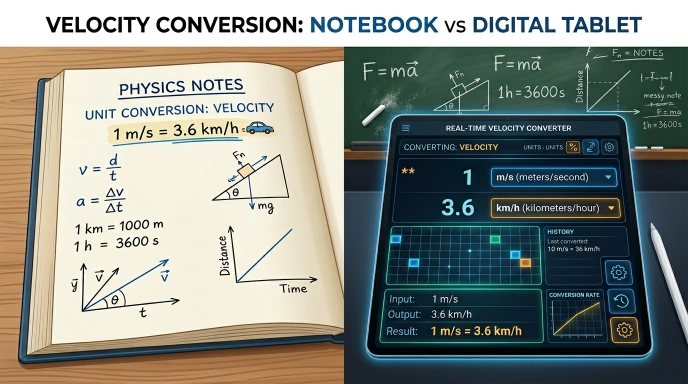
Step 2: Convert m/s to km/h. 15 × 3.6 = 54 km/h
Why × 3.6? 1 m/s = 3.6 km/h because there are 3,600 seconds in an hour and 1,000 meters in a kilometer: (1 × 3,600) ÷ 1,000 = 3.6.
Example 5: Running — Pace Calculation
Problem: A runner completes a 10 km race in 52 minutes. What is their average speed in km/h and mph?
Step 1: Convert time to decimal hours. 52 minutes = 52 ÷ 60 = 0.867 hours
Step 2: Calculate speed in km/h. Speed = 10 ÷ 0.867 = 11.53 km/h
Step 3: Convert to mph. 11.53 ÷ 1.609344 = 7.16 mph
Step 4: Calculate running pace. Pace = 60 ÷ 11.53 = 5.20 min/km (5 minutes 12 seconds per kilometer)
A 52-minute 10K corresponds to a 5:12/km pace or 7.16 mph treadmill speed — a solid intermediate runner performance.
Example 6: Car Speed Calculator — Speed Camera Check
Problem: A car passes two speed cameras 2.4 km apart. The cameras are timed 1 minute 45 seconds apart. Was the car speeding on a 90 km/h road?
Step 1: Convert time to decimal hours. 1 minute 45 seconds = 105 seconds = 105 ÷ 3,600 = 0.02917 hours
Step 2: Calculate average speed. Speed = 2.4 ÷ 0.02917 = 82.3 km/h
Result: The car was traveling at 82.3 km/h — within the 90 km/h limit. No speeding detected.
This is exactly how average speed cameras (SPECS cameras in the UK) work — they measure the time between two points and calculate average speed mathematically.
Speed, Distance, Time Reference Table — Common Journey Calculations
| Distance | Speed | Journey Time |
|---|---|---|
| 100 km | 80 km/h | 1h 15m |
| 100 km | 100 km/h | 1h 00m |
| 100 km | 120 km/h | 0h 50m |
| 200 km | 80 km/h | 2h 30m |
| 200 km | 100 km/h | 2h 00m |
| 300 km | 100 km/h | 3h 00m |
| 500 km | 110 km/h | 4h 33m |
| 60 miles | 60 mph | 1h 00m |
| 100 miles | 70 mph | 1h 26m |
| 300 miles | 70 mph | 4h 17m |
Units — The Most Common Source of Errors
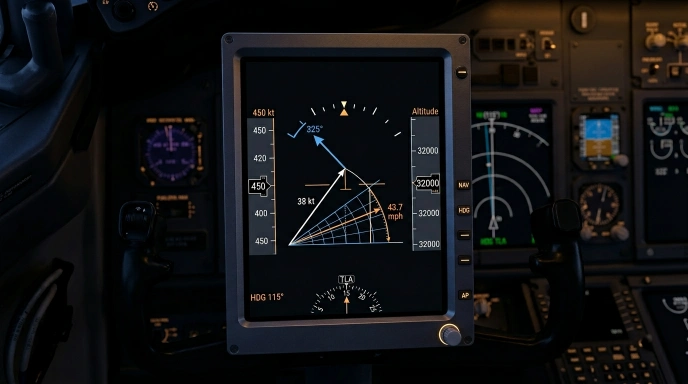
Speed, distance, and time problems go wrong most often because of mismatched units. The formula only works when all three variables use compatible units.
Compatible unit combinations:
- Speed in km/h, Distance in km, Time in hours → ✅
- Speed in mph, Distance in miles, Time in hours → ✅
- Speed in m/s, Distance in meters, Time in seconds → ✅
- Speed in km/h, Distance in km, Time in minutes → ❌ (must convert minutes to hours)
- Speed in mph, Distance in km, Time in hours → ❌ (mixed — must convert km to miles)
The two most common unit mistakes:
Mistake 1: Time in minutes instead of hours A car travels at 60 km/h for 90 minutes. Distance = 60 × 90 = 5,400 km. Wrong. Fix: 90 minutes = 1.5 hours. Distance = 60 × 1.5 = 90 km. Correct.
Mistake 2: Speed in km/h but distance needed in meters A vehicle at 72 km/h for 5 seconds. Convert 72 km/h to m/s: 72 ÷ 3.6 = 20 m/s. Distance = 20 × 5 = 100 meters. Correct.
The unit conversion step is not optional — it is the step that makes the formula work. The speed converter at GetCalcBase handles all unit conversions between km/h, mph, m/s, knots, ft/s, and Mach in real time, making it easy to verify your conversions before applying the formula.
Speed Time Calculator for Different Vehicles
Different vehicles have characteristic speed ranges that come up in problems and real-world planning.
Car Speed Calculator
Average highway driving speed: 100 to 130 km/h (62 to 81 mph) Urban driving average (including stops): 25 to 35 km/h (15 to 22 mph)
Typical car journey calculation: A 250 km highway journey at 110 km/h average: Time = 250 ÷ 110 = 2.27 hours = 2 hours 16 minutes
Bike Speed Calculator
Recreational cycling: 15 to 25 km/h (9 to 16 mph) Trained road cyclist: 25 to 35 km/h (16 to 22 mph) Professional racing speed: 40 to 55 km/h average (25 to 34 mph)
Cycling journey calculation: A 40 km route at 20 km/h average: Time = 40 ÷ 20 = 2 hours
Walking Speed Reference
Average walking pace: 5 km/h (3.1 mph) Brisk walk: 6 to 7 km/h (3.7 to 4.3 mph)
Walking distance estimate: Time available: 45 minutes = 0.75 hours Distance = 5 × 0.75 = 3.75 km at average walking pace
Running Speed — Distance and Pace
Running speed and distance calculations use the same formulas but runners typically think in pace (time per kilometer) rather than speed (km per hour).
Converting pace to speed: Speed (km/h) = 60 ÷ Pace (min/km) Example: 5:30/km pace → 60 ÷ 5.5 = 10.91 km/h
Converting speed to pace: Pace (min/km) = 60 ÷ Speed (km/h) Example: 12 km/h → 60 ÷ 12 = 5:00/km
Speed Problems — Common Examination Questions with Solutions
Problem Type 1: Two Vehicles Meeting
Problem: Two trains start from cities 480 km apart and travel toward each other. Train A travels at 80 km/h and Train B at 100 km/h. How long until they meet?
Solution: Combined speed = 80 + 100 = 180 km/h Time = Distance ÷ Combined Speed = 480 ÷ 180 = 2.67 hours = 2 hours 40 minutes
Problem Type 2: Catching Up
Problem: Car A leaves at 9:00 AM at 80 km/h. Car B leaves at 10:00 AM at 100 km/h in the same direction. When does Car B catch Car A?
Solution: Car A has a 1-hour head start = 80 km lead Relative speed of B over A = 100 – 80 = 20 km/h Time to catch up = 80 ÷ 20 = 4 hours after 10:00 AM = 2:00 PM
Problem Type 3: Average Speed Over Different Segments
Problem: A driver covers the first 100 km at 80 km/h and the next 100 km at 100 km/h. What is the overall average speed?
Solution (common mistake — averaging the speeds gives the wrong answer): Time for first segment = 100 ÷ 80 = 1.25 hours Time for second segment = 100 ÷ 100 = 1.00 hours Total time = 2.25 hours Total distance = 200 km Average speed = 200 ÷ 2.25 = 88.89 km/h (not 90 km/h — the simple average)
Speed and Distance Education Tools at GetCalcBase
The speed converter is one of several education tools at GetCalcBase that work together for complete physics and mathematics support:
Speed Converter — Real-time conversion between km/h, mph, knots, m/s, ft/s, and Mach simultaneously. Use it here.
Scientific Notation Calculator — For very large or very small speed values in physics problems (light speed, orbital velocity). Available at the education tools hub.
Percentage Decrease Calculator — Useful when calculating percentage change in speed or efficiency. The percentage decrease calculator handles these calculations directly.
Time Difference Calculator — For problems involving departure and arrival times. The time difference calculator works in hours and minutes.
GPA and Marks Calculator — Supporting academic performance tracking across subjects including physics and mathematics. Available at GetCalcBase education tools.
Speed Distance Time Checklist — Before Solving Any Problem
✅ Identify which variable you need to find (speed, distance, or time)
✅ Check the units of all given values
✅ Convert all units to a compatible set before applying any formula
✅ For time given in minutes: divide by 60 to convert to hours
✅ For distance in km and speed needed in m/s: divide km/h result by 3.6
✅ Apply the correct formula (d = s × t, s = d ÷ t, or t = d ÷ s)
✅ Check your answer makes intuitive sense (is 88 km/h a reasonable car speed? Yes. Is 880 km/h? No — re-check units)
✅ For multi-segment problems: calculate each segment separately, then sum time and distance
✅ For “average speed” problems: always use total distance ÷ total time, never average the speeds
✅ Verify unit conversions using the speed converter tool
FAQs — Speed Distance Time Calculator
How do I calculate my speed? Divide the distance you traveled by the time it took. Make sure both are in compatible units — kilometers with hours gives km/h, meters with seconds gives m/s. Example: 150 km in 2 hours = 75 km/h average speed.
What is the speed, distance, time formula? Distance = Speed × Time. Rearranged: Speed = Distance ÷ Time, and Time = Distance ÷ Speed. These three forms of the same equation solve any problem where two of the three values are known.
How do I calculate distance from speed and time? Multiply speed by time, ensuring units match. If speed is 80 km/h and time is 2.5 hours, distance = 80 × 2.5 = 200 km. If time is in minutes, divide by 60 first to convert to hours.
How do I calculate a bike speed? Use the same formula: Speed = Distance ÷ Time. Measure your cycling distance (using GPS, odometer, or a mapped route) and your riding time (excluding stops). Divide distance by time to get average speed in km/h or mph.
What is a speed time calculator used for in driving? Calculating journey time (how long a trip will take at a given speed), verifying whether average speed camera penalties apply (by calculating your average speed between two fixed points), estimating fuel requirements based on distance, and planning departure times to arrive at a specific hour.
How do I find speed with distance and time in physics? Convert all values to SI units first (meters and seconds). Then apply: speed (m/s) = distance (m) ÷ time (s). To convert the result to km/h, multiply by 3.6. Use the GetCalcBase speed converter to verify your unit conversions.
Conclusion — Three Variables, One Formula, Every Problem Solved
Speed, distance, and time calculations appear in school examinations, in daily driving decisions, in sports planning, and in engineering work. The formula is always the same: d = s × t and its two rearrangements.
The key to using it correctly is unit consistency — making sure your speed, distance, and time all use compatible units before applying the formula. That step, combined with knowing which form of the formula to use, is all you need to solve any problem in this area.
For all unit conversions — especially between km/h, mph, m/s, and other speed units — the free speed converter at GetCalcBase gives you instant results across all six major speed units simultaneously.
Know the formula. Check your units. Calculate with confidence.
Prepared by Waseem Aijaz — WordPress Developer & SEO Expert
More Free Education Tools at GetCalcBase: